
 Aforika
 Asia
Asia Yuropa
 Amerika Borwa
 Australia le Oceania
 Antarctica
 Lewatle la Pacific
 Lewatle la Atlantic
 Lewatle la India
 Lewatle la Arctic
 Lewatle la Mediterranean
 Lewatle le Lehibidu
 Lewatle la Caribbean
 Lewatle la Coral
 Lewatle la China Borwa
 Lewatle la Philippines
 Lewatle la Andaman
 Lewatle la Bokone
 Lewatle la Timor le la Arafura
 Kou ya Bengal
 Gulf ya California
Tiger keelback
 Go loma
The tiger keelback is a venomous snake with a striped olive-green and orange pattern. It lives across East Asia and Southeast Asia. Its venom is delivered by rear fangs, which sit at the back of the mouth, and it is rarely deadly to people.1

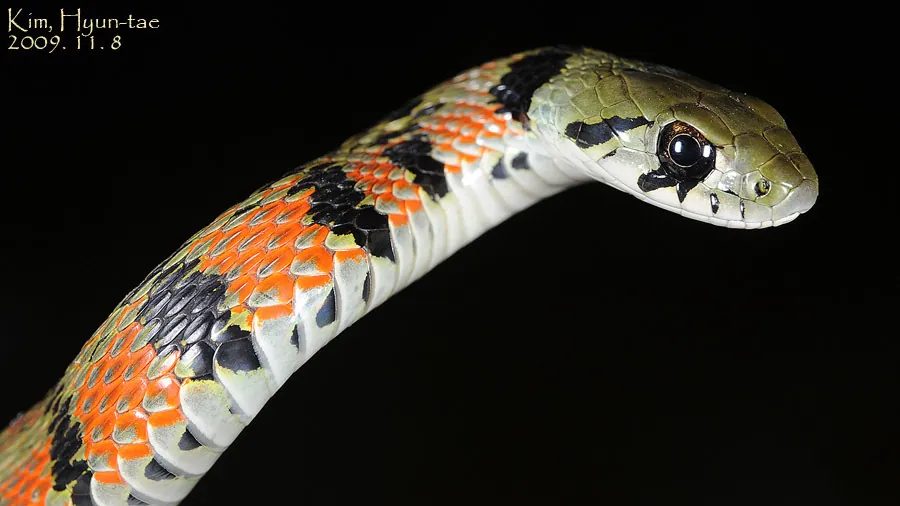
 Tsela ya go e lemoga
Maatla a botlhole
Botlhole bo tswa ka meno a yone fa e loma.
E kotsi go le kae go batho?
Kotsi go batho: E kotsi thataE ka bolaya motho yo o sa alafiweng.Although it is venomous, few deaths have been recorded from its bites. It rarely strikes, because it tends to flatten, lie still or flee instead, and its rear fangs make a strong bite on a large object difficult.1
E dira eng fa e tshogile?
At cooler temperatures it flattens its neck and body and lies still. At higher temperatures it is more likely to flee.1
 Fa e loma
- Tlhatswa fa go lomilweng, dira gore motho a ritibale mme o batle thuso ya bongaka. Mefuta mengwe (jaaka boomslang) e ka bolaya diura morago.
Ka gale leletsa nomoro ya gago ya tshoganyetso pele (112, 000, 911). Se ke kaelo e e akaretsang ya thuso ya ntlha, ga se kgakololo ya bongaka. Motheo wa thuso ya ntlha
 Nna o babalesegile
- O se ka wa ama, wa tshwara kgotsa wa tshwenya phologolo ya naga, le fa e le e nnye, le fa e lebega e robetse kgotsa e sule.
- E fe sebaka. Fa o kopana le yone, ritibala, boela morago ka bonya mme o e tlogele e tsamaye ka tsela ya yone.
- Fa e nngwe e go loma: ritibala, o se ka wa tshikinyega, leletsa nomoro ya gago ya tshoganyetso (112, 000, 911) kgotsa o ye bookelong ka bonako. Gopola gore e ne e lebega jang, setshwantsho se a thusa.
Ga e go batle. E dirisa botlhole jwa yone go tshwara dijo kgotsa go itshireletsa, mme e rata go iphitlha go feta. Go le gontsi ka go nna o babalesegile
Kae mo lefatsheng?
E kgolo go le kae?
E telele go le kae?
 boleele jo bo lekanang le dikatse tsa ntlo di le 2 go tloga kwa nkong go ya mogatleng
 boleele jo bo lekanang le dipanana di le 6 di latelana
 e ka taboga dimetara di le 100 ka metsotswana e le 69 (motho yo o bonako go gaisa o tlhoka 9,6)
Tiger keelback e kgolo go le kae fa e bapisiwa le WENA?
Ke dipalo fela mo sefetleng sa gago (browser). Ga go sepe se se bolokwang kgotsa se se romelwang gope.
E bonako go le kae?


Dintlha
It stores toxic steroids in special glands on the back of its neck, taken from the toads it eats, and it is resistant to their effects.1
Females can pass the stored toad toxins to their offspring through the egg yolk and the egg membranes.1
Two rows of neck glands give it a chemical defence, a process called kleptotoxisism, meaning it steals toxins from its prey and uses them for its own protection.1
Its fangs are at the back of its mouth, which makes a strong strike on a large animal difficult.1
Mosenyi wa ditlhamane
Tlhamane: Its venom is the source of its toxic defence.
Nnete: Its venom is made in glands in the mouth and is not known to contain the toad toxins. The defensive toxins come from glands in its neck.1
Kwa dintlha di tswang teng
- Rhabdophis tigrinus (Wikipedia (CC BY-SA 4.0))
- Rhabdophis tigrinus (iNaturalist): maina le thulaganyo ya mefuta.
- Venom Wiki: seelo sa kotsi, bogolo jo bo tlwaelegileng le kakanyo ya lebelo ke tsa rona. Bona kafa re di balang ka teng: Kafa re lekanyang kotsi ka teng.
Ntlha nngwe le nngwe mo tsebeng e e na le nomoro e e supang motswedi wa yone. Fa re dirile phoso, maitshwarelo, re barati ba diphologolo, e seng kgatiso ya saense. Re bolelele kwa [email protected] mme re tla e baakanya.
 Phepheng e tshwerwe ke tlala! Venom Wiki ke porojeke ya motho a le mongwe: ke mahala, ga e na dipapatso le ditraka. Mpho e nnye e thusa go e tshegetsa mo inthaneteng.Fepa phepheng
Tse dingwe tsa setlhopha se se tshwanang: Dinoga tse di nang le meno a botlhole kwa morago
 Brown tree snakeDinoga tse di nang le meno a botlhole kwa moragoE utlwisa botlhoko fela
 Red-necked keelbackDinoga tse di nang le meno a botlhole kwa moragoE tlhoka ngaka
 Green cat snakeDinoga tse di nang le meno a botlhole kwa moragoE utlwisa botlhoko fela
 Mangrove snakeDinoga tse di nang le meno a botlhole kwa moragoE utlwisa botlhoko fela
 Asian vine snakeDinoga tse di nang le meno a botlhole kwa moragoGa e na kotsi
 Golden tree snakeDinoga tse di nang le meno a botlhole kwa moragoGa e na kotsi
 Deathstalker
 Indian cobra
 Indian saw-scaled viper
 King cobra
 Puff adder
 Phika ya ga Russell