
 Aforika
 Asia
Asia Yuropa
 Amerika Borwa
 Australia le Oceania
 Antarctica
 Lewatle la Pacific
 Lewatle la Atlantic
 Lewatle la India
 Lewatle la Arctic
 Lewatle la Mediterranean
 Lewatle le Lehibidu
 Lewatle la Caribbean
 Lewatle la Coral
 Lewatle la China Borwa
 Lewatle la Philippines
 Lewatle la Andaman
 Lewatle la Bokone
 Lewatle la Timor le la Arafura
 Kou ya Bengal
 Gulf ya California
Golfodulcean poison frog
 Botlhole mo letlalong la yoneE ja: DikhukhwaneE botlhole go e ama kgotsa go e ja, ga e tsenye botlhole
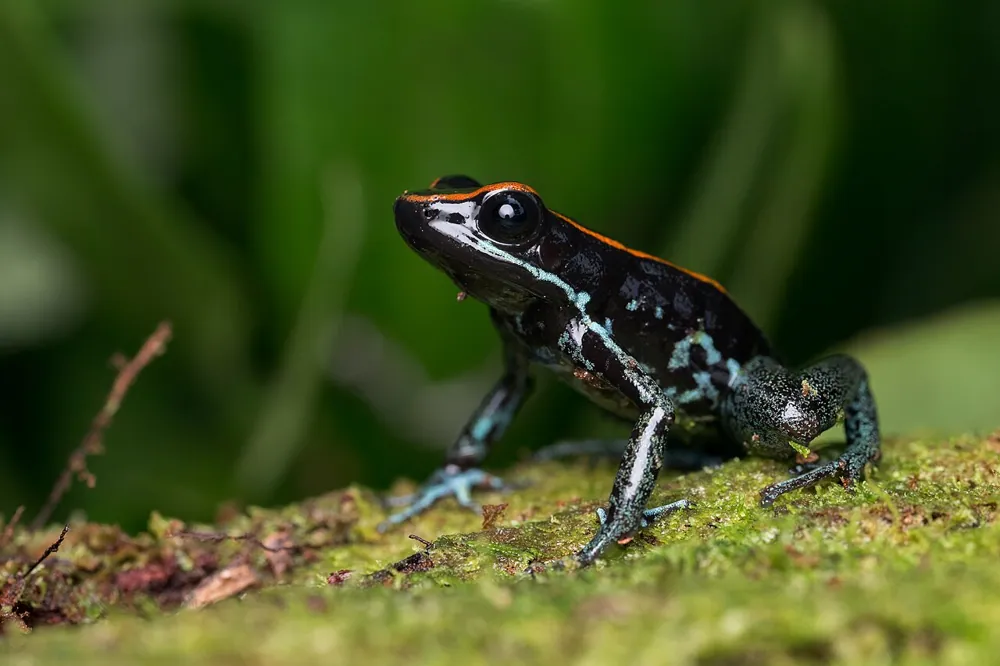
The Golfodulcean poison frog is a small, brightly marked frog that lives only in Costa Rica. Its skin contains a strong nerve poison, so it is one of the most toxic frogs in its genus, and it is a reminder that bright colours can be a warning. It lives in wet forests near streams.1

 Tsela ya go e lemoga
- The body is black, but it can look glittery because of pigments in the skin.1
- Two stripes run down the back from just above the vent to the tip of the nose. They are usually fire orange, but can be golden, yellow or green.1
- The legs are mottled blue, and the sides often have a blue or green marble pattern.1
- It is a fairly large poison frog for its genus, with a smooth, sloping back. Its shoulder blades are usually hidden under the skin, so it can look a little plump.1
- Females are typically larger than males. Adults reach about 3.5 cm long.1
Gantsi e tlhakanngwa le: The related P. bicolor and P. terribilis have visible shoulder blades under the skin, which the Golfodulcean poison frog usually lacks, so it looks smoother and rounder.1
Maatla a botlhole
Letlalo la yone le botlhole. Go kotsi go e ama, go e latswa kgotsa go e ja.
Botlhole jwa yone (jwa go e ama kgotsa go e ja) bo dira eng?
Its skin contains batrachotoxin, a neurotoxic alkaloid poison, which attacks the nerves. A large enough dose causes severe pain, then tonic-clonic seizures (violent convulsions) and paralysis.1
E kotsi go le kae go batho?
Kotsi go batho: E botlhokoE ka utlwisa botlhoko tota, mme go seoka thata gore e nne masisi.It is highly toxic, though it is only the fourth most toxic species in the genus Phyllobates. The poison is in the skin, so the risk comes from handling the frog or getting the poison from its skin into the body.1
E dira eng fa e tshogile?
Its bright, multi-coloured body advertises its toxin as a warning to predators.1
 Fa mongwe a e amile kgotsa a e jele
- Fa mongwe a amile e nngwe: tlhatswa diatla sentle mme o se ka wa ama matlho kgotsa molomo. Fa ngwana kgotsa phologolo ya gae e latswitse kgotsa e jele e nngwe: leletsa senthara ya botlhole kgotsa nomoro ya tshoganyetso.
Ka gale leletsa nomoro ya gago ya tshoganyetso pele (112, 000, 911). Se ke kaelo e e akaretsang ya thuso ya ntlha, ga se kgakololo ya bongaka. Motheo wa thuso ya ntlha
 Nna o babalesegile
- O se ka wa ama, wa tshwara kgotsa wa tshwenya phologolo ya naga, le fa e le e nnye, le fa e lebega e robetse kgotsa e sule.
- E fe sebaka. Fa o kopana le yone, ritibala, boela morago ka bonya mme o e tlogele e tsamaye ka tsela ya yone.
- Fa o e amile kgotsa o e jele: o se ka wa gotlha matlho kgotsa molomo wa gago, tlhatswa diatla mme o batle thuso ya bongaka.
Ga e go batle. Botlhole jwa yone bo teng fela gore sepe se se ka se e je. Go le gontsi ka go nna o babalesegile
Kae mo lefatsheng?
E kgolo go le kae?
E telele go le kae?
 e ka nna boleele jo bo lekanang le jwa kelipi ya pampiri
 e ka taboga dimetara di le 100 ka metsotswana e le 100 (motho yo o bonako go gaisa o tlhoka 9,6)
Golfodulcean poison frog e kgolo go le kae fa e bapisiwa le WENA?
Ke dipalo fela mo sefetleng sa gago (browser). Ga go sepe se se bolokwang kgotsa se se romelwang gope.
E bonako go le kae?


Dintlha
It is one of the few frogs whose poison is named batrachotoxin, a potent nerve toxin.1
Its climbing toe pads stick to leaves in a similar way to geckos, and it can climb out of an unsealed container.1
Male frogs carry their tadpoles on their backs, often for 1 to 2 days, to puddles, pools in palm leaves, or water-filled tree holes.1
Frogs in captivity have no toxin, which shows that their poison comes from what they eat.1
Its skin holds a large amount of poison, because it is comparatively large for a poison dart frog.1
The tadpoles become frogs after about 45 days, and the young frogs become sexually mature after ten months.1
Ya baitseanape ba botlhole
- Leina la saense
- Phyllobates vittatus
- Setlhopha
- Digwagwa tsa botlhole, digwagwa tse dingwe le dinewt
- Lelapa
- Dendrobatidae2
- Lekoko
- Anura
- Dikontinente
- Amerika Bokone
- Masea
- During the breeding season, the female lays 7 to 21 eggs per clutch on leaves, about every one or two weeks, and the male guards the eggs and carries the hatched tadpoles on his back to water.1
- Kotsi go batho
- 2 / 5: E botlhoko3
Kwa dintlha di tswang teng
- Golfodulcean poison frog (Wikipedia (CC BY-SA 4.0))
- Phyllobates vittatus (iNaturalist): maina le thulaganyo ya mefuta.
- Venom Wiki: seelo sa kotsi, bogolo jo bo tlwaelegileng le kakanyo ya lebelo ke tsa rona. Bona kafa re di balang ka teng: Kafa re lekanyang kotsi ka teng.
Ntlha nngwe le nngwe mo tsebeng e e na le nomoro e e supang motswedi wa yone. Fa re dirile phoso, maitshwarelo, re barati ba diphologolo, e seng kgatiso ya saense. Re bolelele kwa [email protected] mme re tla e baakanya.
 Phepheng e tshwerwe ke tlala! Venom Wiki ke porojeke ya motho a le mongwe: ke mahala, ga e na dipapatso le ditraka. Mpho e nnye e thusa go e tshegetsa mo inthaneteng.Fepa phepheng
Tse dingwe tsa setlhopha se se tshwanang: Digwagwa tsa botlhole, digwagwa tse dingwe le dinewt
 Cane toadDigwagwa tsa botlhole, digwagwa tse dingwe le dinewtE tlhoka ngakaO se ka wa ama
 Strawberry poison-dart frogDigwagwa tsa botlhole, digwagwa tse dingwe le dinewtE utlwisa botlhoko felaO se ka wa ama
 California newtDigwagwa tsa botlhole, digwagwa tse dingwe le dinewtE ka bolayaO se ka wa ama
 Rough-skinned newtDigwagwa tsa botlhole, digwagwa tse dingwe le dinewtE ka bolayaO se ka wa ama
 Colorado River toadDigwagwa tsa botlhole, digwagwa tse dingwe le dinewtE tlhoka ngakaO se ka wa ama
 Panamanian golden frogDigwagwa tsa botlhole, digwagwa tse dingwe le dinewtE tlhoka ngakaO se ka wa ama
E tshela gape kwa: Amerika Bokone
 TerciopeloDivaepara tsa mesima (pit vipers)E a bolaya
 Eastern coral snakeDinoga tsa khoraleE ka bolaya
 Eastern diamondback rattlesnakeDinoga tsa ratheleE ka bolaya
 Eyelash viperDivaepara tsa mesima (pit vipers)E ka bolaya
 Timber rattlesnakeDinoga tsa ratheleE ka bolaya
 Western diamondback rattlesnakeDinoga tsa ratheleE ka bolaya