
 Aforika
 Asia
Asia Yuropa
 Amerika Borwa
 Australia le Oceania
 Antarctica
 Lewatle la Pacific
 Lewatle la Atlantic
 Lewatle la India
 Lewatle la Arctic
 Lewatle la Mediterranean
 Lewatle le Lehibidu
 Lewatle la Caribbean
 Lewatle la Coral
 Lewatle la China Borwa
 Lewatle la Philippines
 Lewatle la Andaman
 Lewatle la Bokone
 Lewatle la Timor le la Arafura
 Kou ya Bengal
 Gulf ya California
Greater black krait
 Go loma
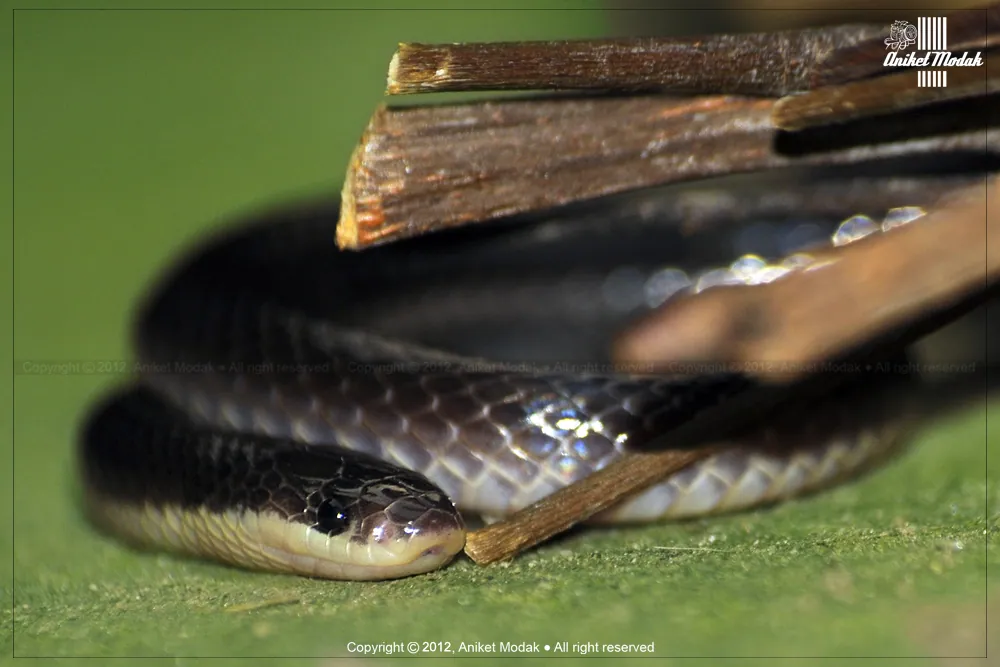
The greater black krait is a shiny black snake that is venomous, meaning it injects venom when it bites. It lives in South Asia, including northeast and north India, Nepal, Bhutan and Bangladesh. It matters because it is often overlooked but has caused many bites.1



 Tsela ya go e lemoga
- Shiny black on the upper body, with whitish colour between the scales1
- Creamy white underside with black edges, which get wider towards the tail1
- Medium length and slender, with a triangular cross-section and a short, pointed tail1
- Smooth, glossy scales, with the scales along the middle of the back enlarged and hexagonal1
- Black eyes with round pupils, and a pinkish tongue with a lighter tip1
Gantsi e tlhakanngwa le: The lesser black krait (Bungarus lividus) lives in the same areas. The greater black krait can be told apart by its enlarged hexagonal scales along the middle of the back.1
Maatla a botlhole
Botlhole bo tswa ka meno a yone fa e loma.
Botlhole jo e bo tsenyang bo dira eng?
Its venom contains presynaptic and postsynaptic neurotoxins, which attack the nerves, and may also contain myotoxins, which damage muscle.1
E kotsi go le kae go batho?
Kotsi go batho: E kotsi thataE ka bolaya motho yo o sa alafiweng.It is a medically important species because it has caused many bites. The mortality rate is not known, but it is said to be quite high. It is an active, nocturnal snake, so people may be bitten at night.1
E dira eng fa e tshogile?
When disturbed, it coils loosely and hides its head beneath its body, and it is reluctant to bite unless it is persistently provoked.1
 Fa e loma
- Dira gore motho a nne a sa tshikinyege a ritibetse, tlosa direng le dilo tse di tiileng, mme o mo ise bookelong ka bonako: antivenom ke yone kalafi.
Ka gale leletsa nomoro ya gago ya tshoganyetso pele (112, 000, 911). Se ke kaelo e e akaretsang ya thuso ya ntlha, ga se kgakololo ya bongaka. Motheo wa thuso ya ntlha
 Nna o babalesegile
- O se ka wa ama, wa tshwara kgotsa wa tshwenya phologolo ya naga, le fa e le e nnye, le fa e lebega e robetse kgotsa e sule.
- E fe sebaka. Fa o kopana le yone, ritibala, boela morago ka bonya mme o e tlogele e tsamaye ka tsela ya yone.
- Fa e nngwe e go loma: ritibala, o se ka wa tshikinyega, leletsa nomoro ya gago ya tshoganyetso (112, 000, 911) kgotsa o ye bookelong ka bonako. Gopola gore e ne e lebega jang, setshwantsho se a thusa.
Ga e go batle. E dirisa botlhole jwa yone go tshwara dijo kgotsa go itshireletsa, mme e rata go iphitlha go feta. Go le gontsi ka go nna o babalesegile
Kae mo lefatsheng?
E kgolo go le kae?
E telele go le kae?
 boleele jo bo lekanang le dikatse tsa ntlo di le 2,5 go tloga kwa nkong go ya mogatleng
 boleele jo bo lekanang le dipanana di le 7 di latelana
 e ka taboga dimetara di le 100 ka metsotswana e le 51 (motho yo o bonako go gaisa o tlhoka 9,6)
Greater black krait e kgolo go le kae fa e bapisiwa le WENA?
Ke dipalo fela mo sefetleng sa gago (browser). Ga go sepe se se bolokwang kgotsa se se romelwang gope.
E bonako go le kae?


Dintlha
Kwa dintlha di tswang teng
- Greater black krait (Wikipedia (CC BY-SA 4.0))
- Bungarus niger (iNaturalist): maina le thulaganyo ya mefuta.
- Venom Wiki: seelo sa kotsi, bogolo jo bo tlwaelegileng le kakanyo ya lebelo ke tsa rona. Bona kafa re di balang ka teng: Kafa re lekanyang kotsi ka teng.
Ntlha nngwe le nngwe mo tsebeng e e na le nomoro e e supang motswedi wa yone. Fa re dirile phoso, maitshwarelo, re barati ba diphologolo, e seng kgatiso ya saense. Re bolelele kwa [email protected] mme re tla e baakanya.
 Phepheng e tshwerwe ke tlala! Venom Wiki ke porojeke ya motho a le mongwe: ke mahala, ga e na dipapatso le ditraka. Mpho e nnye e thusa go e tshegetsa mo inthaneteng.Fepa phepheng
Tse dingwe tsa setlhopha se se tshwanang: Dikobra, dimamba le dikrait
 Indian cobra
 King cobra
 Caspian cobra
 Common krait
 Malayan krait
 Many-banded krait
.jpg)
E tshela gape kwa: Asia
 DeathstalkerDiphephengE a bolaya
 Indian saw-scaled viperDivaepara le diboloboloE a bolaya
 Puff adderDivaepara le diboloboloE a bolaya
 Phika ya ga RussellDivaepara le diboloboloE a bolaya
 Asian giant hornetDinotshe, diwasepe le dihoneteE ka bolaya
 Komodo dragonDikgatitswane tse di tsenyang botlholeE ka bolaya