
 Aforika
 Asia
Asia Yuropa
 Amerika Borwa
 Australia le Oceania
 Antarctica
 Lewatle la Pacific
 Lewatle la Atlantic
 Lewatle la India
 Lewatle la Arctic
 Lewatle la Mediterranean
 Lewatle le Lehibidu
 Lewatle la Caribbean
 Lewatle la Coral
 Lewatle la China Borwa
 Lewatle la Philippines
 Lewatle la Andaman
 Lewatle la Bokone
 Lewatle la Timor le la Arafura
 Kou ya Bengal
 Gulf ya California
Green-head ant
 Go tlhaba
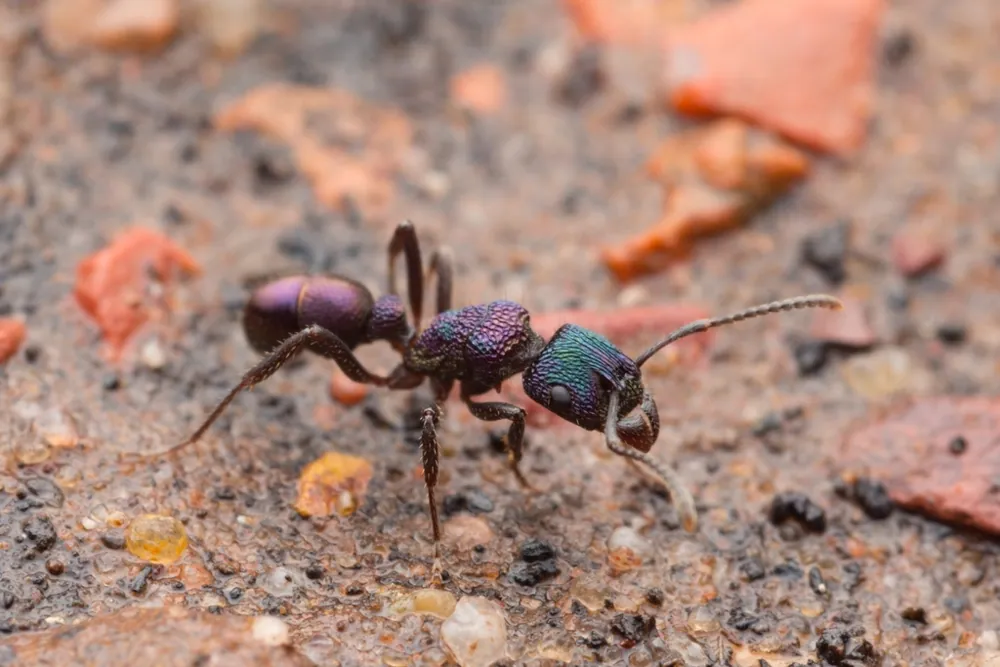
The green-head ant is a small, shiny ant that lives in Australia. It has a metallic colour that can look green, purple or reddish-violet. It is one of the most widespread insects in Australia, and it can give a painful, venomous sting.1


 Tsela ya go e lemoga
- Measures 5 to 7 mm long.1
- Metallic colour that varies by region, from green to purple or reddish-violet.1
- Hard, heavily armoured body with a single-segmented waist.1
- Queens and workers look similar and differ mainly in size. Males are the smallest and look black and dark.1
Gantsi e tlhakanngwa le: Residents of northern Queensland use the name 'green ant' for the green-tree ant (Oecophylla smaragdina), so the two can be confused by name. The name 'green-head ant' is more specific.1
Maatla a botlhole
Botlhole bo tswa ka lemao le le tlhabang.
Botlhole jo e bo tsenyang bo dira eng?
The sting is painful and venomous. It can cause anaphylactic shock, a severe allergic reaction, in people who are sensitive to it.1
E kotsi go le kae go batho?
Kotsi go batho: E botlhokoE ka utlwisa botlhoko tota, mme go seoka thata gore e nne masisi.The sting can cause anaphylactic shock in sensitive people. Ordinary stings are described as painful.1
 Fa e tlhaba
- Tlhatswa le go tsidifatsa mafelo a a tlhabilweng.
- Fa motho a hema ka bothata, sefatlhego kgotsa mometso o ruruga, kgotsa a ikutlwa a tla idibala, ke tshoganyetso ya aletshi: leletsa nomoro ya gago ya tshoganyetso.
Ka gale leletsa nomoro ya gago ya tshoganyetso pele (112, 000, 911). Se ke kaelo e e akaretsang ya thuso ya ntlha, ga se kgakololo ya bongaka. Motheo wa thuso ya ntlha
 Nna o babalesegile
- O se ka wa ama, wa tshwara kgotsa wa tshwenya phologolo ya naga, le fa e le e nnye, le fa e lebega e robetse kgotsa e sule.
- E fe sebaka. Fa o kopana le yone, ritibala, boela morago ka bonya mme o e tlogele e tsamaye ka tsela ya yone.
- Fa e nngwe e go tlhaba: ritibala, o se ka wa tshikinyega, leletsa nomoro ya gago ya tshoganyetso (112, 000, 911) kgotsa o ye bookelong ka bonako. Gopola gore e ne e lebega jang, setshwantsho se a thusa.
Ga e go batle. E dirisa botlhole jwa yone go tshwara dijo kgotsa go itshireletsa, mme e rata go iphitlha go feta. Go le gontsi ka go nna o babalesegile
Kae mo lefatsheng?
E kgolo go le kae?
E telele go le kae?
 e nnye mo e ka nnang mo lenaleng la gago
Green-head ant e kgolo go le kae fa e bapisiwa le WENA?
Ke dipalo fela mo sefetleng sa gago (browser). Ga go sepe se se bolokwang kgotsa se se romelwang gope.
E bonako go le kae?


Dintlha
Green-head ants are among the first insects to appear in burnt-off areas, arriving once the embers have stopped smouldering.1
Workers can reproduce with winged males, so queens are rarely produced in colonies.1
They are useful to farmers because they prey on agricultural pests such as beetles, moths and termites.1
They help plants by scattering and eating seeds from a variety of species, which plays an important role in seed dispersal.1
The short-beaked echidna and a number of bird species prey on them.1
The ant was introduced to New Zealand, where it was first seen in 1959, probably on cargoes of timber.1
Mosenyi wa ditlhamane
Tlhamane: The name 'green ant' always means the green-head ant.
Nnete: In northern Queensland, residents use the name 'green ant' for the green-tree ant, so the shortened name can cause confusion.1
Kwa dintlha di tswang teng
- Green-head ant (Wikipedia (CC BY-SA 4.0))
- Rhytidoponera metallica (iNaturalist): maina le thulaganyo ya mefuta.
- Venom Wiki: seelo sa kotsi, bogolo jo bo tlwaelegileng le kakanyo ya lebelo ke tsa rona. Bona kafa re di balang ka teng: Kafa re lekanyang kotsi ka teng.
Ntlha nngwe le nngwe mo tsebeng e e na le nomoro e e supang motswedi wa yone. Fa re dirile phoso, maitshwarelo, re barati ba diphologolo, e seng kgatiso ya saense. Re bolelele kwa [email protected] mme re tla e baakanya.
 Phepheng e tshwerwe ke tlala! Venom Wiki ke porojeke ya motho a le mongwe: ke mahala, ga e na dipapatso le ditraka. Mpho e nnye e thusa go e tshegetsa mo inthaneteng.Fepa phepheng
Tse dingwe tsa setlhopha se se tshwanang: Ditshoswane
 Bulldog ant
 Jack jumper ant
 Green weaver ant
 Black-banded jumper ant
 Giant bull ant
 Inchman ant
E tshela gape kwa: Australia le Oceania
 Coastal taipanDinoga tsa AustraliaE a bolaya
 Common death adderDinoga tsa AustraliaE a bolaya
 Eastern brown snakeDinoga tsa AustraliaE a bolaya
 Taipan ya kwa teng ga nagaDinoga tsa AustraliaE a bolaya
 Sydney funnel-web spiderDitarantula le di-funnel-webE a bolaya
 Noga ya tigerDinoga tsa AustraliaE a bolaya