
 Aforika
 Asia
Asia Yuropa
 Amerika Borwa
 Australia le Oceania
 Antarctica
 Lewatle la Pacific
 Lewatle la Atlantic
 Lewatle la India
 Lewatle la Arctic
 Lewatle la Mediterranean
 Lewatle le Lehibidu
 Lewatle la Caribbean
 Lewatle la Coral
 Lewatle la China Borwa
 Lewatle la Philippines
 Lewatle la Andaman
 Lewatle la Bokone
 Lewatle la Timor le la Arafura
 Kou ya Bengal
 Gulf ya California
House pseudoscorpion
 Go loma
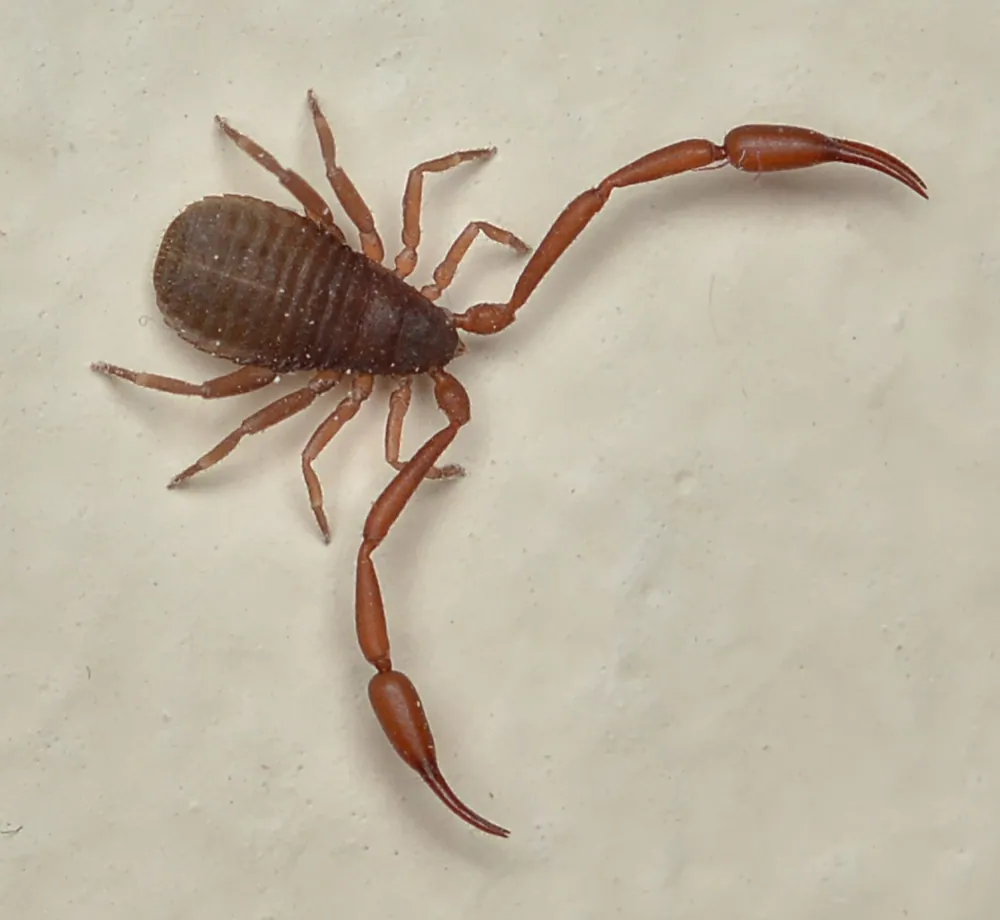
The house pseudoscorpion is a tiny relative of spiders and scorpions that looks a bit like a small scorpion without a stinging tail. It lives in houses, barns and stables, as well as under tree bark and in bird nests. Scientists describe it as harmless to people.1


 Tsela ya go e lemoga
Maatla a botlhole
Botlhole bo tswa ka meno a yone fa e loma.
Botlhole jo e bo tsenyang bo dira eng?
It has venomous pedipalps, which it uses to subdue its prey. The venom contains various peptides and is toxic to bacteria, fungi, other arthropods such as aphids and Varroa mites, and mammalian cells.1
E kotsi go le kae go batho?
Kotsi go batho: Kotsi e nnyeJaaka go tlhabiwa ke notshe kgotsa go le kwa tlase. Ga e na kotsi go batho.It is mostly harmless to humans.1
 Fa e loma
- Ya meriri e e tlhabang ya diboko: e tlose ka theipi e e kgomarelang, morago o tlhatswe letlalo. O se ka wa gotlha.
- Fa e lomile: tlhatswa le go tsidifatsa. Batla thuso ya bongaka fa motho a ikutlwa a sa siama kgotsa a tswa madi bonolo.
Ka gale leletsa nomoro ya gago ya tshoganyetso pele (112, 000, 911). Se ke kaelo e e akaretsang ya thuso ya ntlha, ga se kgakololo ya bongaka. Motheo wa thuso ya ntlha
 Nna o babalesegile
- O se ka wa ama, wa tshwara kgotsa wa tshwenya phologolo ya naga, le fa e le e nnye, le fa e lebega e robetse kgotsa e sule.
- E fe sebaka. Fa o kopana le yone, ritibala, boela morago ka bonya mme o e tlogele e tsamaye ka tsela ya yone.
- Fa e nngwe e go loma: ritibala, o se ka wa tshikinyega, leletsa nomoro ya gago ya tshoganyetso (112, 000, 911) kgotsa o ye bookelong ka bonako. Gopola gore e ne e lebega jang, setshwantsho se a thusa.
Ga e go batle. E dirisa botlhole jwa yone go tshwara dijo kgotsa go itshireletsa, mme e rata go iphitlha go feta. Go le gontsi ka go nna o babalesegile
Kae mo lefatsheng?
E kgolo go le kae?
E telele go le kae?
 e nnye mo e ka nnang mo lenaleng la gago
House pseudoscorpion e kgolo go le kae fa e bapisiwa le WENA?
Ke dipalo fela mo sefetleng sa gago (browser). Ga go sepe se se bolokwang kgotsa se se romelwang gope.
E bonako go le kae?


Dintlha
Its venom is toxic to methicillin-resistant Staphylococcus aureus, a type of bacteria that resists many antibiotics.1
It can hitch a ride on bats, flies and hymenopterans (a group of insects that includes bees, wasps and ants).1
Males keep small territories a few centimetres across, and a male performs a mating dance when a female enters.1
It usually lives for three or four years.1
Ya baitseanape ba botlhole
- Leina la saense
- Chelifer cancroides
- Setlhopha
- Diboko le dikhukhwane
- Lelapa
- Cheliferidae2
- Lekoko
- Pseudoscorpiones
- Dikontinente
- Yuropa, Asia, Amerika Bokone
- Masea
- The female lays 20 to 40 eggs, and the young take 10 to 24 months to reach adulthood after passing through three moults.1
- Kotsi go batho
- 1 / 5: Kotsi e nnye3
Kwa dintlha di tswang teng
- Chelifer cancroides (Wikipedia (CC BY-SA 4.0))
- Chelifer cancroides (iNaturalist): maina le thulaganyo ya mefuta.
- Venom Wiki: seelo sa kotsi, bogolo jo bo tlwaelegileng le kakanyo ya lebelo ke tsa rona. Bona kafa re di balang ka teng: Kafa re lekanyang kotsi ka teng.
Ntlha nngwe le nngwe mo tsebeng e e na le nomoro e e supang motswedi wa yone. Fa re dirile phoso, maitshwarelo, re barati ba diphologolo, e seng kgatiso ya saense. Re bolelele kwa [email protected] mme re tla e baakanya.
 Phepheng e tshwerwe ke tlala! Venom Wiki ke porojeke ya motho a le mongwe: ke mahala, ga e na dipapatso le ditraka. Mpho e nnye e thusa go e tshegetsa mo inthaneteng.Fepa phepheng
Tse dingwe tsa setlhopha se se tshwanang: Diboko le dikhukhwane
 Giant water bugDiboko le dikhukhwaneE utlwisa botlhoko fela
 Oak processionaryDiboko le dikhukhwaneE utlwisa botlhoko felaO se ka wa ama
 Pine processionaryDiboko le dikhukhwaneE utlwisa botlhoko felaO se ka wa ama
 Puss caterpillarDiboko le dikhukhwaneE utlwisa botlhoko felaO se ka wa ama
 Saddleback caterpillarDiboko le dikhukhwaneE utlwisa botlhoko felaO se ka wa ama
 Wheel bugDiboko le dikhukhwaneE utlwisa botlhoko fela
E tshela gape kwa: Yuropa
 Common European adderDivaepara le diboloboloE tlhoka ngaka
 Spanish flyDiphologolo tse dingwe tse di botlhole go di ama kgotsa go di jaE tlhoka ngakaO se ka wa ama
 Common waspDinotshe, diwasepe le dihoneteE utlwisa botlhoko fela
 European hornetDinotshe, diwasepe le dihoneteE utlwisa botlhoko fela
 Fire salamanderDigwagwa tsa botlhole, digwagwa tse dingwe le dinewtE utlwisa botlhoko felaO se ka wa ama
 Western honey beeDinotshe, diwasepe le dihoneteE utlwisa botlhoko fela