
 Aforika
 Asia
Asia Yuropa
 Amerika Borwa
 Australia le Oceania
 Antarctica
 Lewatle la Pacific
 Lewatle la Atlantic
 Lewatle la India
 Lewatle la Arctic
 Lewatle la Mediterranean
 Lewatle le Lehibidu
 Lewatle la Caribbean
 Lewatle la Coral
 Lewatle la China Borwa
 Lewatle la Philippines
 Lewatle la Andaman
 Lewatle la Bokone
 Lewatle la Timor le la Arafura
 Kou ya Bengal
 Gulf ya California
Hump-nosed viper
 Go loma
The hump-nosed viper is a small, stout pit viper with an upturned snout that ends in a hump. It lives in India and Sri Lanka, in jungle and coffee plantations. It matters because its bite can cause serious harm, and for a long time it was wrongly thought to be harmless.1
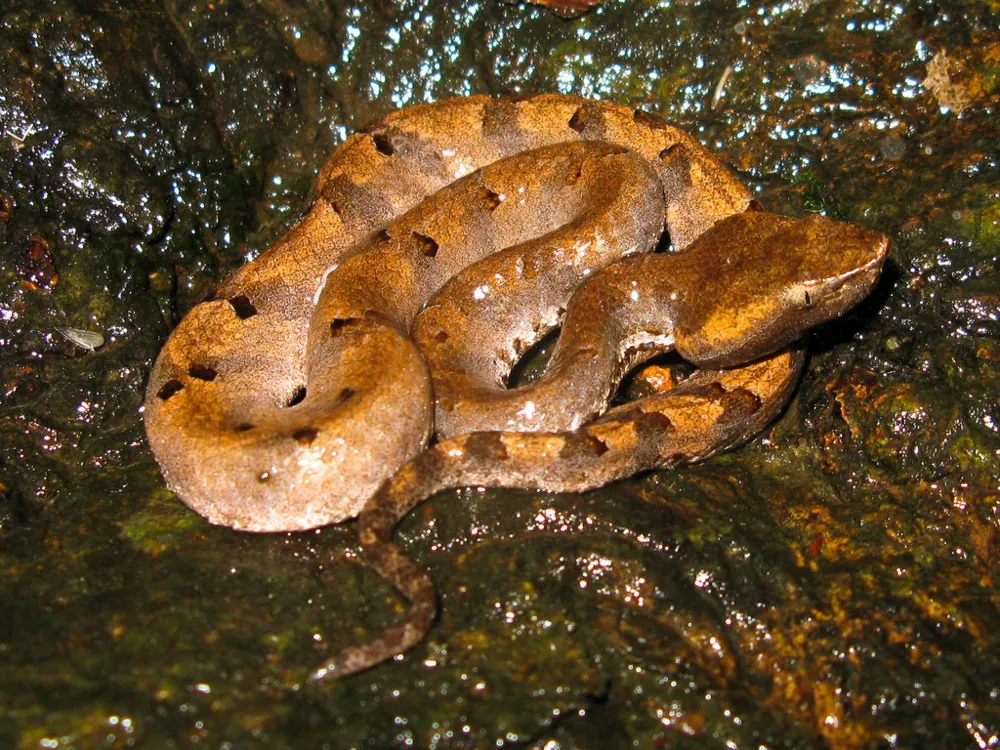
 Tsela ya go e lemoga
Maatla a botlhole
Botlhole bo tswa ka meno a yone fa e loma.
Botlhole jo e bo tsenyang bo dira eng?
Its venom causes coagulopathy, a problem with blood clotting, and acute renal failure, which is sudden kidney failure. If a bite is not treated within a few hours, it can be fatal to people.1
E kotsi go le kae go batho?
Kotsi go batho: E kotsi thataE ka bolaya motho yo o sa alafiweng.Bites were once thought to be harmless, but they are now known to be serious. It is the snake that causes the highest number of recorded snake bites in Sri Lanka. It is now considered highly venomous and is one of the medically important venomous snakes in Sri Lanka and on the south-west coast of India.1
E dira eng fa e tshogile?
When annoyed it vibrates its tail, a warning behaviour it shares with other pit vipers such as rattlesnakes, and it can make fast strikes despite being a slow mover.1
 Fa e loma
- Bites need medical treatment within a few hours. An antivenom is being developed and tested in Sri Lanka.1
- Dira gore motho a nne a sa tshikinyege a ritibetse, tshegetsa setho se se lomilweng mo boemong jwa pelo, tlosa direng le dilo tse di tiileng, mme o mo ise bookelong ka bonako.
Ka gale leletsa nomoro ya gago ya tshoganyetso pele (112, 000, 911). Se ke kaelo e e akaretsang ya thuso ya ntlha, ga se kgakololo ya bongaka. Motheo wa thuso ya ntlha
 Nna o babalesegile
- O se ka wa ama, wa tshwara kgotsa wa tshwenya phologolo ya naga, le fa e le e nnye, le fa e lebega e robetse kgotsa e sule.
- E fe sebaka. Fa o kopana le yone, ritibala, boela morago ka bonya mme o e tlogele e tsamaye ka tsela ya yone.
- Fa e nngwe e go loma: ritibala, o se ka wa tshikinyega, leletsa nomoro ya gago ya tshoganyetso (112, 000, 911) kgotsa o ye bookelong ka bonako. Gopola gore e ne e lebega jang, setshwantsho se a thusa.
Ga e go batle. E dirisa botlhole jwa yone go tshwara dijo kgotsa go itshireletsa, mme e rata go iphitlha go feta. Go le gontsi ka go nna o babalesegile
Kae mo lefatsheng?
E kgolo go le kae?
E telele go le kae?
 boleele jo bo lekanang le dipanana di le 2,5 di latelana
 boleele jo bo lekanang le diboloko tsa go aga tsa ditshamekisi di le 14 mo moleng
 e ka taboga dimetara di le 100 ka metsotswana e le 110 (motho yo o bonako go gaisa o tlhoka 9,6)
Hump-nosed viper e kgolo go le kae fa e bapisiwa le WENA?
Ke dipalo fela mo sefetleng sa gago (browser). Ga go sepe se se bolokwang kgotsa se se romelwang gope.
E bonako go le kae?


Dintlha
For a long time its bites were thought to be harmless, but they are now known to cause serious complications.1
It causes more recorded snake bites in Sri Lanka than any other snake.1
It vibrates its tail when annoyed, a behaviour it shares with rattlesnakes.1
Although it is a slow mover, it can make fast strikes.1
Females give birth to live young, with broods of 4 to 17 newborns.1
Mosenyi wa ditlhamane
Tlhamane: Its bites are harmless.
Nnete: Its bites can cause serious complications, including blood clotting problems and kidney failure, and can be fatal if not treated within a few hours.1
Ya baitseanape ba botlhole
Kwa dintlha di tswang teng
- Hypnale hypnale (Wikipedia (CC BY-SA 4.0))
- Hypnale hypnale (iNaturalist): maina le thulaganyo ya mefuta.
- Venom Wiki: seelo sa kotsi, bogolo jo bo tlwaelegileng le kakanyo ya lebelo ke tsa rona. Bona kafa re di balang ka teng: Kafa re lekanyang kotsi ka teng.
Ntlha nngwe le nngwe mo tsebeng e e na le nomoro e e supang motswedi wa yone. Fa re dirile phoso, maitshwarelo, re barati ba diphologolo, e seng kgatiso ya saense. Re bolelele kwa [email protected] mme re tla e baakanya.
 Phepheng e tshwerwe ke tlala! Venom Wiki ke porojeke ya motho a le mongwe: ke mahala, ga e na dipapatso le ditraka. Mpho e nnye e thusa go e tshegetsa mo inthaneteng.Fepa phepheng
Tse dingwe tsa setlhopha se se tshwanang: Divaepara tsa mesima (pit vipers)
 Brown spotted pit viperDivaepara tsa mesima (pit vipers)E ka bolaya
 HabuDivaepara tsa mesima (pit vipers)E ka bolaya
 Hundred-pace viperDivaepara tsa mesima (pit vipers)E ka bolaya
 Malayan pit viperDivaepara tsa mesima (pit vipers)E ka bolaya
 MamushiDivaepara tsa mesima (pit vipers)E ka bolaya
 Mangshan pit viperDivaepara tsa mesima (pit vipers)E ka bolaya
 Deathstalker
 Indian cobra
 Indian saw-scaled viper
 King cobra
 Puff adder
 Phika ya ga Russell