
 Aforika
 Asia
Asia Yuropa
 Amerika Borwa
 Australia le Oceania
 Antarctica
 Lewatle la Pacific
 Lewatle la Atlantic
 Lewatle la India
 Lewatle la Arctic
 Lewatle la Mediterranean
 Lewatle le Lehibidu
 Lewatle la Caribbean
 Lewatle la Coral
 Lewatle la China Borwa
 Lewatle la Philippines
 Lewatle la Andaman
 Lewatle la Bokone
 Lewatle la Timor le la Arafura
 Kou ya Bengal
 Gulf ya California
Greenland shark
 E botlhole go e jaE ja: NamaE botlhole go e ama kgotsa go e ja, ga e tsenye botlhole
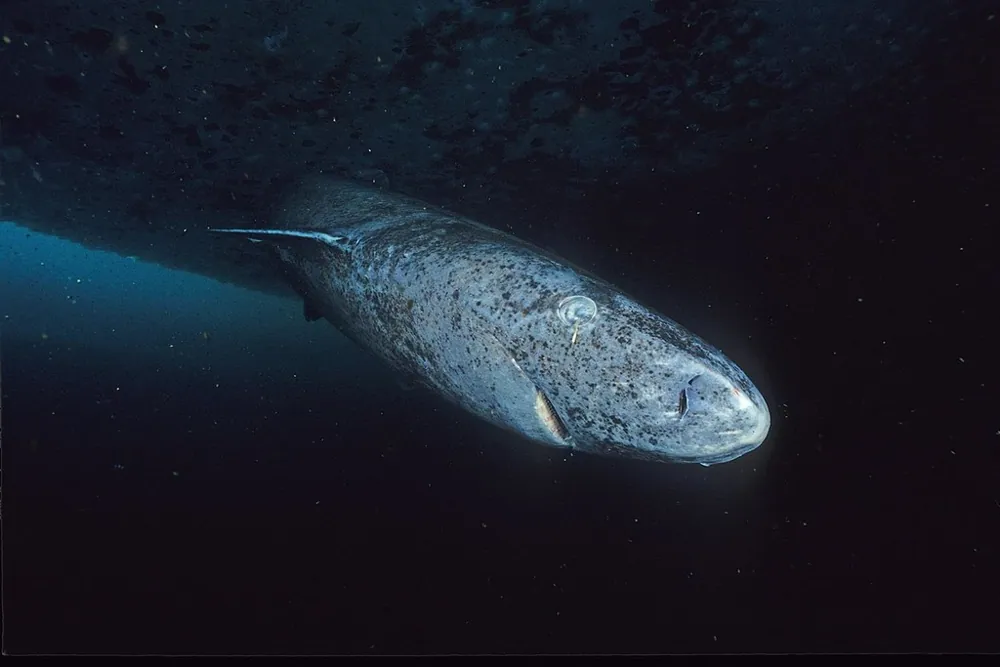
The Greenland shark is a huge, slow shark that lives in the cold, deep waters of the North Atlantic and Arctic Oceans. It is famous for living longer than any known vertebrate (animal with a backbone). Its flesh is poisonous to eat unless it is specially prepared.1



 Tsela ya go e lemoga
- A thickset, heavy body with a short, rounded snout1
- Small eyes and small dorsal and pectoral fins1
- Five very small gill openings for its size1
- Colour ranges from pale creamy-grey to blackish-brown, usually uniform, sometimes with whitish spots or faint dark streaks on the back1
- Often has small parasitic copepods (crustaceans) attached to its eyes1
Maatla a botlhole
E kotsi fela fa sengwe se e ja.
Botlhole jwa yone (jwa go e ama kgotsa go e ja) bo dira eng?
The shark is not venomous. Its meat is poisonous to mammals because it contains high levels of trimethylamine N-oxide (TMAO), a natural chemical that makes the flesh toxic.1
E kotsi go le kae go batho?
Kotsi go batho: E botlhokoE ka utlwisa botlhoko tota, mme go seoka thata gore e nne masisi.Greenland sharks are not considered a threat to people, because they live deep in remote, cold waters. Only one possible attack is recorded, in 1936, and it was never linked to this species. One unverified report from around 1859 describes a human leg found in a shark's stomach.1
E dira eng fa e tshogile?
When hauled onto a boat, it thrashes its tail so violently that it is dangerous to stand near it, and its muscles can still twitch after death.1
 Fa mongwe a e amile kgotsa a e jele
- Fa mongwe a e jele kgotsa a na le matshwao morago ga go e ja: leletsa nomoro ya gago ya tshoganyetso kgotsa senthara ya botlhole ka yone nako eo.
Ka gale leletsa nomoro ya gago ya tshoganyetso pele (112, 000, 911). Se ke kaelo e e akaretsang ya thuso ya ntlha, ga se kgakololo ya bongaka. Motheo wa thuso ya ntlha
 Nna o babalesegile
- O se ka wa ama, wa tshwara kgotsa wa tshwenya phologolo ya naga, le fa e le e nnye, le fa e lebega e robetse kgotsa e sule.
- E fe sebaka. Fa o kopana le yone, ritibala, boela morago ka bonya mme o e tlogele e tsamaye ka tsela ya yone.
- Fa o e amile kgotsa o e jele: o se ka wa gotlha matlho kgotsa molomo wa gago, tlhatswa diatla mme o batle thuso ya bongaka.
Ga e go batle. Botlhole jwa yone bo teng fela gore sepe se se ka se e je. Go le gontsi ka go nna o babalesegile
Kae mo lefatsheng?
E kgolo go le kae?
E telele go le kae?
E kima go le kae?
 boleele jo bo lekanang le dintša di le 6 go tloga kwa nkong go ya mogatleng
 boleele jo bo lekanang le dipanana di le 36 di latelana
 e ka thuma boleele jwa bodiba jo bogolo jwa go thuma (50 m) ka metsotswana e le 69
Greenland shark e kgolo go le kae fa e bapisiwa le WENA?
Ke dipalo fela mo sefetleng sa gago (browser). Ga go sepe se se bolokwang kgotsa se se romelwang gope.
E bonako go le kae?

Dintlha
It is thought to have the longest lifespan of any known vertebrate, estimated at between 272 and 510 years.1
It is one of the slowest-swimming fish for its size, with a fastest cruising speed of about 2.7 km/h.1
Parasitic copepods often attach to its eyes and can damage them, but this does not seem to shorten its life, because it relies mainly on smell and hearing.1
It is one of the largest shark species alive, with the largest confirmed specimen weighing around 1,023 kg.1
In Iceland, a specially treated form of its meat is eaten as a pungent delicacy called kæstur hákarl.1
Its slow metabolism is thought to be linked to its very long life, although this is still a hypothesis.1
Mosenyi wa ditlhamane
Tlhamane: The Greenland shark is a dangerous threat to humans.
Nnete: It is not considered a threat to people. It lives deep in cold, remote waters, and the only report of a possible attack was never confirmed as this species.1
Ya baitseanape ba botlhole
- Leina la saense
- Somniosus microcephalus
- Setlhopha
- Diphologolo tse dingwe tse di botlhole go di ama kgotsa go di ja
- Lelapa
- Somniosidae2
- Lekoko
- Squaliformes
- Dikontinente
- Lewatle la Arctic, Lewatle la Atlantic, Mawatle
- Masea
- Pups are born alive, after an estimated gestation period of 8 to 18 years. Females reach sexual maturity at around 150 years of age.1
- Kotsi go batho
- 2 / 5: E botlhoko3
Kwa dintlha di tswang teng
- Greenland shark (Wikipedia (CC BY-SA 4.0))
- Somniosus microcephalus (iNaturalist): maina le thulaganyo ya mefuta.
- Venom Wiki: seelo sa kotsi, bogolo jo bo tlwaelegileng le kakanyo ya lebelo ke tsa rona. Bona kafa re di balang ka teng: Kafa re lekanyang kotsi ka teng.
Ntlha nngwe le nngwe mo tsebeng e e na le nomoro e e supang motswedi wa yone. Fa re dirile phoso, maitshwarelo, re barati ba diphologolo, e seng kgatiso ya saense. Re bolelele kwa [email protected] mme re tla e baakanya.
 Phepheng e tshwerwe ke tlala! Venom Wiki ke porojeke ya motho a le mongwe: ke mahala, ga e na dipapatso le ditraka. Mpho e nnye e thusa go e tshegetsa mo inthaneteng.Fepa phepheng
Tse dingwe tsa setlhopha se se tshwanang: Diphologolo tse dingwe tse di botlhole go di ama kgotsa go di ja
 Japanese pufferfishDiphologolo tse dingwe tse di botlhole go di ama kgotsa go di jaE a bolaya
 Hawksbill sea turtleDiphologolo tse dingwe tse di botlhole go di ama kgotsa go di jaE ka bolaya
 Silver-cheeked toadfishDiphologolo tse dingwe tse di botlhole go di ama kgotsa go di jaE a bolaya
 Blackspotted pufferDiphologolo tse dingwe tse di botlhole go di ama kgotsa go di jaE ka bolaya
 White-spotted pufferDiphologolo tse dingwe tse di botlhole go di ama kgotsa go di jaE ka bolaya
 Long-spine porcupinefishDiphologolo tse dingwe tse di botlhole go di ama kgotsa go di jaE tlhoka ngaka
E tshela gape kwa: Lewatle la Arctic
 Lion's mane jellyfishDijelifishi le dibopiwa tsa lewatle tse di tlhabangE utlwisa botlhoko felaO se ka wa ama
 Moon jellyfishDijelifishi le dibopiwa tsa lewatle tse di tlhabangGa e na kotsi
 Spiny dogfishDitlhapi tse di tsenyang botlholeE utlwisa botlhoko felaO se ka wa ama
 Bootlace wormDi-urchin, dinaledi tsa lewatle le dibokoGa e na kotsi