
 Aforika
 Asia
Asia Yuropa
 Amerika Borwa
 Australia le Oceania
 Antarctica
 Lewatle la Pacific
 Lewatle la Atlantic
 Lewatle la India
 Lewatle la Arctic
 Lewatle la Mediterranean
 Lewatle le Lehibidu
 Lewatle la Caribbean
 Lewatle la Coral
 Lewatle la China Borwa
 Lewatle la Philippines
 Lewatle la Andaman
 Lewatle la Bokone
 Lewatle la Timor le la Arafura
 Kou ya Bengal
 Gulf ya California
Noble false widow
 Go loma
The noble false widow is a spider that looks a lot like the black widow, which is why it has its name. It is now found in many parts of the world, including Europe, the United States and New Zealand, and it is one of the world's most invasive spiders. Its bite can be painful, so it is worth knowing what it looks like.1


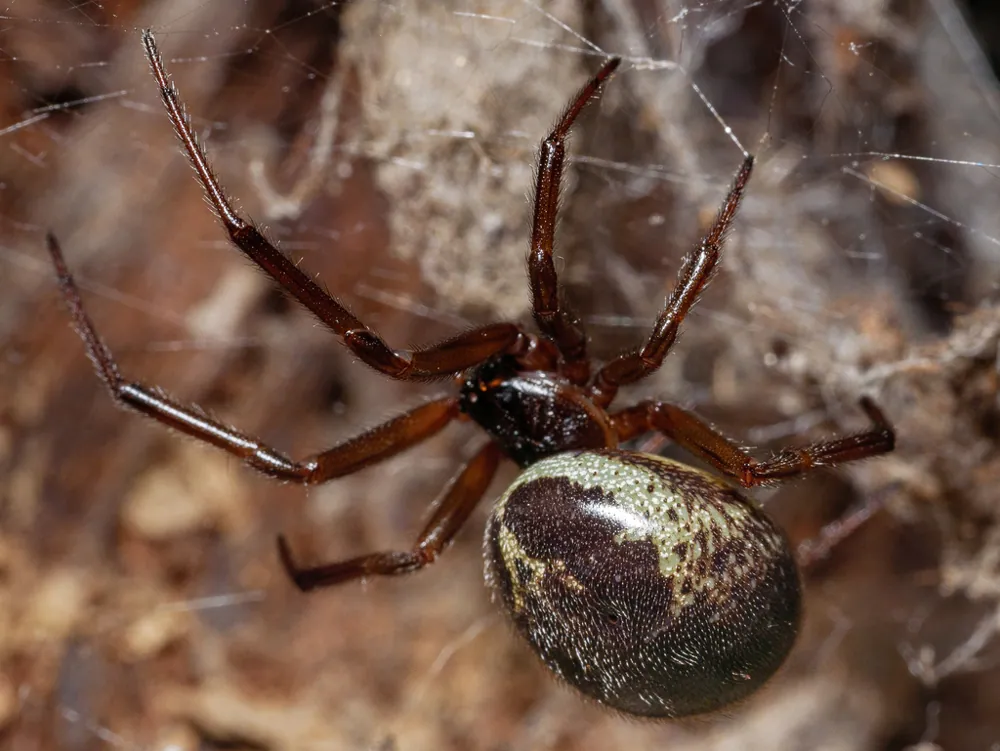
 Tsela ya go e lemoga
- The abdomen (rear body) is brown and rounded, with cream markings that are often said to look like a skull.1
- The legs are reddish-orange.1
- Adult females are about 9.5 to 14 mm in size, and males are about 7 to 11 mm.1
- It is larger than other spiders in its genus, Steatoda, and has a typical colour pattern.1
Gantsi e tlhakanngwa le: It is often mistaken for the black widow (Latrodectus) and other false widow species. It can be told apart from the black widow by its larger size within its genus and its typical colouring, though many spiders in this group look similar.1
Maatla a botlhole
Botlhole bo tswa ka meno a yone fa e loma.
Botlhole jo e bo tsenyang bo dira eng?
Most of its venom is made of toxins similar to those of the widow spiders, mainly alpha-latrotoxin. This toxin makes holes in nerve cells, which releases chemical messengers and blocks the signals between nerves and muscles, causing paralysis. In people, the venom is most noticeable as pain at the bite site, along with swelling, redness and fever.1
E kotsi go le kae go batho?
Kotsi go batho: E botlhokoE ka utlwisa botlhoko tota, mme go seoka thata gore e nne masisi.It is considered moderately medically significant. Most bites cause symptoms similar to a bee or wasp sting, but some can be more serious, partly because of bacteria. It is considered one of the most dangerous spiders in western Europe. Bites from males are less severe than bites from females, and the bite itself is usually painless, with pain coming from the venom.1
 Fa e loma
- Without proper treatment, a bite wound can become infected and develop into gangrene or sepsis, so medical care should be sought.1
- Tlhatswa fa go lomilweng mme o tsenye pakana ya aese mo go gone go fokotsa botlhoko. Batla thuso ya bongaka fa botlhoko bo le bogolo, bo anama kgotsa motho a ikutlwa a sa siama.
Ka gale leletsa nomoro ya gago ya tshoganyetso pele (112, 000, 911). Se ke kaelo e e akaretsang ya thuso ya ntlha, ga se kgakololo ya bongaka. Motheo wa thuso ya ntlha
 Nna o babalesegile
- O se ka wa ama, wa tshwara kgotsa wa tshwenya phologolo ya naga, le fa e le e nnye, le fa e lebega e robetse kgotsa e sule.
- E fe sebaka. Fa o kopana le yone, ritibala, boela morago ka bonya mme o e tlogele e tsamaye ka tsela ya yone.
- Fa e nngwe e go loma: ritibala, o se ka wa tshikinyega, leletsa nomoro ya gago ya tshoganyetso (112, 000, 911) kgotsa o ye bookelong ka bonako. Gopola gore e ne e lebega jang, setshwantsho se a thusa.
Ga e go batle. E dirisa botlhole jwa yone go tshwara dijo kgotsa go itshireletsa, mme e rata go iphitlha go feta. Go le gontsi ka go nna o babalesegile
Kae mo lefatsheng?
E kgolo go le kae?
E telele go le kae?
 e nnye mo e ka nnang mo lenaleng la gago
Noble false widow e kgolo go le kae fa e bapisiwa le WENA?
Ke dipalo fela mo sefetleng sa gago (browser). Ga go sepe se se bolokwang kgotsa se se romelwang gope.
E bonako go le kae?


Dintlha
The spider often catches prey much larger than itself, including bats, because its venom works quickly.1
It can survive without drinking water, getting all its liquid from its prey.1
Males court females by tapping the web and vibrating their bodies, and they can make scraping sounds with their abdomens.1
It has poor eyesight and relies mainly on vibrations travelling through its web.1
It produces three-dimensional cobwebs, and its silk is unusually strong for its genus.1
One adult female lived almost five and a half years in captivity, and adult females are long-lived.1
Mosenyi wa ditlhamane
Tlhamane: It is the same spider as the black widow.
Nnete: It only looks similar to the black widow. It belongs to the genus Steatoda, while the black widow belongs to the genus Latrodectus.1
Ya baitseanape ba botlhole
- Leina la saense
- Steatoda nobilis
- Setlhopha
- Digokgo
- Lelapa
- Theridiidae2
- Lekoko
- Araneae
- Dikontinente
- Yuropa, Aforika
- Masea
- Females make egg sacs containing an average of 94 eggs, with a range of 34 to 208 eggs. The young hatch inside the egg sac about 18 days after the eggs are laid.1
- Dingwaga tsa botshelo
- e ka nna dingwaga di le 51
- Kotsi go batho
- 2 / 5: E botlhoko3
Kwa dintlha di tswang teng
- Steatoda nobilis (Wikipedia (CC BY-SA 4.0))
- Steatoda nobilis (iNaturalist): maina le thulaganyo ya mefuta.
- Venom Wiki: seelo sa kotsi, bogolo jo bo tlwaelegileng le kakanyo ya lebelo ke tsa rona. Bona kafa re di balang ka teng: Kafa re lekanyang kotsi ka teng.
Ntlha nngwe le nngwe mo tsebeng e e na le nomoro e e supang motswedi wa yone. Fa re dirile phoso, maitshwarelo, re barati ba diphologolo, e seng kgatiso ya saense. Re bolelele kwa [email protected] mme re tla e baakanya.
 Phepheng e tshwerwe ke tlala! Venom Wiki ke porojeke ya motho a le mongwe: ke mahala, ga e na dipapatso le ditraka. Mpho e nnye e thusa go e tshegetsa mo inthaneteng.Fepa phepheng
Tse dingwe tsa setlhopha se se tshwanang: Digokgo
 Mediterranean black widow
 Six-eyed sand spider
 Brown widow
 Diving bell spider
 European yellow sac spider
 Tarantula wolf spider
E tshela gape kwa: Yuropa
 Common European adderDivaepara le diboloboloE tlhoka ngaka
 Spanish flyDiphologolo tse dingwe tse di botlhole go di ama kgotsa go di jaE tlhoka ngakaO se ka wa ama
 Common waspDinotshe, diwasepe le dihoneteE utlwisa botlhoko fela
 European hornetDinotshe, diwasepe le dihoneteE utlwisa botlhoko fela
 Fire salamanderDigwagwa tsa botlhole, digwagwa tse dingwe le dinewtE utlwisa botlhoko felaO se ka wa ama
 Western honey beeDinotshe, diwasepe le dihoneteE utlwisa botlhoko fela