
 Aforika
 Asia
Asia Yuropa
 Amerika Borwa
 Australia le Oceania
 Antarctica
 Lewatle la Pacific
 Lewatle la Atlantic
 Lewatle la India
 Lewatle la Arctic
 Lewatle la Mediterranean
 Lewatle le Lehibidu
 Lewatle la Caribbean
 Lewatle la Coral
 Lewatle la China Borwa
 Lewatle la Philippines
 Lewatle la Andaman
 Lewatle la Bokone
 Lewatle la Timor le la Arafura
 Kou ya Bengal
 Gulf ya California
Pantropical huntsman spider
 Go loma
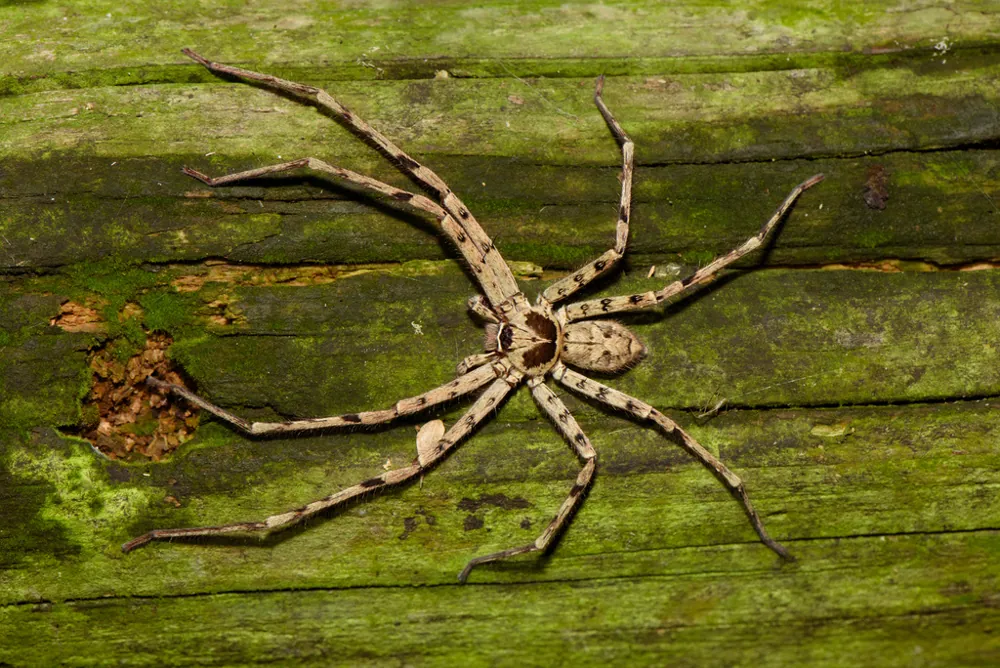
Heteropoda venatoria is a large, flat spider that hunts its prey instead of catching it in a web. It lives in tropical regions around the world and is often found in houses, barns and sheds. Its bite is painful, but it is not considered dangerous.1


 Tsela ya go e lemoga
- Adults have a flat, brown body about 2.2 to 2.8 cm long.1
- Leg span is about 7 to 10 cm.1
- The area just in front of the eyes is cream or yellowish.1
- A wide band behind the eyes is usually tan in females and cream in males.1
- The body is not very hairy, but the legs have hairs (setae), each marked with a black dot.1
Gantsi e tlhakanngwa le: In Bermuda, where most are found indoors, it is often called a house spider, which may be confused with the southern house spider. It is sometimes called a wolf spider, which should not be confused with the true wolf spiders of the family Lycosidae.1
Maatla a botlhole
Botlhole bo tswa ka meno a yone fa e loma.
Botlhole jo e bo tsenyang bo dira eng?
Its venom contains the toxin HpTX2, which is a potassium channel blocker. The venom is strong enough to cause a painful bite.1
E kotsi go le kae go batho?
Kotsi go batho: Kotsi e nnyeJaaka go tlhabiwa ke notshe kgotsa go le kwa tlase. Ga e na kotsi go batho.The spider is not considered dangerous to people, but its bite is painful.1
 Fa e loma
- Tlhatswa fa go lomilweng mme o tsenye pakana ya aese mo go gone go fokotsa botlhoko. Batla thuso ya bongaka fa botlhoko bo le bogolo, bo anama kgotsa motho a ikutlwa a sa siama.
Ka gale leletsa nomoro ya gago ya tshoganyetso pele (112, 000, 911). Se ke kaelo e e akaretsang ya thuso ya ntlha, ga se kgakololo ya bongaka. Motheo wa thuso ya ntlha
 Nna o babalesegile
- O se ka wa ama, wa tshwara kgotsa wa tshwenya phologolo ya naga, le fa e le e nnye, le fa e lebega e robetse kgotsa e sule.
- E fe sebaka. Fa o kopana le yone, ritibala, boela morago ka bonya mme o e tlogele e tsamaye ka tsela ya yone.
- Fa e nngwe e go loma: ritibala, o se ka wa tshikinyega, leletsa nomoro ya gago ya tshoganyetso (112, 000, 911) kgotsa o ye bookelong ka bonako. Gopola gore e ne e lebega jang, setshwantsho se a thusa.
Ga e go batle. E dirisa botlhole jwa yone go tshwara dijo kgotsa go itshireletsa, mme e rata go iphitlha go feta. Go le gontsi ka go nna o babalesegile
Kae mo lefatsheng?
E kgolo go le kae?
E telele go le kae?
 e ka nna boleele jo bo lekanang le jwa kelipi ya pampiri
 e ka taboga dimetara di le 100 ka metsotswana e le 200 (motho yo o bonako go gaisa o tlhoka 9,6)
Pantropical huntsman spider e kgolo go le kae fa e bapisiwa le WENA?
Ke dipalo fela mo sefetleng sa gago (browser). Ga go sepe se se bolokwang kgotsa se se romelwang gope.
E bonako go le kae?


Dintlha
It has been known to prey on scorpions and bats, as well as insects.1
During courtship, the male makes a faint buzz or hum by vibrating its abdomen while keeping its feet firmly planted.1
It does not spin webs. It hunts its prey directly.1
Females carry their egg sacs under the body until the young are ready to emerge.1
In one small laboratory sample, males lived an average of 465 days and females an average of 580 days.1
Ya baitseanape ba botlhole
- Leina la saense
- Heteropoda venatoria
- Setlhopha
- Digokgo
- Lelapa
- Sparassidae2
- Lekoko
- Araneae
- Dikontinente
- Asia
- Masea
- Females carry an egg sac up to about 2.5 cm wide tucked under the body with their pedipalps. Each sac usually holds over 100 eggs, and larger sacs hold over 400. The young moult for the first time while still inside the sac.1
- Kotsi go batho
- 1 / 5: Kotsi e nnye3
Kwa dintlha di tswang teng
- Heteropoda venatoria (Wikipedia (CC BY-SA 4.0))
- Heteropoda venatoria (iNaturalist): maina le thulaganyo ya mefuta.
- Venom Wiki: seelo sa kotsi, bogolo jo bo tlwaelegileng le kakanyo ya lebelo ke tsa rona. Bona kafa re di balang ka teng: Kafa re lekanyang kotsi ka teng.
Ntlha nngwe le nngwe mo tsebeng e e na le nomoro e e supang motswedi wa yone. Fa re dirile phoso, maitshwarelo, re barati ba diphologolo, e seng kgatiso ya saense. Re bolelele kwa [email protected] mme re tla e baakanya.
 Phepheng e tshwerwe ke tlala! Venom Wiki ke porojeke ya motho a le mongwe: ke mahala, ga e na dipapatso le ditraka. Mpho e nnye e thusa go e tshegetsa mo inthaneteng.Fepa phepheng
 Mediterranean black widow
 Diving bell spider
 European yellow sac spider
 Daddy long-legs spider
 Giant huntsman spider
 Hobo spider
 Deathstalker
 Indian cobra
 Indian saw-scaled viper
 King cobra
 Puff adder
 Phika ya ga Russell