
 Aforika
 Asia
Asia Yuropa
 Amerika Borwa
 Australia le Oceania
 Antarctica
 Lewatle la Pacific
 Lewatle la Atlantic
 Lewatle la India
 Lewatle la Arctic
 Lewatle la Mediterranean
 Lewatle le Lehibidu
 Lewatle la Caribbean
 Lewatle la Coral
 Lewatle la China Borwa
 Lewatle la Philippines
 Lewatle la Andaman
 Lewatle la Bokone
 Lewatle la Timor le la Arafura
 Kou ya Bengal
 Gulf ya California
Philippine cobra
 Go loma
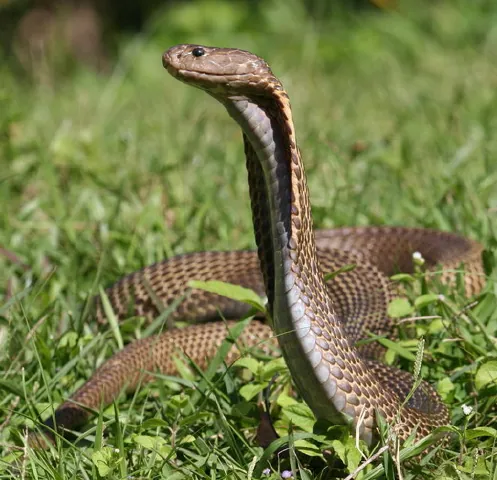
The Philippine cobra is a stocky, highly venomous snake that lives in the northern parts of the Philippines. It is a type of spitting cobra, and its bite can cause serious breathing problems very quickly. It is important to know it because it lives close to people, in farms, villages and near water.1



 Tsela ya go e lemoga
Maatla a botlhole
Botlhole bo tswa ka meno a yone fa e loma.
Botlhole jo e bo tsenyang bo dira eng?
Its venom is a potent neurotoxin, which attacks the nerves and stops nerve signals from reaching the muscles. This can cause respiratory paralysis, meaning the victim can no longer breathe properly. Symptoms can include headache, nausea, vomiting, abdominal pain, diarrhoea, dizziness and difficulty breathing. In some cases, breathing stopped within 30 minutes of the bite.1
E kotsi go le kae go batho?
Kotsi go batho: E a bolayaNngwe ya diphologolo tse di kotsi go gaisa mo lefatsheng.Bites cause severe neurotoxicity that comes on quickly, with little or no swelling at the bite site. In a study of 39 patients bitten by this snake in 1988, 19 developed complete respiratory failure and there were two deaths. Both people who died were already in a critical state when they reached hospital.1
E dira eng fa e tshogile?
When threatened, it forms a hood, and females can spit venom at a target up to 3 metres away.1
 Fa e loma kgotsa e tshwela
- Dira gore motho a nne a sa tshikinyege a ritibetse, tlosa direng le dilo tse di tiileng, mme o mo ise bookelong ka bonako: antivenom ke yone kalafi.
- Fa botlhole bo tshwetswe mo matlhong, a tlhatswe ka metsi a mantsi a a phepa ka yone nako eo.
Ka gale leletsa nomoro ya gago ya tshoganyetso pele (112, 000, 911). Se ke kaelo e e akaretsang ya thuso ya ntlha, ga se kgakololo ya bongaka. Motheo wa thuso ya ntlha
 Nna o babalesegile
- O se ka wa ama, wa tshwara kgotsa wa tshwenya phologolo ya naga, le fa e le e nnye, le fa e lebega e robetse kgotsa e sule.
- E fe sebaka. Fa o kopana le yone, ritibala, boela morago ka bonya mme o e tlogele e tsamaye ka tsela ya yone.
- Fa e nngwe e go loma kgotsa e go tshwela botlhole mo matlhong: ritibala, o se ka wa tshikinyega, leletsa nomoro ya gago ya tshoganyetso (112, 000, 911) kgotsa o ye bookelong ka bonako. Gopola gore e ne e lebega jang, setshwantsho se a thusa.
Ga e go batle. E dirisa botlhole jwa yone go tshwara dijo kgotsa go itshireletsa, mme e rata go iphitlha go feta. Go le gontsi ka go nna o babalesegile
Kae mo lefatsheng?
E kgolo go le kae?
E telele go le kae?
 boleele jo bo lekanang le dikatse tsa ntlo di le 3 go tloga kwa nkong go ya mogatleng
 boleele jo bo lekanang le dipanana di le 9 di latelana
 e ka taboga dimetara di le 100 ka metsotswana e le 52 (motho yo o bonako go gaisa o tlhoka 9,6)
Philippine cobra e kgolo go le kae fa e bapisiwa le WENA?
Ke dipalo fela mo sefetleng sa gago (browser). Ga go sepe se se bolokwang kgotsa se se romelwang gope.
E bonako go le kae?


Dintlha
Only female Philippine cobras have been reported to spit their venom, and they can hit a target up to 3 metres away.1
Its venom is considered one of the most toxic among cobra species, although toxicity can vary between individual snakes.1
Research has found that its venom is purely a neurotoxin, with no cardiotoxins and no obvious tissue-destroying components.1
Large rats sometimes fight back after being bitten. They can injure the snake's eyes, and this can leave it blind.1
Kwa dintlha di tswang teng
- Philippine cobra (Wikipedia (CC BY-SA 4.0))
- Naja philippinensis (iNaturalist): maina le thulaganyo ya mefuta.
- Venom Wiki: seelo sa kotsi, bogolo jo bo tlwaelegileng le kakanyo ya lebelo ke tsa rona. Bona kafa re di balang ka teng: Kafa re lekanyang kotsi ka teng.
Ntlha nngwe le nngwe mo tsebeng e e na le nomoro e e supang motswedi wa yone. Fa re dirile phoso, maitshwarelo, re barati ba diphologolo, e seng kgatiso ya saense. Re bolelele kwa [email protected] mme re tla e baakanya.
 Phepheng e tshwerwe ke tlala! Venom Wiki ke porojeke ya motho a le mongwe: ke mahala, ga e na dipapatso le ditraka. Mpho e nnye e thusa go e tshegetsa mo inthaneteng.Fepa phepheng
Tse dingwe tsa setlhopha se se tshwanang: Dikobra, dimamba le dikrait
 Indian cobra
 King cobra
 Caspian cobra
 Common krait
 Malayan krait
 Many-banded krait
E tshela gape kwa: Asia
 DeathstalkerDiphephengE a bolaya
 Indian saw-scaled viperDivaepara le diboloboloE a bolaya
 Puff adderDivaepara le diboloboloE a bolaya
 Phika ya ga RussellDivaepara le diboloboloE a bolaya
 Asian giant hornetDinotshe, diwasepe le dihoneteE ka bolaya
 Komodo dragonDikgatitswane tse di tsenyang botlholeE ka bolaya