
 Aforika
 Asia
Asia Yuropa
 Amerika Borwa
 Australia le Oceania
 Antarctica
 Lewatle la Pacific
 Lewatle la Atlantic
 Lewatle la India
 Lewatle la Arctic
 Lewatle la Mediterranean
 Lewatle le Lehibidu
 Lewatle la Caribbean
 Lewatle la Coral
 Lewatle la China Borwa
 Lewatle la Philippines
 Lewatle la Andaman
 Lewatle la Bokone
 Lewatle la Timor le la Arafura
 Kou ya Bengal
 Gulf ya California
Southern black widow
 Go loma
The southern black widow is a venomous spider that lives in North America. Mature females are shiny black with a red hourglass mark on their underside. Its bite can cause pain and other symptoms, but it is rarely fatal to healthy people.1


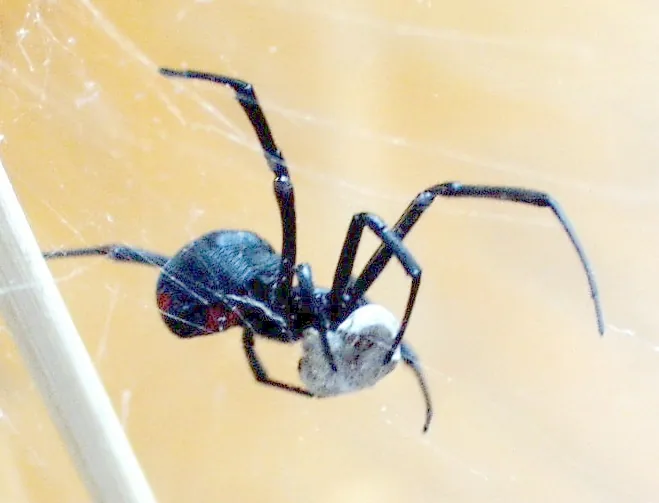
 Tsela ya go e lemoga
- Mature females are shiny black, with a red hourglass-shaped mark on the underside of a very rounded abdomen.1
- Many females have an orange or red patch on the top of the abdomen, just above the spinnerets.1
- Mature females have a body length of 8–13 mm, not counting the legs. Males are 3–6 mm.1
- Juveniles look very different. They have a grey to black abdomen with white stripes across it, spotted with yellow and orange.1
- Males are either purple, or look more like the juveniles.1
Gantsi e tlhakanngwa le: It is often confused with the false widows (genus Steatoda) and with the closely related northern (L. variolus) and western (L. hesperus) black widows.1
Maatla a botlhole
Botlhole bo tswa ka meno a yone fa e loma.
Botlhole jo e bo tsenyang bo dira eng?
The venom contains alpha-latrotoxin, a neurotoxic venom that attacks the nerves. It causes pain and other symptoms, which are collectively called latrodectism.1
E kotsi go le kae go batho?
Kotsi go batho: E masisiGo lomiwa ke yone go tlhoka ngaka. Go swa go seoka thata.Deaths in healthy adults are exceedingly rare. No deaths were reported among 23,409 documented Latrodectus bites in the US from 2000 to 2008, though about 2,000 bites happen each year. Only mature females can bite people.1
 Dikgang tse di molemo: dingaka di na le molemo (antivenom) kgotsa kalafi ya se.1
 Fa e loma
- Tlhatswa fa go lomilweng mme o tsenye pakana ya aese mo go gone go fokotsa botlhoko. Batla thuso ya bongaka fa botlhoko bo le bogolo, bo anama kgotsa motho a ikutlwa a sa siama.
Ka gale leletsa nomoro ya gago ya tshoganyetso pele (112, 000, 911). Se ke kaelo e e akaretsang ya thuso ya ntlha, ga se kgakololo ya bongaka. Motheo wa thuso ya ntlha
 Nna o babalesegile
- O se ka wa ama, wa tshwara kgotsa wa tshwenya phologolo ya naga, le fa e le e nnye, le fa e lebega e robetse kgotsa e sule.
- E fe sebaka. Fa o kopana le yone, ritibala, boela morago ka bonya mme o e tlogele e tsamaye ka tsela ya yone.
- Fa e nngwe e go loma: ritibala, o se ka wa tshikinyega, leletsa nomoro ya gago ya tshoganyetso (112, 000, 911) kgotsa o ye bookelong ka bonako. Gopola gore e ne e lebega jang, setshwantsho se a thusa.
Ga e go batle. E dirisa botlhole jwa yone go tshwara dijo kgotsa go itshireletsa, mme e rata go iphitlha go feta. Go le gontsi ka go nna o babalesegile
Kae mo lefatsheng?
E kgolo go le kae?
E telele go le kae?
 e nnye mo e ka nnang mo lenaleng la gago
Southern black widow e kgolo go le kae fa e bapisiwa le WENA?
Ke dipalo fela mo sefetleng sa gago (browser). Ga go sepe se se bolokwang kgotsa se se romelwang gope.
E bonako go le kae?


Dintlha
In 1933, Allan Blair let himself be bitten by one of these spiders to study its venom in humans and to convince sceptics that it could be dangerous.1
Females will occasionally eat their mates after reproduction.1
Only mature females can bite people. Their hollow, needle-like mouthparts are about 1 mm long, which is long enough to inject venom into people.1
The brown widow (Latrodectus geometricus) competes with black widows for territory. In areas where they share space, it can displace them.1
Males live only about three to four months, while females can live for up to three years.1
Mosenyi wa ditlhamane
Tlhamane: A black widow bite is usually fatal.
Nnete: Black widow bites are rarely fatal to healthy people. No deaths from the US species were reported among 23,409 documented bites from 2000 to 2008.1
Ya baitseanape ba botlhole
- Leina la saense
- Latrodectus mactans
- Setlhopha
- Digokgo
- Lelapa
- Theridiidae2
- Lekoko
- Araneae
- Dikontinente
- Amerika Bokone
- Masea
- A female can produce four to nine egg sacs in one summer, each holding about 100–400 eggs, which she guards in a silken container.1
- Dingwaga tsa botshelo
- e ka nna dingwaga di le 31
- Kotsi go batho
- 3 / 5: E masisi3
Kwa dintlha di tswang teng
- Latrodectus mactans (Wikipedia (CC BY-SA 4.0))
- Latrodectus mactans (iNaturalist): maina le thulaganyo ya mefuta.
- Venom Wiki: seelo sa kotsi, bogolo jo bo tlwaelegileng le kakanyo ya lebelo ke tsa rona. Bona kafa re di balang ka teng: Kafa re lekanyang kotsi ka teng.
Ntlha nngwe le nngwe mo tsebeng e e na le nomoro e e supang motswedi wa yone. Fa re dirile phoso, maitshwarelo, re barati ba diphologolo, e seng kgatiso ya saense. Re bolelele kwa [email protected] mme re tla e baakanya.
 Phepheng e tshwerwe ke tlala! Venom Wiki ke porojeke ya motho a le mongwe: ke mahala, ga e na dipapatso le ditraka. Mpho e nnye e thusa go e tshegetsa mo inthaneteng.Fepa phepheng
Tse dingwe tsa setlhopha se se tshwanang: Digokgo
 Brown recluse
 Northern black widow
 Western black widow
 Bold jumping spider
 Golden silk orb-weaver
 Central American wandering spider
E tshela gape kwa: Amerika Bokone
 TerciopeloDivaepara tsa mesima (pit vipers)E a bolaya
 Eastern coral snakeDinoga tsa khoraleE ka bolaya
 Eastern diamondback rattlesnakeDinoga tsa ratheleE ka bolaya
 Eyelash viperDivaepara tsa mesima (pit vipers)E ka bolaya
 Timber rattlesnakeDinoga tsa ratheleE ka bolaya
 Western diamondback rattlesnakeDinoga tsa ratheleE ka bolaya