
 Aforika
 Asia
Asia Yuropa
 Amerika Borwa
 Australia le Oceania
 Antarctica
 Lewatle la Pacific
 Lewatle la Atlantic
 Lewatle la India
 Lewatle la Arctic
 Lewatle la Mediterranean
 Lewatle le Lehibidu
 Lewatle la Caribbean
 Lewatle la Coral
 Lewatle la China Borwa
 Lewatle la Philippines
 Lewatle la Andaman
 Lewatle la Bokone
 Lewatle la Timor le la Arafura
 Kou ya Bengal
 Gulf ya California
Golden silk orb-weaver
 Go loma
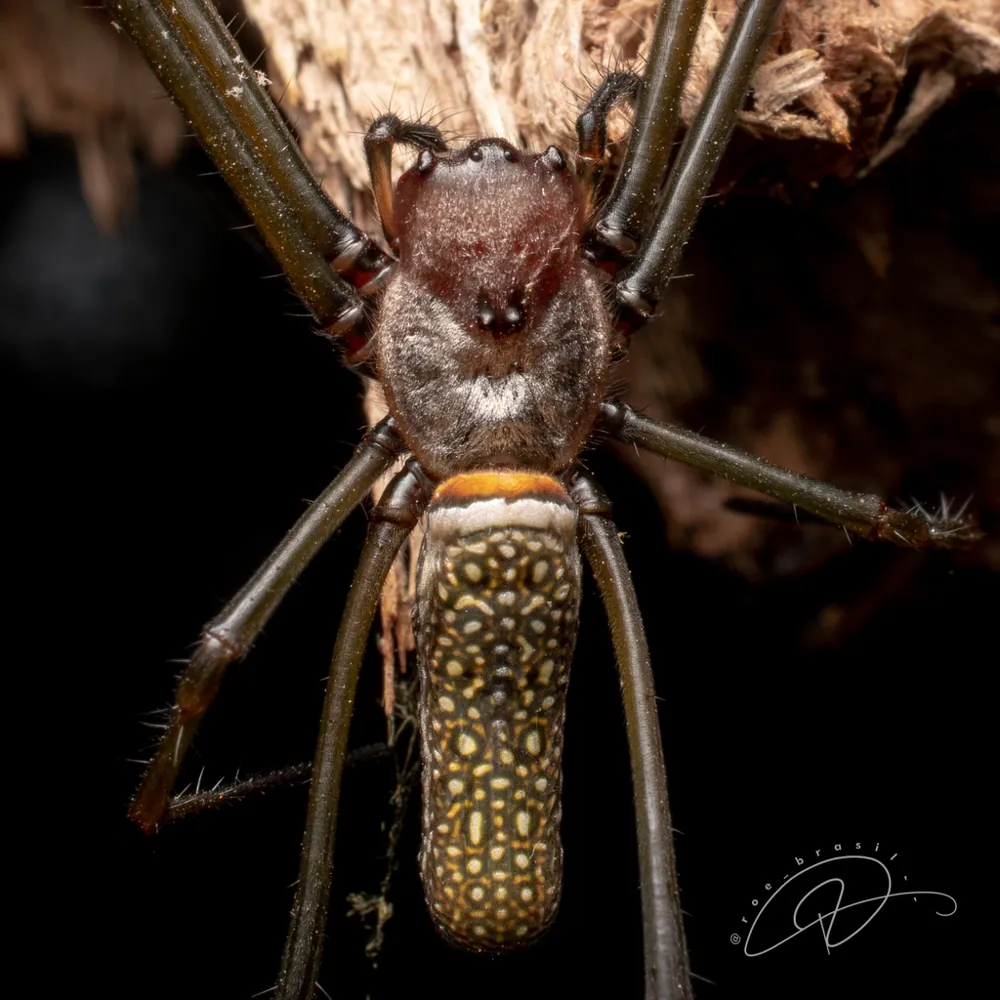
The golden silk orb-weaver is a large spider with silk that shines golden in sunlight. It lives in forests and wooded areas from the southern United States to Argentina. It is special because its silk is studied by scientists, and because it is one of the largest non-tarantula spiders in North America.1

 Tsela ya go e lemoga
- Females have a silvery white front body (cephalothorax) and a longer orange-brown abdomen with two rows of small white-yellow spots.1
- Females have dark yellow and brown banding on their legs, with black brush-like tufts of hair near the joints of the first, second and fourth leg pairs.1
- Females are about 24 to 40 mm long when fully grown.1
- Males are much smaller, about 6 mm long, with a plain dark brown body and legs.1
- The large webs are circular and vertical, and the yellow pigment in the silk gives them a golden glow in good light.1
Gantsi e tlhakanngwa le: Trichonephila plumipes also has stiff hairs on its legs. In that species the hairs are set more closely together than in the golden silk orb-weaver.1
Maatla a botlhole
Botlhole bo tswa ka meno a yone fa e loma.
Botlhole jo e bo tsenyang bo dira eng?
Its venom has low toxicity. It is relatively harmless and poses little health concern to healthy adult humans.1
E kotsi go le kae go batho?
Kotsi go batho: Kotsi e nnyeJaaka go tlhabiwa ke notshe kgotsa go le kwa tlase. Ga e na kotsi go batho.It is not known to be aggressive towards humans. It bites only in self-defence if it is touched, and its venom poses little health concern to healthy adults.1
E dira eng fa e tshogile?
It bites only in self-defence if it is touched.1
 Fa e loma
- Tlhatswa fa go lomilweng mme o tsenye pakana ya aese mo go gone go fokotsa botlhoko. Batla thuso ya bongaka fa botlhoko bo le bogolo, bo anama kgotsa motho a ikutlwa a sa siama.
Ka gale leletsa nomoro ya gago ya tshoganyetso pele (112, 000, 911). Se ke kaelo e e akaretsang ya thuso ya ntlha, ga se kgakololo ya bongaka. Motheo wa thuso ya ntlha
 Nna o babalesegile
- O se ka wa ama, wa tshwara kgotsa wa tshwenya phologolo ya naga, le fa e le e nnye, le fa e lebega e robetse kgotsa e sule.
- E fe sebaka. Fa o kopana le yone, ritibala, boela morago ka bonya mme o e tlogele e tsamaye ka tsela ya yone.
- Fa e nngwe e go loma: ritibala, o se ka wa tshikinyega, leletsa nomoro ya gago ya tshoganyetso (112, 000, 911) kgotsa o ye bookelong ka bonako. Gopola gore e ne e lebega jang, setshwantsho se a thusa.
Ga e go batle. E dirisa botlhole jwa yone go tshwara dijo kgotsa go itshireletsa, mme e rata go iphitlha go feta. Go le gontsi ka go nna o babalesegile
Kae mo lefatsheng?
E kgolo go le kae?
E telele go le kae?
 e ka nna boleele jo bo lekanang le jwa kelipi ya pampiri
 e ka taboga dimetara di le 100 ka metsotswana e le 210 (motho yo o bonako go gaisa o tlhoka 9,6)
Golden silk orb-weaver e kgolo go le kae fa e bapisiwa le WENA?
Ke dipalo fela mo sefetleng sa gago (browser). Ga go sepe se se bolokwang kgotsa se se romelwang gope.
E bonako go le kae?


Dintlha
Its silk may help in surgeries involving the nervous system, as shown in past experimental studies.1
It produces seven different types of silk, and its silk is valued in spider silk research.1
Its genome was the first of the orb-weaving spiders to be completely annotated, revealing 28 unique genes for spider silk proteins.1
Some individuals living in developed areas have grown significantly larger than their rural counterparts.1
Males rarely suffer sexual cannibalism or genital mutilation, unlike males of many related species, which makes it a focus of study into spider mating.1
Females are some of the largest non-tarantula spiders in North America, and may be the largest orb-weaver species native to the United States.1
Mosenyi wa ditlhamane
Tlhamane: The golden silk orb-weaver is an aggressive spider that attacks people.
Nnete: It is not known to be aggressive towards humans. It bites only in self-defence if it is touched.1
Kwa dintlha di tswang teng
- Trichonephila clavipes (Wikipedia (CC BY-SA 4.0))
- Trichonephila clavipes (iNaturalist): maina le thulaganyo ya mefuta.
- Venom Wiki: seelo sa kotsi, bogolo jo bo tlwaelegileng le kakanyo ya lebelo ke tsa rona. Bona kafa re di balang ka teng: Kafa re lekanyang kotsi ka teng.
Ntlha nngwe le nngwe mo tsebeng e e na le nomoro e e supang motswedi wa yone. Fa re dirile phoso, maitshwarelo, re barati ba diphologolo, e seng kgatiso ya saense. Re bolelele kwa [email protected] mme re tla e baakanya.
 Phepheng e tshwerwe ke tlala! Venom Wiki ke porojeke ya motho a le mongwe: ke mahala, ga e na dipapatso le ditraka. Mpho e nnye e thusa go e tshegetsa mo inthaneteng.Fepa phepheng
Tse dingwe tsa setlhopha se se tshwanang: Digokgo
 Brazilian wandering spider
 Brown recluse
 Southern black widow
 Amazon wandering spider
 Chilean recluse
 Northern black widow
E tshela gape kwa: Amerika Bokone
 TerciopeloDivaepara tsa mesima (pit vipers)E a bolaya
 Eastern coral snakeDinoga tsa khoraleE ka bolaya
 Eastern diamondback rattlesnakeDinoga tsa ratheleE ka bolaya
 Eyelash viperDivaepara tsa mesima (pit vipers)E ka bolaya
 Timber rattlesnakeDinoga tsa ratheleE ka bolaya
 Western diamondback rattlesnakeDinoga tsa ratheleE ka bolaya