
 Aforika
 Asia
Asia Yuropa
 Amerika Borwa
 Australia le Oceania
 Antarctica
 Lewatle la Pacific
 Lewatle la Atlantic
 Lewatle la India
 Lewatle la Arctic
 Lewatle la Mediterranean
 Lewatle le Lehibidu
 Lewatle la Caribbean
 Lewatle la Coral
 Lewatle la China Borwa
 Lewatle la Philippines
 Lewatle la Andaman
 Lewatle la Bokone
 Lewatle la Timor le la Arafura
 Kou ya Bengal
 Gulf ya California
Wagler's pit viper
 Go loma
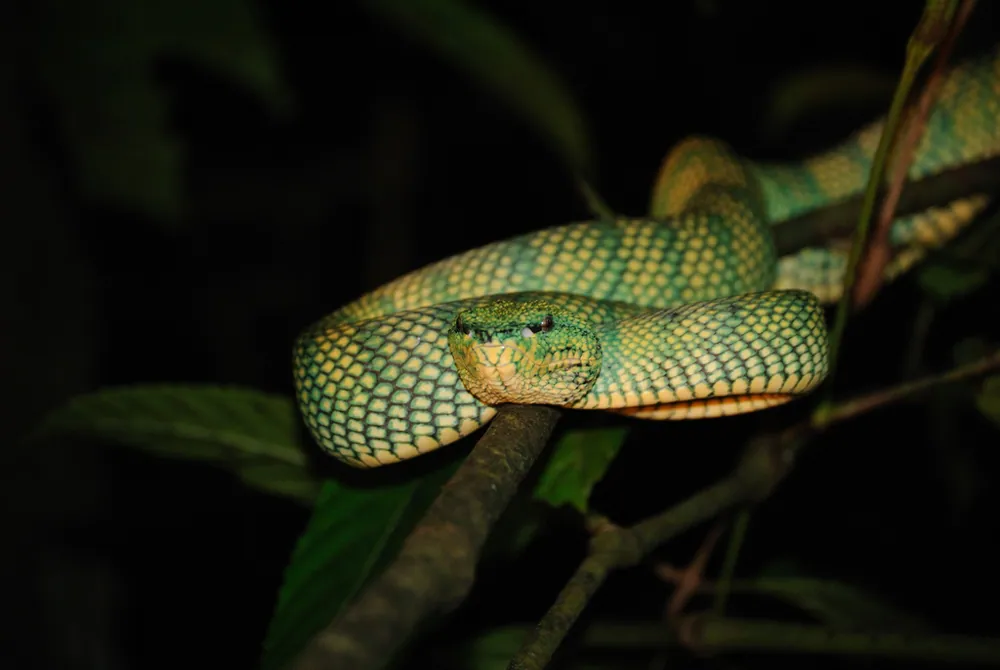
Wagler's pit viper is a venomous snake that lives in the forests of Southeast Asia. It spends most of its life in trees and is sometimes called the temple viper, because it is common around the Temple of the Azure Cloud in Malaysia. Its venom has also been used in scientific research.1



 Tsela ya go e lemoga
- Females can reach about 1 m (39 in) in total length, including the tail, and are black with yellow stripes.1
- Males typically do not exceed 75 cm (29.5 in). They have large triangular heads and relatively thin green bodies.1
- The species has many colour forms. Some are black or brown with orange and yellow banding, and others are light green with yellow or orange banding.1
- It is nocturnal, so it is active at night, and it often stays still for long periods.1
Maatla a botlhole
Botlhole bo tswa ka meno a yone fa e loma.
Botlhole jo e bo tsenyang bo dira eng?
The venom contains four peptides (small protein chains) called waglerins. In studies on mice, waglerin-1 blocked signals passing from nerves to muscles. Waglerins caused fatal breathing paralysis in adult mice.1
E kotsi go le kae go batho?
Kotsi go batho: E masisiGo lomiwa ke yone go tlhoka ngaka. Go swa go seoka thata.E dira eng fa e tshogile?
When disturbed, it can strike quickly.1
 Fa e loma
- Dira gore motho a nne a sa tshikinyege a ritibetse, tshegetsa setho se se lomilweng mo boemong jwa pelo, tlosa direng le dilo tse di tiileng, mme o mo ise bookelong ka bonako.
Ka gale leletsa nomoro ya gago ya tshoganyetso pele (112, 000, 911). Se ke kaelo e e akaretsang ya thuso ya ntlha, ga se kgakololo ya bongaka. Motheo wa thuso ya ntlha
 Nna o babalesegile
- O se ka wa ama, wa tshwara kgotsa wa tshwenya phologolo ya naga, le fa e le e nnye, le fa e lebega e robetse kgotsa e sule.
- E fe sebaka. Fa o kopana le yone, ritibala, boela morago ka bonya mme o e tlogele e tsamaye ka tsela ya yone.
- Fa e nngwe e go loma: ritibala, o se ka wa tshikinyega, leletsa nomoro ya gago ya tshoganyetso (112, 000, 911) kgotsa o ye bookelong ka bonako. Gopola gore e ne e lebega jang, setshwantsho se a thusa.
Ga e go batle. E dirisa botlhole jwa yone go tshwara dijo kgotsa go itshireletsa, mme e rata go iphitlha go feta. Go le gontsi ka go nna o babalesegile
Kae mo lefatsheng?
E kgolo go le kae?
E telele go le kae?
 boleele jo bo lekanang le dikatse tsa ntlo di le 2 go tloga kwa nkong go ya mogatleng
 boleele jo bo lekanang le dipanana di le 6 di latelana
 e ka taboga dimetara di le 100 ka metsotswana e le 100 (motho yo o bonako go gaisa o tlhoka 9,6)
Wagler's pit viper e kgolo go le kae fa e bapisiwa le WENA?
Ke dipalo fela mo sefetleng sa gago (browser). Ga go sepe se se bolokwang kgotsa se se romelwang gope.
E bonako go le kae?


Dintlha
Its pits can detect temperature differences as small as 0.003 °C (0.0054 °F).1
Waglerins, the peptides in its venom, are useful tools for studying how nerves and muscles connect.1
Females and males look very different, so the sexes were once hard to tell apart as one animal.1
Its many colour forms, called phases, were once thought by some researchers to be separate subspecies.1
Mosenyi wa ditlhamane
Tlhamane: Waglerin-1 smooths wrinkles, so it is safe to use in skin creams for that purpose.
Nnete: Waglerin-1 is included in some skin creams marketed as wrinkle removers, but there is no scientific evidence that it relaxes the muscles that cause wrinkles.1
Ya baitseanape ba botlhole
Kwa dintlha di tswang teng
- Tropidolaemus wagleri (Wikipedia (CC BY-SA 4.0))
- Tropidolaemus wagleri (iNaturalist): maina le thulaganyo ya mefuta.
- Venom Wiki: seelo sa kotsi, bogolo jo bo tlwaelegileng le kakanyo ya lebelo ke tsa rona. Bona kafa re di balang ka teng: Kafa re lekanyang kotsi ka teng.
Ntlha nngwe le nngwe mo tsebeng e e na le nomoro e e supang motswedi wa yone. Fa re dirile phoso, maitshwarelo, re barati ba diphologolo, e seng kgatiso ya saense. Re bolelele kwa [email protected] mme re tla e baakanya.
 Phepheng e tshwerwe ke tlala! Venom Wiki ke porojeke ya motho a le mongwe: ke mahala, ga e na dipapatso le ditraka. Mpho e nnye e thusa go e tshegetsa mo inthaneteng.Fepa phepheng
Tse dingwe tsa setlhopha se se tshwanang: Divaepara tsa mesima (pit vipers)
 Brown spotted pit viperDivaepara tsa mesima (pit vipers)E ka bolaya
 HabuDivaepara tsa mesima (pit vipers)E ka bolaya
 Hump-nosed viperDivaepara tsa mesima (pit vipers)E ka bolaya
 Hundred-pace viperDivaepara tsa mesima (pit vipers)E ka bolaya
 Malayan pit viperDivaepara tsa mesima (pit vipers)E ka bolaya
 MamushiDivaepara tsa mesima (pit vipers)E ka bolaya
 Deathstalker
 Indian cobra
 Indian saw-scaled viper
 King cobra
 Puff adder
 Phika ya ga Russell