
 Afrika
 Osiyo
Osiyo Yevropa
 Janubiy Amerika
 Avstraliya va Okeaniya
 Antarktida
 Tinch okeani
 Atlantika okeani
 Hind okeani
 Shimoliy Muz okeani
 Oʻrta yer dengizi
 Qizil dengiz
 Karib dengizi
 Marjon dengizi
 Janubiy Xitoy dengizi
 Filippin dengizi
 Andaman dengizi
 Shimoliy dengiz
 Timor va Arafura dengizi
 Bengal koʻrfazi
 Kaliforniya koʻrfazi
Desert night snake
 Chaqadi
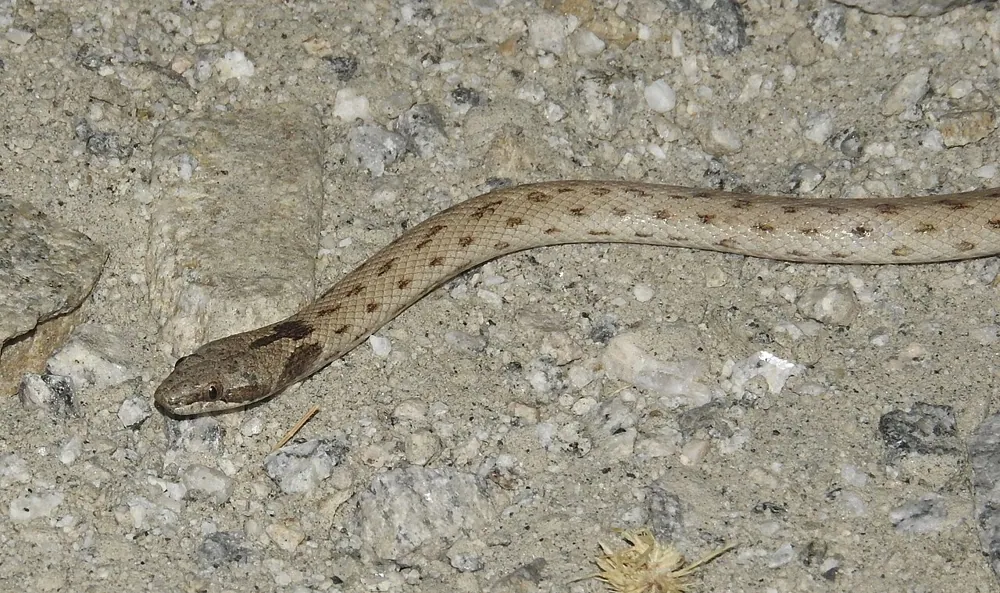
The desert nightsnake is a small, slender snake that hunts at night and spends the day hidden. It lives in dry parts of western North America, from the southwestern United States into northwestern Mexico. It is mildly venomous, but it poses no danger to people.1



 Uni qanday tanish mumkin
- Small and slender, usually 30 to 66 cm long in total.1
- Base colour is beige, yellowish or grey, with dark grey-brown blotches that usually form offset pairs down the back.1
- Three long dark blotches on the neck and one behind each eye.1
- Triangular head with vertical pupils.1
- Smooth scales on the back and no rattle at the tail.1
Koʻpincha adashtiriladi: It is often mistaken for a juvenile rattlesnake because of its triangular head, vertical pupils and blotched pattern. Unlike a rattlesnake, it has no rattle and its back scales are smooth.1
Zahar quvvati
Chaqqanda zahar zaharli tishlari yoki tishlari orqali chiqadi.
Uning zahari (chaqsa yoki nish ursa) nima qiladi?
It is mildly venomous and uses its venom to subdue prey. It has rear fangs, which are grooved teeth at the back of the upper jaw.1
Odamlar uchun qanchalik xavfli?
Odamlar uchun xavf: YengilAri nishidek yoki undan ham kam. Odamlar uchun deyarli zararsiz.It is mildly venomous and poses no danger to humans.1
 Agar chaqsa
- Chaqilgan joyni yuv, odamni xotirjam tut va tibbiy yordam ol. Baʼzi turlar (masalan, bumslang) soatlar oʻtib halokatli boʻlishi mumkin.
Har doim avval favqulodda yordam raqamiga qoʻngʻiroq qil (112, 000, 911). Bu birinchi yordam boʻyicha umumiy maslahat, tibbiy maslahat emas. Birinchi yordam asoslari
 Xavfsiz boʻl
- Hech qachon yovvoyi hayvonga tegma, uni tutma yoki jigʻiga tegma, hatto kichkina boʻlsa ham va hatto uxlayotgan yoki oʻlik koʻrinsa ham.
- Unga joy ber. Agar duch kelsang, xotirjam boʻl, sekin orqaga chekin va uni oʻz yoʻliga ketishiga qoʻy.
- Agar biri seni chaqsa: xotirjam boʻl, qimirlamay tur, favqulodda yordam raqamiga qoʻngʻiroq qil (112, 000, 911) yoki tezda kasalxonaga yet. U qanday koʻrinishda ekanini eslab qol, surat yordam beradi.
U seni ovlamoqchi emas. Zaharini ovqat tutish yoki oʻzini himoya qilish uchun ishlatadi va yashirinishni ancha afzal koʻradi. Xavfsiz qolish haqida batafsil
Dunyoning qayerida?
U qanchalik katta?
U qanchalik uzun?
 ketma-ket qoʻyilgan 4 ta banandek uzun
 100 metrni 80 soniyada bosib oʻtishi mumkin (eng tez odamga 9,6 soniya kerak)
Desert night snake SEN bilan solishtirganda qanchalik katta?
Faqat brauzeringdagi hisob-kitob. Hech narsa saqlanmaydi va hech qayerga yuborilmaydi.
U qanchalik tez?


Faktlar
It is a rear-fanged snake, with enlarged grooved teeth at the back of the upper jaw that help it subdue prey.1
In Canada, it is federally listed as Endangered, because its small population is threatened by habitat loss.1
Females are generally longer and heavier than males.1
It is mainly active at night and at dusk, which is why it has the name nightsnake.1
Afsonalarni fosh qiluvchi
Afsona: It is a juvenile rattlesnake.
Haqiqat: It is a separate species. It has no rattle and its back scales are smooth.1
Zahar mutaxassislari uchun
- Ilmiy nomi
- Hypsiglena chlorophaea
- Guruh
- Orqa tishli ilonlar
- Oila
- Colubridae2
- Tartib
- Squamata
- Qitʼalar
- Shimoliy Amerika
- Chaqaloqlar
- It lays eggs. Females lay a single clutch of 2 to 9 eggs, usually around 4, between April and July, hidden in rock crevices or abandoned burrows. The eggs hatch in late summer, and the hatchlings are about 17 cm long.1
- Tabiatda ahvoli qanday
- Least Concern globally (IUCN); Endangered in Canada (COSEWIC)1
- Odamlar uchun xavf
- 1 / 5: Yengil3
Faktlar qayerdan olingan
- Hypsiglena chlorophaea (Wikipedia (CC BY-SA 4.0))
- Hypsiglena chlorophaea (iNaturalist): nomlar va tasnif.
- Venom Wiki: xavf darajasi, odatiy oʻlcham va taxminiy tezlik bizning oʻz baholarimiz. Ularni qanday hisoblashimizni koʻr: Xavfni qanday baholaymiz.
Bu sahifadagi har bir faktning manbasiga ishora qiluvchi raqami bor. Agar biror narsani xato yozgan boʻlsak, kechir, biz hayvon ixlosmandlarimiz, ilmiy jurnal emas. [email protected] manziliga yoz, tuzatamiz.
 Chayon och! Venom Wiki bir kishining loyihasi: bepul, reklamasiz va kuzatuvchilarsiz. Kichik xayriya uni internetda saqlab qolishga yordam beradi.Chayonni boq
Shu guruhdan yana: Orqa tishli ilonlar
 Western hognose snake
 Brown vine snake
 Eastern hognose snake
 Green vine snake
 Night snake
 Sonoran lyre snake
Yana shu yerlarda yashaydi: Shimoliy Amerika
 TerciopeloChuqurboshli ilonlarHalokatli
 Eastern coral snakeMarjon ilonlariOʻldirishi mumkin
 Eastern diamondback rattlesnakeShaqildoq ilonlarOʻldirishi mumkin
 Eyelash viperChuqurboshli ilonlarOʻldirishi mumkin
 Timber rattlesnakeShaqildoq ilonlarOʻldirishi mumkin
 Western diamondback rattlesnakeShaqildoq ilonlarOʻldirishi mumkin