
 Afrig
Afrig Asi
Asi Tugal
Tugal Amerig gu Bëj-saalum
 Ostarali ak Oseyani
 Antarktig
 Mbàmbulaanu Pasifik
 Mbàmbulaanu Atlantig
 Mbàmbulaanu End
 Mbàmbulaanu Arktik
 Géeju Mediteraane
 Géej gu Xonq
 Géeju Karayib
 Géeju Koraay
 Géeju Siin gu Bëj-saalum
 Géeju Filipin
 Géeju Andaman
 Géeju Bëj-gànnaar
 Géeju Timor ak Arafura
 Golfu Bengal
 Golfu Kaliforni
Anchieta's cobra
 Dafay màtt
Anchieta's cobra is a venomous snake that lives in parts of southwestern Africa. It is a ground-dwelling cobra that spreads a broad hood when threatened. It is active at night and often comes close to human homes and farmyards.1



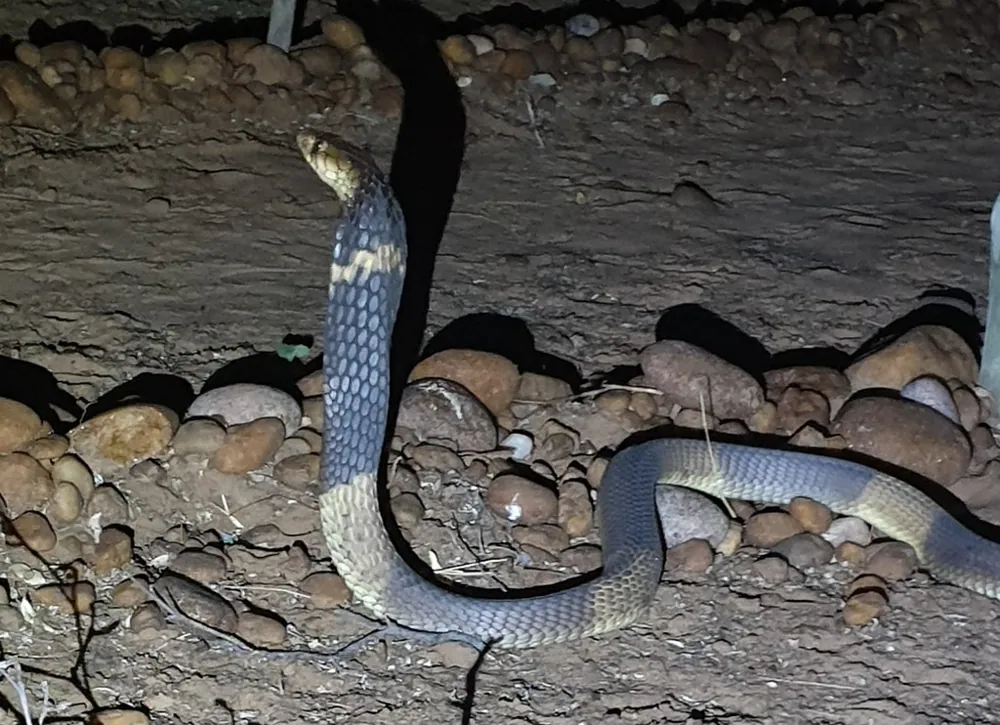
 Ni ngay ko xàmmee
- Young snakes are yellowish to light brown, with a black band circling the neck.1
- As it grows, it becomes a darker brown and the neck band fades away.1
- The throat band, which covers the front belly scales, is blue-black.1
- When threatened, it spreads a large, impressive hood about 10 to 12 cm wide.1
- In the southernmost parts of its range, some snakes are black with yellow bands across the body and tail.1
Ñu ngi koy faral di jaxasoo ak: The snouted cobra is very similar in shape, size and habits. The Anchieta's cobra is more inclined to stand its ground when confronted by a threat.1
Kàttanu daŋar
Daŋar bi dafay génn ci bëñam yi su màttee.
Lan la daŋar biy sóob di def?
Its venom is mainly a potent neurotoxin, which attacks the nerves. It may also contain cardiotoxic components, which harm the heart. Because it has moderately large size and relatively large fangs, it can inject a large volume of venom in a single bite.1
Ni mu lore nit ñi?
Musiba ci nit: Am na musiba loolMën na rey nit ku ñu fajul.Bites are rare, but they have been known to cause human deaths.1
Lan lay def bu tiitee?
When provoked it lifts its front body off the ground, spreads its hood and takes a defensive posture, but it will flee if it gets the chance, and it sometimes feigns death.1
 Su màttee
- Def ba nit ki bañ a yëngu te dal, dindi jaaro yi ak lu xat lépp, te yóbbu ko lopitaan ci gaaw: sérum antivenimeux mooy paj mi.
Saa su nekk, woo jëkk sa nimerob urgence (112, 000, 911). Lii ay ndigal yu yaatu ci ndimbal yu jëkk la, du ndigalu doktoor. Li war a xam ci ndimbal yu jëkk
 Sàmmal sa bopp
- Bul laal mukk, bul jàpp, bul sonal ab rab bu àll, doonte bu ndaw la, te doonte dafa mel ni dafa nelaw walla dafa dee.
- May ko bérab. Su nga ko gisee, dalal, dellu ginnaaw ndànk-ndànk te bàyyi ko mu dem yoonam.
- Su benn màttee la: dalal, bul yëngu, woo sa nimerob urgence (112, 000, 911) walla dem lopitaan ci gaaw. Bul fàtte ni mu meloon, ab nataal dina dimbali.
Du la wut. Dafay jëfandikoo daŋaram ngir jàpp lu muy lekk walla ngir aar boppam, te nëbbu moo ko gën a neex. Yeneen ci ni ngay sàmme sa bopp
Ni mu réye?
Ni mu guddoo?
 guddu na ni 5 muusu kër, bakkan ba geen
 guddu na ni 13 banaana yu ñu toftale
 mën na daw 100 meetar ci 46 segond (nit ki gën a gaaw soxla na 9,6)
Anchieta's cobra ni mu réye ci wetu YOW?
Ay waññ rekk ci sa navigateur. Dara du denc te dara du yónnee fenn.
Ni mu gaawe?


Xibaar
The longest recorded male was 2.31 metres long and was caught in Windhoek, Namibia.1
It is hunted by birds of prey such as secretary birds and snake eagles, and by honey badgers and white-throated monitors.1
Males and females grow to similar sizes, although males usually have larger heads and longer tails.1
A banded form has been noted in roughly 13% of males and up to 22% of females.1
Ngir boroom xam-xam ci daŋar
Fa xibaar yi jóge
- Anchieta's cobra (Wikipedia (CC BY-SA 4.0))
- Naja anchietae (iNaturalist): tur ak ni ñu leen séddale.
- Venom Wiki: tolluwaayu musiba bi, réyaay bu yem bi ak xalaatu gaawaay bi, nun ñoo leen defar. Seetal ni nu leen waññe: Ni nuy natte musiba.
Xibaar bu nekk ci xët wii am na ab nimero buy won fa mu jóge. Su nu juumee, baal nu, nun ay nit ñu bëgg rab lanu, du ab jurnaalu xam-xam. Wax nu ko ci [email protected] te dinanu ko jubbanti.
 Jiit bi dafa xiif! Venom Wiki ab liggéeyu kenn la: amul pay, amul piblisite te amul traceur. Ab may bu tuuti dafay dimbali ngir mu des ci internet.Leel jiit bi
 Black mamba
 Egyptian cobra
 Cape cobra
 Eastern green mamba
 Jameson's mamba
 Western green mamba
 Deathstalker
 Jaan wu ñuul wi (Bitis arietans)
 Boomslang
 Fat-tailed scorpion
 Gaboon viper
 Western honey bee