
 Afrig
Afrig Asi
Asi Tugal
Tugal Amerig gu Bëj-saalum
 Ostarali ak Oseyani
 Antarktig
 Mbàmbulaanu Pasifik
 Mbàmbulaanu Atlantig
 Mbàmbulaanu End
 Mbàmbulaanu Arktik
 Géeju Mediteraane
 Géej gu Xonq
 Géeju Karayib
 Géeju Koraay
 Géeju Siin gu Bëj-saalum
 Géeju Filipin
 Géeju Andaman
 Géeju Bëj-gànnaar
 Géeju Timor ak Arafura
 Golfu Bengal
 Golfu Kaliforni
Brazilian lancehead
 Dafay màtt
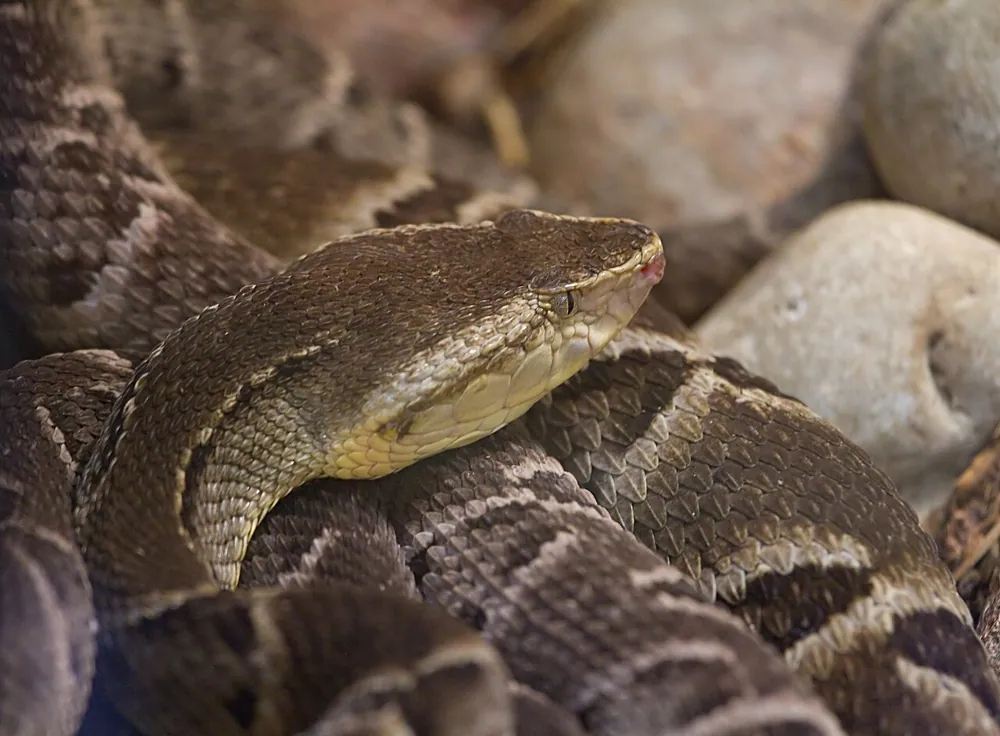
The Brazilian lancehead is a highly venomous snake, a type of pit viper, found in South America. It lives in forests and open woodland in Brazil and nearby countries, and it hunts mostly at night. Its venom damages muscle and blood, so bites need urgent medical care.1



 Ni ngay ko xàmmee
- Tan, grey-brown or olive-grey body with 14–21 trapezoidal side markings that are dark grey or black.1
- Belly is usually white or cream, with scattered dark grey spots.1
- Broad head is flattened into a lance shape when seen from above, and is distinct from the narrow neck.1
- Eyes have vertically elliptical (cat-like) pupils.1
- Juveniles have a white tail.1
Kàttanu daŋar
Daŋar bi dafay génn ci bëñam yi su màttee.
Lan la daŋar biy sóob di def?
Its venom is haemolytic (it breaks down red blood cells) and proteolytic (it breaks down proteins). A muscle-damaging component causes necrosis, meaning the muscle tissue dies, and the venom also stops blood from clotting. Symptoms may include intense local pain, swelling and muscle death, and the venom can cause severe bleeding and strokes.1
Ni mu lore nit ñi?
Musiba ci nit: Am na musiba loolMën na rey nit ku ñu fajul.This snake is highly venomous. Its venom can cause severe haemorrhage (serious bleeding) and strokes.1
Lan lay def bu tiitee?
It is considered very defensive.1
 Su màttee
- Def ba nit ki bañ a yëngu te dal, yemale cër bi ñu màtt ak kawewaayu xol bi, dindi jaaro yi ak lu xat lépp, te yóbbu ko lopitaan ci gaaw.
Saa su nekk, woo jëkk sa nimerob urgence (112, 000, 911). Lii ay ndigal yu yaatu ci ndimbal yu jëkk la, du ndigalu doktoor. Li war a xam ci ndimbal yu jëkk
 Sàmmal sa bopp
- Bul laal mukk, bul jàpp, bul sonal ab rab bu àll, doonte bu ndaw la, te doonte dafa mel ni dafa nelaw walla dafa dee.
- May ko bérab. Su nga ko gisee, dalal, dellu ginnaaw ndànk-ndànk te bàyyi ko mu dem yoonam.
- Su benn màttee la: dalal, bul yëngu, woo sa nimerob urgence (112, 000, 911) walla dem lopitaan ci gaaw. Bul fàtte ni mu meloon, ab nataal dina dimbali.
Du la wut. Dafay jëfandikoo daŋaram ngir jàpp lu muy lekk walla ngir aar boppam, te nëbbu moo ko gën a neex. Yeneen ci ni ngay sàmme sa bopp
Ni mu réye?
Ni mu guddoo?
 guddu na ni 5 muusu kër, bakkan ba geen
 guddu na ni 13 banaana yu ñu toftale
 mën na daw 100 meetar ci 90 segond (nit ki gën a gaaw soxla na 9,6)
Brazilian lancehead ni mu réye ci wetu YOW?
Ay waññ rekk ci sa navigateur. Dara du denc te dara du yónnee fenn.
Ni mu gaawe?


Xibaar
The venom contains a clotting-related enzyme that can trigger disseminated intravascular coagulation, a serious condition where blood clots and bleeds at the same time.1
Its venom contains a wide range of enzymes, including a muscle-damaging myotoxin.1
The venom yield of adult females averages 335 mg, while newborns average 63 mg.1
It is one of several pit vipers with heat-sensing pits, which help it find prey in the dark.1
It is nocturnal, so it is most active at night.1
Ngir boroom xam-xam ci daŋar
- Turu xam-xam
- Bothrops moojeni
- Mbooloo
- Vipère à fossettes
- Njaboot
- Viperidae2
- Toftal
- Squamata
- Kontinaa yi
- Amerig gu Bëj-saalum
- Liir yi
- It gives birth to live young (viviparous). Gestation lasts around four months, it happens once a year, and a litter is usually 12–14 newborns.1
- Diiru dund
- lu tollu ci 15 at1
- Musiba ci nit
- 4 / 5: Am na musiba lool3
Fa xibaar yi jóge
- Bothrops moojeni (Wikipedia (CC BY-SA 4.0))
- Bothrops moojeni (iNaturalist): tur ak ni ñu leen séddale.
- Venom Wiki: tolluwaayu musiba bi, réyaay bu yem bi ak xalaatu gaawaay bi, nun ñoo leen defar. Seetal ni nu leen waññe: Ni nuy natte musiba.
Xibaar bu nekk ci xët wii am na ab nimero buy won fa mu jóge. Su nu juumee, baal nu, nun ay nit ñu bëgg rab lanu, du ab jurnaalu xam-xam. Wax nu ko ci [email protected] te dinanu ko jubbanti.
 Jiit bi dafa xiif! Venom Wiki ab liggéeyu kenn la: amul pay, amul piblisite te amul traceur. Ab may bu tuuti dafay dimbali ngir mu des ci internet.Leel jiit bi
Yeneen ci mbooloo mi: Vipère à fossettes
 Terciopelo
 Eyelash viper
 Golden lancehead
 South American bushmaster
 Common lancehead
 Jararaca
Dafay dund itam ci: Amerig gu Bëj-saalum
 Golden poison frogMbott yu am daŋar, crapaud ak tritonMën a reyBul laal
 Brazilian wandering spiderJargoñMën na rey
 Cane toadMbott yu am daŋar, crapaud ak tritonSoxla na doktoorBul laal
 Peruvian giant centipedeMille-pattesSoxla na doktoor
 Bullet antFourmi yiDafay metti rekk
 Common vampire batRab yuy nàmpal yu am daŋarDafay metti rekk