
 Afrig
Afrig Asi
Asi Tugal
Tugal Amerig gu Bëj-saalum
 Ostarali ak Oseyani
 Antarktig
 Mbàmbulaanu Pasifik
 Mbàmbulaanu Atlantig
 Mbàmbulaanu End
 Mbàmbulaanu Arktik
 Géeju Mediteraane
 Géej gu Xonq
 Géeju Karayib
 Géeju Koraay
 Géeju Siin gu Bëj-saalum
 Géeju Filipin
 Géeju Andaman
 Géeju Bëj-gànnaar
 Géeju Timor ak Arafura
 Golfu Bengal
 Golfu Kaliforni
Chilean six-eyed sand spider
 Dafay màtt
The Chilean six-eyed sand spider is a small spider that lives in the deserts of northern and central Chile. It hides under rocks and comes out at night. Its venom has effects similar to those of the Chilean recluse spider, which is why it matters to people who live nearby.1


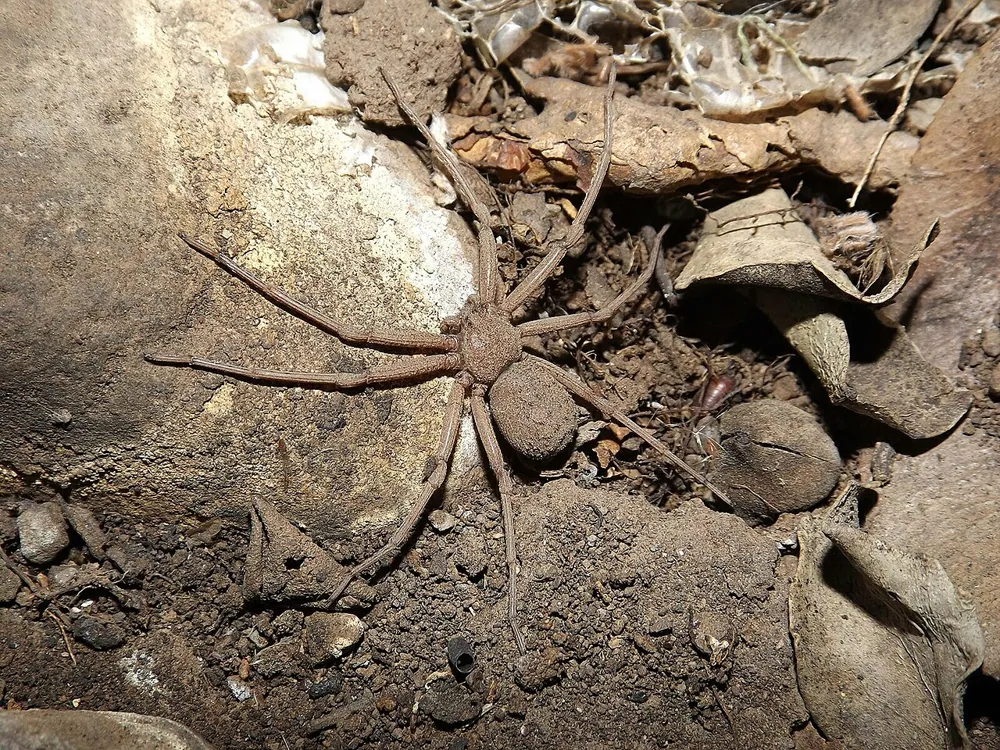
 Ni ngay ko xàmmee
- Body length of 12 to 20 mm1
- Active at night, with nocturnal habits1
- Shelters under rocks on sandy ground1
- Very common in urban areas with household waste1
Ñu ngi koy faral di jaxasoo ak: Older records under the name Sicarius terrosus may actually describe other species, such as Sicarius levii. Names in older books can therefore be unreliable.1
Kàttanu daŋar
Daŋar bi dafay génn ci bëñam yi su màttee.
Lan la daŋar biy sóob di def?
Its venom contains an enzyme called sphingomyelinase D, which has effects similar to those of the Chilean recluse spider. In laboratory tests the venom broke down red blood cells (haemolysis) and damaged skin cells, and 50 μg was enough to cause dermonecrosis, or the death of skin tissue. The venom also broke down fibrinogen, a protein needed for blood to clot.1
Ni mu lore nit ñi?
Musiba ci nit: Dafay mettiMën na metti lool, waaye lu bon du faral di am.Laboratory work shows that the venom can damage human tissue. Adult spiders carry up to eight times the amount of venom tested, so bites from adults could cause more serious lesions.1
 Su màttee
- Raxas fa mu màtt te teg ci mbuusu galaas ngir metit wi. Wutal ndimbal doktoor su metit wi dëgëree, mu law, walla yaramu nit ki baaxul.
Saa su nekk, woo jëkk sa nimerob urgence (112, 000, 911). Lii ay ndigal yu yaatu ci ndimbal yu jëkk la, du ndigalu doktoor. Li war a xam ci ndimbal yu jëkk
 Sàmmal sa bopp
- Bul laal mukk, bul jàpp, bul sonal ab rab bu àll, doonte bu ndaw la, te doonte dafa mel ni dafa nelaw walla dafa dee.
- May ko bérab. Su nga ko gisee, dalal, dellu ginnaaw ndànk-ndànk te bàyyi ko mu dem yoonam.
- Su benn màttee la: dalal, bul yëngu, woo sa nimerob urgence (112, 000, 911) walla dem lopitaan ci gaaw. Bul fàtte ni mu meloon, ab nataal dina dimbali.
Du la wut. Dafay jëfandikoo daŋaram ngir jàpp lu muy lekk walla ngir aar boppam, te nëbbu moo ko gën a neex. Yeneen ci ni ngay sàmme sa bopp
Ni mu réye?
Ni mu guddoo?
 guddu na lu tollu ci trombone
 mën na daw 100 meetar ci 330 segond (nit ki gën a gaaw soxla na 9,6)
Chilean six-eyed sand spider ni mu réye ci wetu YOW?
Ay waññ rekk ci sa navigateur. Dara du denc te dara du yónnee fenn.
Ni mu gaawe?


Xibaar
In 2020 a 20 mm spider was recorded preying on a 28 mm gecko, which is larger than the spider itself.1
Its venom breaks down fibrinogen, a clotting protein, faster than the venom of the Loxosceles species it was compared with.1
Scientists found that 50 μg of its venom was enough to cause dermonecrosis in laboratory tests.1
It is extremely common in Chilean cities where household waste is plentiful.1
Tasukatu léeb
Xalaat bu juum: The species is known as Sicarius terrosus.
Dëgg: The correct name is Sicarius thomisoides. The name terrosus was used for this species for a long time, but it was often used wrongly for other species too.1
Fa xibaar yi jóge
- Sicarius thomisoides (Wikipedia (CC BY-SA 4.0))
- Sicarius thomisoides (iNaturalist): tur ak ni ñu leen séddale.
- Venom Wiki: tolluwaayu musiba bi, réyaay bu yem bi ak xalaatu gaawaay bi, nun ñoo leen defar. Seetal ni nu leen waññe: Ni nuy natte musiba.
Xibaar bu nekk ci xët wii am na ab nimero buy won fa mu jóge. Su nu juumee, baal nu, nun ay nit ñu bëgg rab lanu, du ab jurnaalu xam-xam. Wax nu ko ci [email protected] te dinanu ko jubbanti.
 Jiit bi dafa xiif! Venom Wiki ab liggéeyu kenn la: amul pay, amul piblisite te amul traceur. Ab may bu tuuti dafay dimbali ngir mu des ci internet.Leel jiit bi
Yeneen ci mbooloo mi: Jargoñ
 Brazilian wandering spider
 Amazon wandering spider
 Chilean recluse
 Golden silk orb-weaver
 Keyserling's wandering spider
 Argentine black widow
Dafay dund itam ci: Amerig gu Bëj-saalum
 Golden poison frogMbott yu am daŋar, crapaud ak tritonMën a reyBul laal
 TerciopeloVipère à fossettesMën a rey
 Eyelash viperVipère à fossettesMën na rey
 Golden lanceheadVipère à fossettesMën na rey
 South American bushmasterVipère à fossettesMën na rey
 Cane toadMbott yu am daŋar, crapaud ak tritonSoxla na doktoorBul laal