
 Afrig
Afrig Asi
Asi Tugal
Tugal Amerig gu Bëj-saalum
 Ostarali ak Oseyani
 Antarktig
 Mbàmbulaanu Pasifik
 Mbàmbulaanu Atlantig
 Mbàmbulaanu End
 Mbàmbulaanu Arktik
 Géeju Mediteraane
 Géej gu Xonq
 Géeju Karayib
 Géeju Koraay
 Géeju Siin gu Bëj-saalum
 Géeju Filipin
 Géeju Andaman
 Géeju Bëj-gànnaar
 Géeju Timor ak Arafura
 Golfu Bengal
 Golfu Kaliforni
Florida bark scorpion
 Dafay jam
The Florida bark scorpion is a small scorpion with a sting that can cause serious harm. It is not really from Florida: it is native to northern Middle America and has spread to other places, including Florida. It hides under rocks, bark and rubbish, and sometimes lives inside houses.1


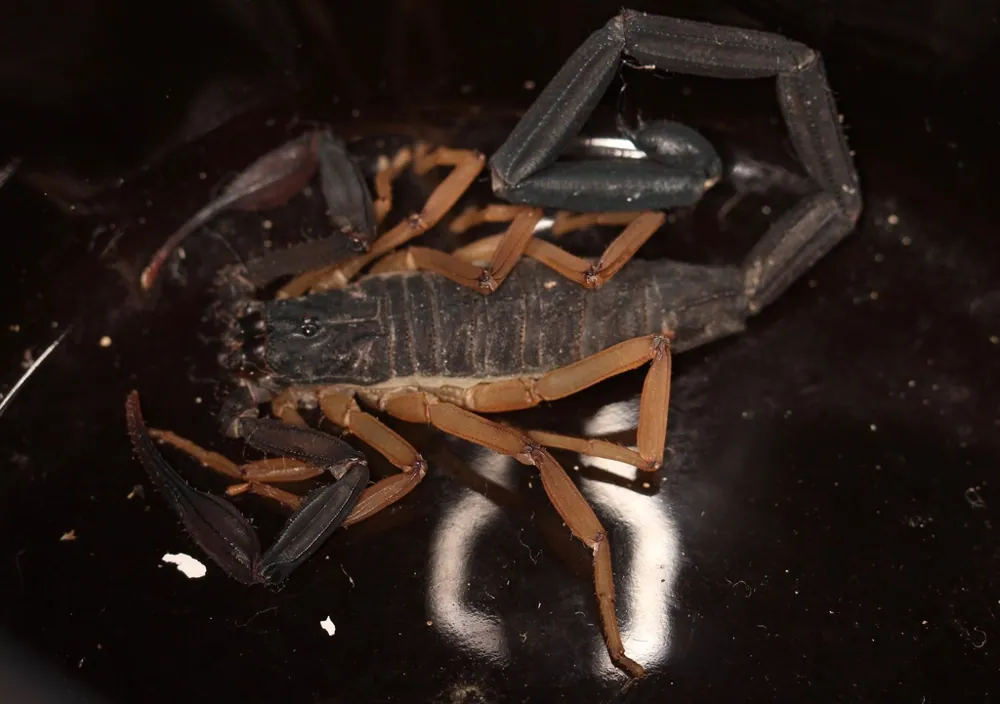
 Ni ngay ko xàmmee
- Its colour varies. It may be reddish, black with reddish pincers, or dark brown with yellowish legs and red pincers.1
- Some individuals are dark brown with reddish and black tail sections.1
- Females reach up to 10 cm long. Males can grow over 15 cm long.1
Ñu ngi koy faral di jaxasoo ak: In Florida it lives alongside two native scorpions, the Hentz striped scorpion and the Guiana striped scorpion.1
Kàttanu daŋar
Daŋar bi dafay génn ci ab dag buy jam.
Lan la daŋar biy sóob di def?
This scorpion is venomous, but much less toxic than others in its genus. Its venom is neurotoxic (it attacks the nerves) and cardiotoxic (it affects the heart), and it causes the release of catecholamines, hormones that speed up the body. Local effects include pain, redness, itching and swelling. Possible symptoms include irregular or fast heartbeat, fluid in the lungs, nausea, vomiting, sweating, diarrhoea, shock, convulsions and coma.1
Ni mu lore nit ñi?
Musiba ci nit: Dafay mettiMën na metti lool, waaye lu bon du faral di am.It is much less toxic than other scorpions in its genus. Serious symptoms can still occur, and death is possible.1
 Su jamee
- Sedalal fa mu jam ak mbuusu galaas, te def ba nit ki bañ a yëngu. Wutal ndimbal doktoor ci gaaw, rawatina ngir xale yi: am na ay jiit yuy rey xale.
Saa su nekk, woo jëkk sa nimerob urgence (112, 000, 911). Lii ay ndigal yu yaatu ci ndimbal yu jëkk la, du ndigalu doktoor. Li war a xam ci ndimbal yu jëkk
 Sàmmal sa bopp
- Bul laal mukk, bul jàpp, bul sonal ab rab bu àll, doonte bu ndaw la, te doonte dafa mel ni dafa nelaw walla dafa dee.
- May ko bérab. Su nga ko gisee, dalal, dellu ginnaaw ndànk-ndànk te bàyyi ko mu dem yoonam.
- Su benn jamee la: dalal, bul yëngu, woo sa nimerob urgence (112, 000, 911) walla dem lopitaan ci gaaw. Bul fàtte ni mu meloon, ab nataal dina dimbali.
Du la wut. Dafay jëfandikoo daŋaram ngir jàpp lu muy lekk walla ngir aar boppam, te nëbbu moo ko gën a neex. Yeneen ci ni ngay sàmme sa bopp
Ni mu réye?
Ni mu guddoo?
 guddu na ni 5 bloku tabax yu ñu toftale
 mën na daw 100 meetar ci 180 segond (nit ki gën a gaaw soxla na 9,6)
Florida bark scorpion ni mu réye ci wetu YOW?
Ay waññ rekk ci sa navigateur. Dara du denc te dara du yónnee fenn.
Ni mu gaawe?


Xibaar
Females can reproduce without a male, through a process called parthenogenesis.1
Newborn young ride on their mother's back.1
Tarantulas such as Tliltocatl vagans prey on it, and a tarantula may kill it even if the scorpion strikes first.1
In a laboratory study, males lived about 33 months on average and females about 38 months.1
Despite its name, it is native to northern Middle America, not Florida.1
Tasukatu léeb
Xalaat bu juum: It is a Florida native scorpion, as its name suggests.
Dëgg: It is not native to Florida. It comes from northern Middle America and was introduced to Florida and other places.1
Ngir boroom xam-xam ci daŋar
- Turu xam-xam
- Centruroides gracilis
- Mbooloo
- Jiit yi
- Njaboot
- Buthidae2
- Toftal
- Scorpiones
- Kontinaa yi
- Amerig gu Bëj-gànnaar, Amerig gu Bëj-saalum
- Liir yi
- The female gives birth to a litter of 25 to 35 young, and litters of 91 have been recorded. The young ride on the female's back.1
- Musiba ci nit
- 2 / 5: Dafay metti3
Fa xibaar yi jóge
- Centruroides gracilis (Wikipedia (CC BY-SA 4.0))
- Centruroides gracilis (iNaturalist): tur ak ni ñu leen séddale.
- Venom Wiki: tolluwaayu musiba bi, réyaay bu yem bi ak xalaatu gaawaay bi, nun ñoo leen defar. Seetal ni nu leen waññe: Ni nuy natte musiba.
Xibaar bu nekk ci xët wii am na ab nimero buy won fa mu jóge. Su nu juumee, baal nu, nun ay nit ñu bëgg rab lanu, du ab jurnaalu xam-xam. Wax nu ko ci [email protected] te dinanu ko jubbanti.
 Jiit bi dafa xiif! Venom Wiki ab liggéeyu kenn la: amul pay, amul piblisite te amul traceur. Ab may bu tuuti dafay dimbali ngir mu des ci internet.Leel jiit bi
 Arizona bark scorpion
 Brazilian yellow scorpion
 Cuban blue scorpion
 Striped bark scorpion
 Giant desert hairy scorpion
 Amazonian black scorpion
 Terciopelo
 Eastern coral snake
 Eastern diamondback rattlesnake
 Eyelash viper
 Timber rattlesnake
 Western diamondback rattlesnake