
 Afrig
Afrig Asi
Asi Tugal
Tugal Amerig gu Bëj-saalum
 Ostarali ak Oseyani
 Antarktig
 Mbàmbulaanu Pasifik
 Mbàmbulaanu Atlantig
 Mbàmbulaanu End
 Mbàmbulaanu Arktik
 Géeju Mediteraane
 Géej gu Xonq
 Géeju Karayib
 Géeju Koraay
 Géeju Siin gu Bëj-saalum
 Géeju Filipin
 Géeju Andaman
 Géeju Bëj-gànnaar
 Géeju Timor ak Arafura
 Golfu Bengal
 Golfu Kaliforni
Iberian ribbed newt
 Dag yu am daŋarDafay lekk: YàppAm daŋar ci yaram, du màtt walla jam
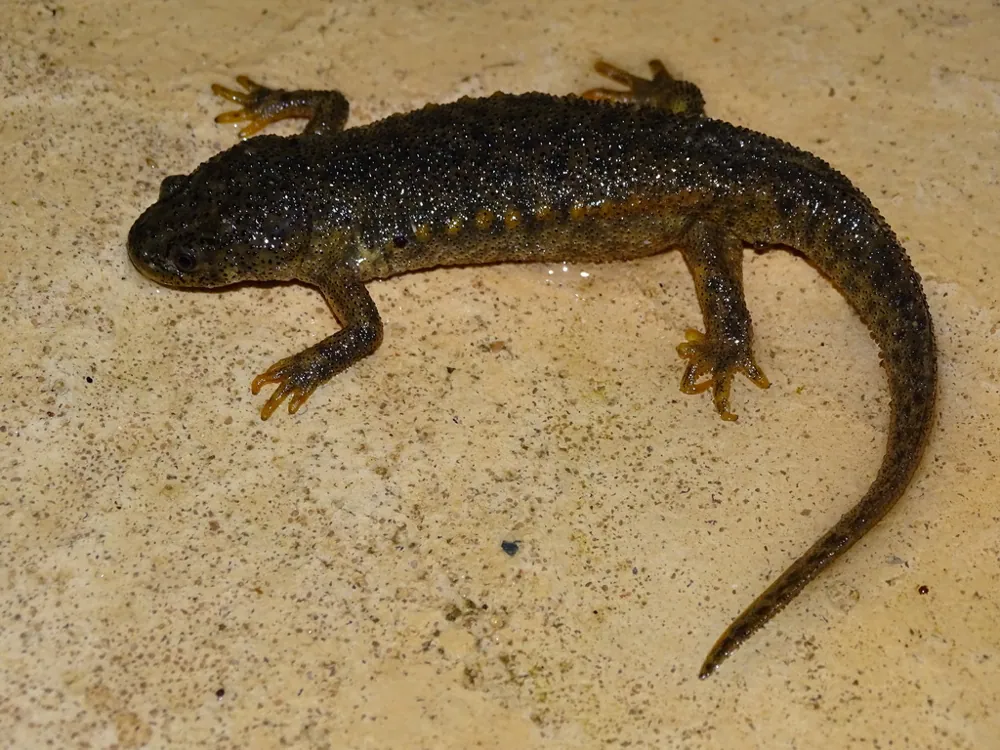
The Iberian ribbed newt is a salamander that lives in ponds and wells in Spain, Portugal and northern Morocco. It is the largest European newt species. When threatened, it can push its sharp ribs out through its skin, which gives it a way to defend itself against predators.1



 Ni ngay ko xàmmee
- Dark grey on its back and lighter grey on its belly, with small rust-coloured spots1
- Usually 8 to 10 orange, wart-like bumps (tubercles) running down each side of the body1
- Flat, spade-shaped head and a long tail, about half of its body length1
- Males are more slender and usually smaller than females1
- Larvae have bushy external gills and paler colours than adults1
Ñu ngi koy faral di jaxasoo ak: It is sometimes confused with the Iberian newt (Lissotriton boscai), a different species with a similar common name.1
Kàttanu daŋar
Ay dag yu ñaw ñoo yor daŋar bi. Teg tànk ci kawam walla jàpp ko dafay metti.
Lan la daŋar biy sóob di def?
When threatened, the newt releases a milky, thick poison from glands on its neck, back, sides and tail as its ribs push out. The poison coats the ribs, which can pierce the skin of a predator's mouth and inject toxins.1
Ni mu lore nit ñi?
Musiba ci nit: WoyofNi jamu yamb walla lu ko yées. Lu jege, amul lor ci nit.The rib defence is completely harmless to humans. The ribs cause only little harm to the newt itself, and its skin quickly heals without infection.1
Lan lay def bu tiitee?
It tries to run away from predators first. If it cannot escape, it pushes its sharp ribs through its sides and releases poison.1
 Su ay dagam jamee la
- Su kenn laalee benn: raxas loxo yi bu baax te bul laal bët yi walla gémmiñ gi. Su ab xale walla ab mala bu kër maree benn walla mu lekk benn: woo sa centre antipoison walla sa nimerob urgence.
Saa su nekk, woo jëkk sa nimerob urgence (112, 000, 911). Lii ay ndigal yu yaatu ci ndimbal yu jëkk la, du ndigalu doktoor. Li war a xam ci ndimbal yu jëkk
 Sàmmal sa bopp
- Bul laal mukk, bul jàpp, bul sonal ab rab bu àll, doonte bu ndaw la, te doonte dafa mel ni dafa nelaw walla dafa dee.
- May ko bérab. Su nga ko gisee, dalal, dellu ginnaaw ndànk-ndànk te bàyyi ko mu dem yoonam.
- Su ay dagam jamee la: dalal, bul yëngu, woo sa nimerob urgence (112, 000, 911) walla dem lopitaan ci gaaw. Bul fàtte ni mu meloon, ab nataal dina dimbali.
Du la wut. Dafay jëfandikoo daŋaram ngir jàpp lu muy lekk walla ngir aar boppam, te nëbbu moo ko gën a neex. Yeneen ci ni ngay sàmme sa bopp
Ni mu réye?
Ni mu guddoo?
 guddu na ni 9 bloku tabax yu ñu toftale
Iberian ribbed newt ni mu réye ci wetu YOW?
Ay waññ rekk ci sa navigateur. Dara du denc te dara du yónnee fenn.
Ni mu gaawe?


Xibaar
Its ribs can push through its skin to act as a defence, a primitive and rudimentary form of envenomation.1
It is a model animal for regeneration research. It can regrow lost limbs, injured heart tissue, brain cells, eye lenses and parts of its spinal cord.1
This newt has been sent into space on at least six missions, starting in 1985.1
In genetic males and females, temperature can override sex chromosomes. Some ZW larvae reared at 32 °C (90 °F) become functional males.1
Its immune system, rib-coated collagen and antimicrobial peptides let the pierced skin heal quickly without infection.1
Females can keep live sperm in their cloaca for up to five months.1
Tasukatu léeb
Xalaat bu juum: The newt's ribs and poison are dangerous to people.
Dëgg: The ribs and poison are a defence against predators. The rib defence is completely harmless to humans.1
Ngir boroom xam-xam ci daŋar
- Turu xam-xam
- Pleurodeles waltl
- Mbooloo
- Mbott yu am daŋar, crapaud ak triton
- Njaboot
- Salamandridae2
- Toftal
- Caudata
- Kontinaa yi
- Tugal, Afrig
- Liir yi
- The young are born in water as larvae, breathing through gills. They lose their gills as their limbs grow and can then live on land as well as in water.1
- Ni mu nekke ci àll bi
- Least Concern (IUCN, assessed October 2020)1
- Musiba ci nit
- 1 / 5: Woyof3
Fa xibaar yi jóge
- Iberian ribbed newt (Wikipedia (CC BY-SA 4.0))
- Pleurodeles waltl (iNaturalist): tur ak ni ñu leen séddale.
- Venom Wiki: tolluwaayu musiba bi, réyaay bu yem bi ak xalaatu gaawaay bi, nun ñoo leen defar. Seetal ni nu leen waññe: Ni nuy natte musiba.
Xibaar bu nekk ci xët wii am na ab nimero buy won fa mu jóge. Su nu juumee, baal nu, nun ay nit ñu bëgg rab lanu, du ab jurnaalu xam-xam. Wax nu ko ci [email protected] te dinanu ko jubbanti.
 Jiit bi dafa xiif! Venom Wiki ab liggéeyu kenn la: amul pay, amul piblisite te amul traceur. Ab may bu tuuti dafay dimbali ngir mu des ci internet.Leel jiit bi
Yeneen ci mbooloo mi: Mbott yu am daŋar, crapaud ak triton
 Fire salamanderMbott yu am daŋar, crapaud ak tritonDafay metti rekkBul laal
 Common toadMbott yu am daŋar, crapaud ak tritonDafay metti rekkBul laal
 European fire-bellied toadMbott yu am daŋar, crapaud ak tritonAmul lor
 Golden mantellaMbott yu am daŋar, crapaud ak tritonAmul lor
 Natterjack toadMbott yu am daŋar, crapaud ak tritonAmul lor
 Tomato frogMbott yu am daŋar, crapaud ak tritonAmul lor
Dafay dund itam ci: Tugal
 Common European adderVipèreSoxla na doktoor
 Spanish flyYeneen rab yu am daŋar ci seen yaramSoxla na doktoorBul laal
 Common waspYamb, guêpe ak frelonDafay metti rekk
 European hornetYamb, guêpe ak frelonDafay metti rekk
 Western honey beeYamb, guêpe ak frelonDafay metti rekk
 Blunt-nosed viperVipèreMën na rey