
 Afrig
Afrig Asi
Asi Tugal
Tugal Amerig gu Bëj-saalum
 Ostarali ak Oseyani
 Antarktig
 Mbàmbulaanu Pasifik
 Mbàmbulaanu Atlantig
 Mbàmbulaanu End
 Mbàmbulaanu Arktik
 Géeju Mediteraane
 Géej gu Xonq
 Géeju Karayib
 Géeju Koraay
 Géeju Siin gu Bëj-saalum
 Géeju Filipin
 Géeju Andaman
 Géeju Bëj-gànnaar
 Géeju Timor ak Arafura
 Golfu Bengal
 Golfu Kaliforni
Mediterranean recluse
 Dafay màtt
The Mediterranean recluse spider is a small spider that comes from the Mediterranean region. It has spread to many parts of the world through human travel and trade, and it is listed as one of the most invasive spiders in the world. Its bite can cause skin damage, so it is worth knowing what it looks like.1

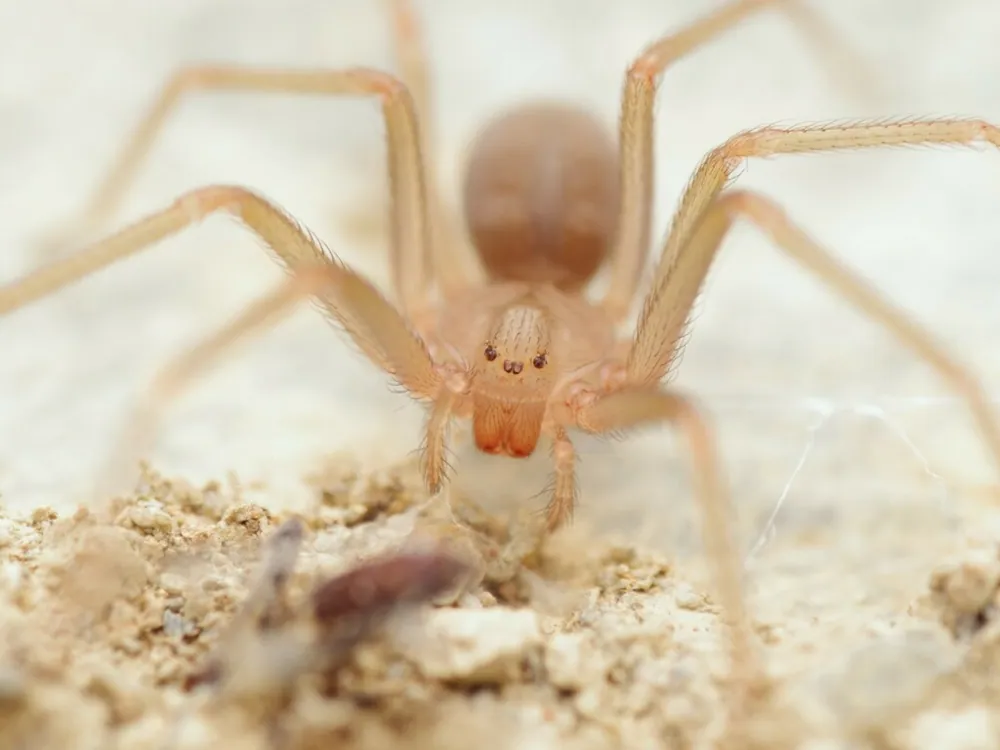
 Ni ngay ko xàmmee
- A medium-sized spider with three pairs of two eyes arranged in a triangle, instead of the usual eight eyes1
- A violin-shaped pattern on the front part of the body (cephalothorax)1
- Adults of both sexes grow to about 7 to 7.5 cm... no, 7 to 7.5 mm long1
- Its web is very thin and fragile, made of silk strands laid in a disorganised way1
Ñu ngi koy faral di jaxasoo ak: It is nearly indistinguishable in appearance from the brown recluse spider (Loxosceles reclusa). Pest control for one can often be adapted for the other.1
Kàttanu daŋar
Daŋar bi dafay génn ci bëñam yi su màttee.
Lan la daŋar biy sóob di def?
Its venom contains an enzyme called sphingomyelinase D, which causes necrosis, meaning the death of skin and other tissue around the bite. Most cases are medically insignificant. In some cases, penetrating pain starts 2 to 8 hours after the bite, followed by burning, and the area becomes red and painful. A blister may form that turns dark blue with a sunken centre over several days. In rare cases, the blood and kidneys can be damaged, which can lead to kidney failure.1
Ni mu lore nit ñi?
Musiba ci nit: Dafay mettiMën na metti lool, waaye lu bon du faral di am.Most bites are medically insignificant, but some people are affected much more seriously. In 2024, the species was blamed for the deaths of two people in Italy.1
 Su màttee
- Raxas fa mu màtt te teg ci mbuusu galaas ngir metit wi. Wutal ndimbal doktoor su metit wi dëgëree, mu law, walla yaramu nit ki baaxul.
Saa su nekk, woo jëkk sa nimerob urgence (112, 000, 911). Lii ay ndigal yu yaatu ci ndimbal yu jëkk la, du ndigalu doktoor. Li war a xam ci ndimbal yu jëkk
 Sàmmal sa bopp
- Bul laal mukk, bul jàpp, bul sonal ab rab bu àll, doonte bu ndaw la, te doonte dafa mel ni dafa nelaw walla dafa dee.
- May ko bérab. Su nga ko gisee, dalal, dellu ginnaaw ndànk-ndànk te bàyyi ko mu dem yoonam.
- Su benn màttee la: dalal, bul yëngu, woo sa nimerob urgence (112, 000, 911) walla dem lopitaan ci gaaw. Bul fàtte ni mu meloon, ab nataal dina dimbali.
Du la wut. Dafay jëfandikoo daŋaram ngir jàpp lu muy lekk walla ngir aar boppam, te nëbbu moo ko gën a neex. Yeneen ci ni ngay sàmme sa bopp
Ni mu réye?
Ni mu guddoo?
 tuuti ba mën a toog ci sa wewu baaraam
Mediterranean recluse ni mu réye ci wetu YOW?
Ay waññ rekk ci sa navigateur. Dara du denc te dara du yónnee fenn.
Ni mu gaawe?


Xibaar
It is listed as one of the most invasive spiders in the world.1
It can survive for long periods without food and water, which makes it hard to control in homes.1
Young spiders shed their skins several times as they grow, and these skins often look pale and ghostly.1
Males hunt more actively than females, partly because they are also searching for a mate.1
Ngir boroom xam-xam ci daŋar
- Turu xam-xam
- Loxosceles rufescens
- Mbooloo
- Jargoñ
- Njaboot
- Sicariidae2
- Toftal
- Araneae
- Kontinaa yi
- Tugal, Asi, Afrig
- Liir yi
- Egg sacs contain about 40 eggs, which take a few weeks to hatch, depending on the temperature.1
- Ni mu nekke ci àll bi
- Least Concern (South African National Biodiversity Institute)1
- Musiba ci nit
- 2 / 5: Dafay metti3
Fa xibaar yi jóge
- Mediterranean recluse spider (Wikipedia (CC BY-SA 4.0))
- Loxosceles rufescens (iNaturalist): tur ak ni ñu leen séddale.
- Venom Wiki: tolluwaayu musiba bi, réyaay bu yem bi ak xalaatu gaawaay bi, nun ñoo leen defar. Seetal ni nu leen waññe: Ni nuy natte musiba.
Xibaar bu nekk ci xët wii am na ab nimero buy won fa mu jóge. Su nu juumee, baal nu, nun ay nit ñu bëgg rab lanu, du ab jurnaalu xam-xam. Wax nu ko ci [email protected] te dinanu ko jubbanti.
 Jiit bi dafa xiif! Venom Wiki ab liggéeyu kenn la: amul pay, amul piblisite te amul traceur. Ab may bu tuuti dafay dimbali ngir mu des ci internet.Leel jiit bi
Yeneen ci mbooloo mi: Jargoñ
 Mediterranean black widow
 Six-eyed sand spider
 Brown widow
 Diving bell spider
 European yellow sac spider
 Noble false widow
Dafay dund itam ci: Tugal
 Common European adderVipèreSoxla na doktoor
 Spanish flyYeneen rab yu am daŋar ci seen yaramSoxla na doktoorBul laal
 Common waspYamb, guêpe ak frelonDafay metti rekk
 European hornetYamb, guêpe ak frelonDafay metti rekk
 Fire salamanderMbott yu am daŋar, crapaud ak tritonDafay metti rekkBul laal
 Western honey beeYamb, guêpe ak frelonDafay metti rekk