
 Afrig
Afrig Asi
Asi Tugal
Tugal Amerig gu Bëj-saalum
 Ostarali ak Oseyani
 Antarktig
 Mbàmbulaanu Pasifik
 Mbàmbulaanu Atlantig
 Mbàmbulaanu End
 Mbàmbulaanu Arktik
 Géeju Mediteraane
 Géej gu Xonq
 Géeju Karayib
 Géeju Koraay
 Géeju Siin gu Bëj-saalum
 Géeju Filipin
 Géeju Andaman
 Géeju Bëj-gànnaar
 Géeju Timor ak Arafura
 Golfu Bengal
 Golfu Kaliforni
Northeastern Brazilian scorpion
 Dafay jam
The Northeastern Brazilian scorpion is a venomous scorpion that lives in northeastern Brazil. It is golden-tan or yellowish-brown and grows to about the length of a finger. Its sting can cause serious symptoms, so it should be left alone.1

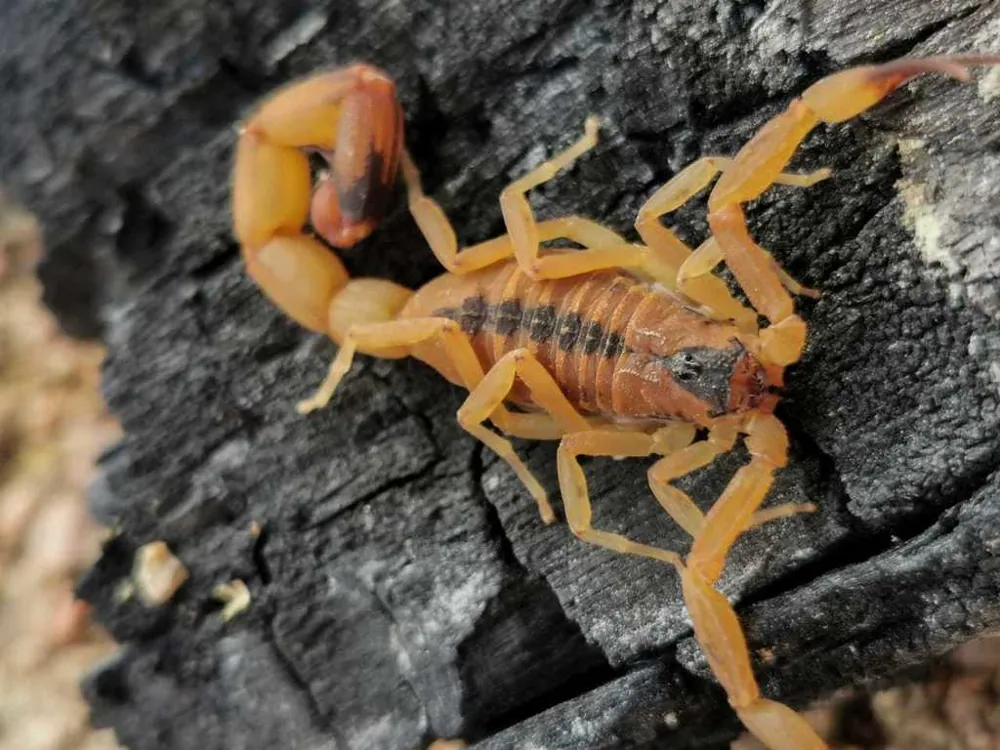
 Ni ngay ko xàmmee
Kàttanu daŋar
Daŋar bi dafay génn ci ab dag buy jam.
Lan la daŋar biy sóob di def?
The venom contains the neurotoxins Tst1 and Tst26, which act on the nerves. Lab tests on mice give an LD50 of 0.575 mg/kg, a measure of how strong a venom is, which is significant. Reported symptoms include local pain, numbness, swelling, burning and itching, plus sweating, headache, vomiting, nausea, tremors, agitation, dizziness, low blood pressure and difficulty breathing.1
Ni mu lore nit ñi?
Musiba ci nit: Lu bonJam laaj na doktoor. Ñi ciy dee dañoo néew lool.A study in Bahia state, Brazil, recorded 237 people stung by this species between January 1982 and December 1995. Symptoms were recorded for only 90 of them, so the full picture is unclear.1
 Su jamee
- Put an ice pack on the sting to cool it. Go to hospital and ask to be checked for serious complications such as acute kidney injury and pancreatitis. Venom extraction kits were tested and found not to work; they can cause more damage to the wound because of the suction.1
- Sedalal fa mu jam ak mbuusu galaas, te def ba nit ki bañ a yëngu. Wutal ndimbal doktoor ci gaaw, rawatina ngir xale yi: am na ay jiit yuy rey xale.
Saa su nekk, woo jëkk sa nimerob urgence (112, 000, 911). Lii ay ndigal yu yaatu ci ndimbal yu jëkk la, du ndigalu doktoor. Li war a xam ci ndimbal yu jëkk
 Sàmmal sa bopp
- Bul laal mukk, bul jàpp, bul sonal ab rab bu àll, doonte bu ndaw la, te doonte dafa mel ni dafa nelaw walla dafa dee.
- May ko bérab. Su nga ko gisee, dalal, dellu ginnaaw ndànk-ndànk te bàyyi ko mu dem yoonam.
- Su benn jamee la: dalal, bul yëngu, woo sa nimerob urgence (112, 000, 911) walla dem lopitaan ci gaaw. Bul fàtte ni mu meloon, ab nataal dina dimbali.
Du la wut. Dafay jëfandikoo daŋaram ngir jàpp lu muy lekk walla ngir aar boppam, te nëbbu moo ko gën a neex. Yeneen ci ni ngay sàmme sa bopp
Ni mu réye?
Ni mu guddoo?
 guddu na ni 2 bloku tabax yu ñu toftale
 mën na daw 100 meetar ci 260 segond (nit ki gën a gaaw soxla na 9,6)
Northeastern Brazilian scorpion ni mu réye ci wetu YOW?
Ay waññ rekk ci sa navigateur. Dara du denc te dara du yónnee fenn.
Ni mu gaawe?


Xibaar
Females can reproduce without a male, a process called facultative parthenogenesis.1
It does not need to drink water, because it gets moisture from its prey.1
Its venom contains two neurotoxins, Tst1 and Tst26, which affect the nerves.1
Females can have as many as 16 young in one brood, with an average of 8.1
It takes about a year for this scorpion to mature into an adult, which makes it a fast-growing species.1
Ngir boroom xam-xam ci daŋar
- Turu xam-xam
- Tityus stigmurus
- Mbooloo
- Jiit yi
- Njaboot
- Buthidae2
- Toftal
- Scorpiones
- Kontinaa yi
- Amerig gu Bëj-saalum
- Liir yi
- Females give birth to live young, usually 2 to 16 at a time, with an average of 8. Pregnancy typically lasts about 3 months, and can be as long as 4 to 5 months.1
- Musiba ci nit
- 3 / 5: Lu bon3
Fa xibaar yi jóge
- Tityus stigmurus (Wikipedia (CC BY-SA 4.0))
- Tityus stigmurus (iNaturalist): tur ak ni ñu leen séddale.
- Venom Wiki: tolluwaayu musiba bi, réyaay bu yem bi ak xalaatu gaawaay bi, nun ñoo leen defar. Seetal ni nu leen waññe: Ni nuy natte musiba.
Xibaar bu nekk ci xët wii am na ab nimero buy won fa mu jóge. Su nu juumee, baal nu, nun ay nit ñu bëgg rab lanu, du ab jurnaalu xam-xam. Wax nu ko ci [email protected] te dinanu ko jubbanti.
 Jiit bi dafa xiif! Venom Wiki ab liggéeyu kenn la: amul pay, amul piblisite te amul traceur. Ab may bu tuuti dafay dimbali ngir mu des ci internet.Leel jiit bi
 Brazilian yellow scorpion
 Amazonian black scorpion
 Caracas scorpion
 Panamanian black scorpion
 Zulia scorpion
 Amazon forest scorpion
 Golden poison frog
 Terciopelo
 Brazilian wandering spider
 Eyelash viper
 Golden lancehead
 South American bushmaster