
 Afrig
Afrig Asi
Asi Tugal
Tugal Amerig gu Bëj-saalum
 Ostarali ak Oseyani
 Antarktig
 Mbàmbulaanu Pasifik
 Mbàmbulaanu Atlantig
 Mbàmbulaanu End
 Mbàmbulaanu Arktik
 Géeju Mediteraane
 Géej gu Xonq
 Géeju Karayib
 Géeju Koraay
 Géeju Siin gu Bëj-saalum
 Géeju Filipin
 Géeju Andaman
 Géeju Bëj-gànnaar
 Géeju Timor ak Arafura
 Golfu Bengal
 Golfu Kaliforni
Rough-skinned newt
 Daŋar ci deram
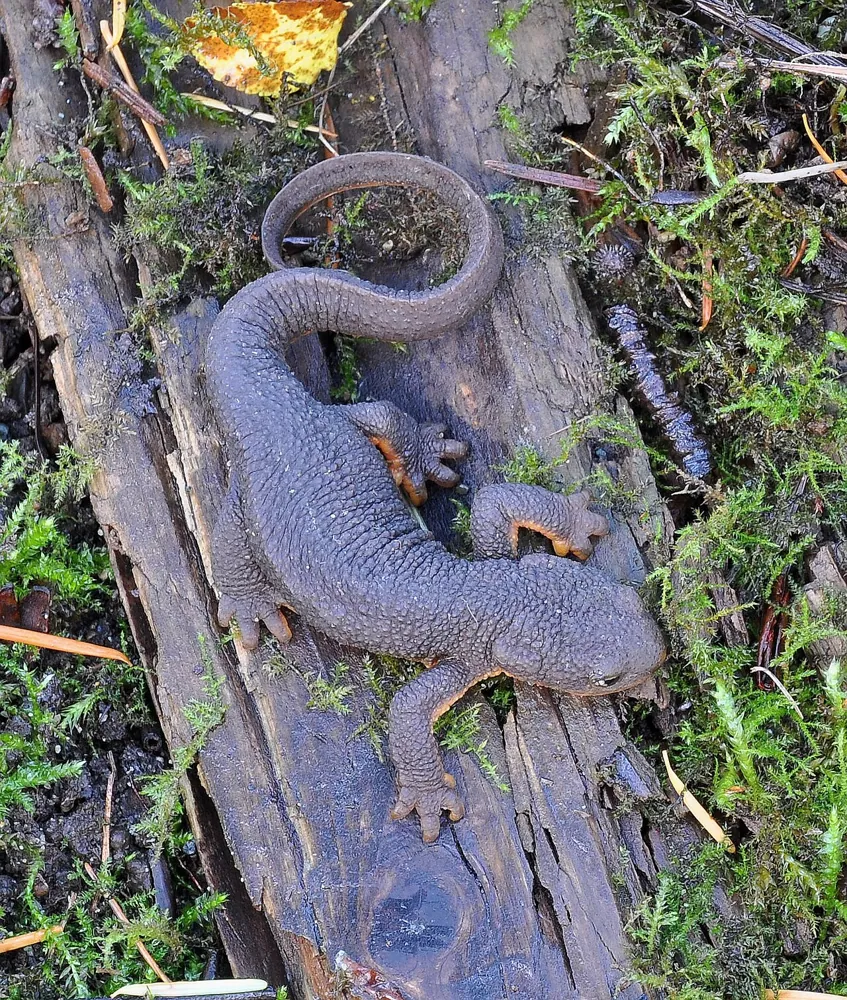
The rough-skinned newt is a small, stocky amphibian from the Pacific Northwest of North America. Its skin gives off one of the strongest toxins of any newt, so it is a creature to admire from a distance and never handle. Its toxin is also linked to a famous fight between newts and garter snakes.1
 Ni ngay ko xàmmee
- Stocky body with a rounded snout.1
- Top ranges from light brown to olive or brownish-black.1
- Underside, including the head, legs and tail, is orange to yellow.1
- Skin is granular, but males are smooth-skinned during the breeding season.1
- Adults are 11 to 18 cm long overall, including the tail.1
Ñu ngi koy faral di jaxasoo ak: The California newt (Taricha torosa) looks similar. The rough-skinned newt has smaller eyes, yellow irises, V-shaped tooth patterns and uniformly dark eyelids. During breeding season, males have large swollen vent lobes and cornified toe pads, which separate them from females.1
Kàttanu daŋar
Deram am na daŋar. Musiba la ci laal, mar walla lekk.
Lan la daŋar bi ci yaramam di def?
This animal is poisonous rather than venomous, so it does not bite or sting. Its skin produces tetrodotoxin (TTX), a neurotoxin that attacks the nerves. It blocks the sodium channels that nerves need to send signals. This can cause paralysis and death by asphyxiation, which means the person cannot breathe.1
Ni mu lore nit ñi?
Musiba ci nit: Am na musiba loolMën na rey nit ku ñu fajul.The toxin is mainly dangerous if the newt is eaten. Some people have had skin irritation after handling the newt, especially if they touch their eyes without washing their hands first. In 1979, a 29-year-old man from Oregon died after eating one. Some newts make enough toxin to kill several adult humans.1
Lan lay def bu tiitee?
It gives off an acrid smell that warns animals to stay away.1
 Su kenn laalee ko walla mu lekk ko
- Su kenn laalee benn: raxas loxo yi bu baax te bul laal bët yi walla gémmiñ gi. Su ab xale walla ab mala bu kër maree benn walla mu lekk benn: woo sa centre antipoison walla sa nimerob urgence.
Saa su nekk, woo jëkk sa nimerob urgence (112, 000, 911). Lii ay ndigal yu yaatu ci ndimbal yu jëkk la, du ndigalu doktoor. Li war a xam ci ndimbal yu jëkk
 Sàmmal sa bopp
- Bul laal mukk, bul jàpp, bul sonal ab rab bu àll, doonte bu ndaw la, te doonte dafa mel ni dafa nelaw walla dafa dee.
- May ko bérab. Su nga ko gisee, dalal, dellu ginnaaw ndànk-ndànk te bàyyi ko mu dem yoonam.
- Su nga ko laalee walla nga lekk ko: bul moos say bët walla sa gémmiñ, raxas say loxo te wutal ndimbal doktoor.
Du la wut. Daŋaram nekk na rekk ngir kenn bañ ko lekk. Yeneen ci ni ngay sàmme sa bopp
Ni mu réye?
Ni mu guddoo?
 guddu na ni 6 bloku tabax yu ñu toftale
Rough-skinned newt ni mu réye ci wetu YOW?
Ay waññ rekk ci sa navigateur. Dara du denc te dara du yónnee fenn.
Ni mu gaawe?


Xibaar
Some common garter snakes can eat rough-skinned newts and survive. They are the only known animals today able to do this.1
A garter snake tests a newt's toxin level by partly swallowing it, then either swallows it fully or lets it go.1
Newts can detect the chemical signature of a snake that has digested one of their kind, and they move away from it.1
The toxin is made by the newt's skin microbiome, meaning the bacteria living on its skin.1
The newt and the garter snake are an example of an evolutionary arms race. Each change in one species drives change in the other.1
The toxin also appears in pufferfish and other marine animals, which share the same nerve-blocking effect.1
Ngir boroom xam-xam ci daŋar
Fa xibaar yi jóge
- Rough-skinned newt (Wikipedia (CC BY-SA 4.0))
- Taricha granulosa (iNaturalist): tur ak ni ñu leen séddale.
- Venom Wiki: tolluwaayu musiba bi, réyaay bu yem bi ak xalaatu gaawaay bi, nun ñoo leen defar. Seetal ni nu leen waññe: Ni nuy natte musiba.
Xibaar bu nekk ci xët wii am na ab nimero buy won fa mu jóge. Su nu juumee, baal nu, nun ay nit ñu bëgg rab lanu, du ab jurnaalu xam-xam. Wax nu ko ci [email protected] te dinanu ko jubbanti.
 Jiit bi dafa xiif! Venom Wiki ab liggéeyu kenn la: amul pay, amul piblisite te amul traceur. Ab may bu tuuti dafay dimbali ngir mu des ci internet.Leel jiit bi
Yeneen ci mbooloo mi: Mbott yu am daŋar, crapaud ak triton
 Cane toadMbott yu am daŋar, crapaud ak tritonSoxla na doktoorBul laal
 Strawberry poison-dart frogMbott yu am daŋar, crapaud ak tritonDafay metti rekkBul laal
 California newtMbott yu am daŋar, crapaud ak tritonMën na reyBul laal
 Colorado River toadMbott yu am daŋar, crapaud ak tritonSoxla na doktoorBul laal
 Panamanian golden frogMbott yu am daŋar, crapaud ak tritonSoxla na doktoorBul laal
 Eastern newtMbott yu am daŋar, crapaud ak tritonDafay metti rekkBul laal
 Terciopelo
 Eastern coral snake
 Eastern diamondback rattlesnake
 Eyelash viper
 Timber rattlesnake
 Western diamondback rattlesnake
.JPG)