
 Afrig
Afrig Asi
Asi Tugal
Tugal Amerig gu Bëj-saalum
 Ostarali ak Oseyani
 Antarktig
 Mbàmbulaanu Pasifik
 Mbàmbulaanu Atlantig
 Mbàmbulaanu End
 Mbàmbulaanu Arktik
 Géeju Mediteraane
 Géej gu Xonq
 Géeju Karayib
 Géeju Koraay
 Géeju Siin gu Bëj-saalum
 Géeju Filipin
 Géeju Andaman
 Géeju Bëj-gànnaar
 Géeju Timor ak Arafura
 Golfu Bengal
 Golfu Kaliforni
Savigny's long-spined urchin
 Dag yu am daŋar
Savigny's long-spined urchin is a spiny sea animal that lives on reefs and in shallow lagoons. It has very long, thin spines that can grow up to 25 cm, and it comes out at night to graze on algae. Its spines are the part that can hurt people, so it is worth giving it plenty of room.1


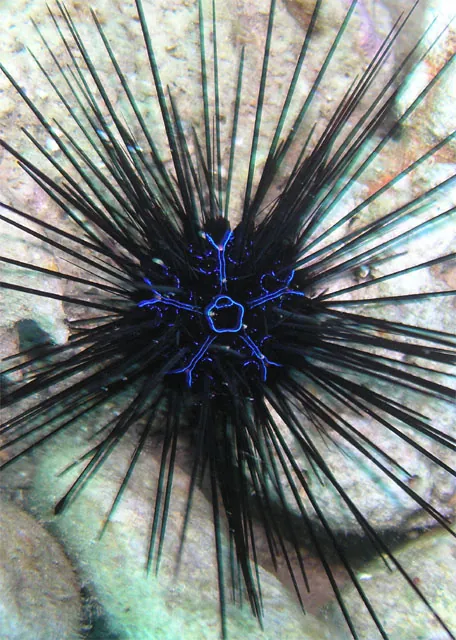
 Ni ngay ko xàmmee
- Usually black, with a rounded body (called a test) up to about 9 cm across1
- Long, thin, hollow spines that grow in tufts and can reach 25 cm; they are usually black but can be grey, dark brown or purple1
- Juveniles may have bands of lighter and darker shades, and the occasional individual is completely white1
- Iridescent green or blue lines around the interambulacral areas and around the periproct (the cone-shaped region surrounding the anus)1
Ñu ngi koy faral di jaxasoo ak: It is very similar to Diadema setosum, which shares much of its range and often lives in the same groups. Savigny's long-spined urchin lacks the thin orange ring around the periproct that Diadema setosum has.1
Kàttanu daŋar
Ay dag yu ñaw ñoo yor daŋar bi. Teg tànk ci kawam walla jàpp ko dafay metti.
Ni mu lore nit ñi?
Musiba ci nit: Dafay mettiMën na metti lool, waaye lu bon du faral di am.Lan lay def bu tiitee?
When a shadow falls on it, it angles its spines towards the possible attacker.1
 Su ay dagam jamee la
- Teg gaañu-gaañu bi ci ndox mu tàng, lu nit ki mën a muñ waaye bu dul ko lakk, te wutal ndimbal doktoor ngir dindi dag yi. Bul gas ngir wut leen sa bopp.
Saa su nekk, woo jëkk sa nimerob urgence (112, 000, 911). Lii ay ndigal yu yaatu ci ndimbal yu jëkk la, du ndigalu doktoor. Li war a xam ci ndimbal yu jëkk
 Sàmmal sa bopp
- Bul laal mukk, bul jàpp, bul sonal ab rab bu àll, doonte bu ndaw la, te doonte dafa mel ni dafa nelaw walla dafa dee.
- May ko bérab. Su nga ko gisee, dalal, dellu ginnaaw ndànk-ndànk te bàyyi ko mu dem yoonam.
- Su ay dagam jamee la: dalal, bul yëngu, woo sa nimerob urgence (112, 000, 911) walla dem lopitaan ci gaaw. Bul fàtte ni mu meloon, ab nataal dina dimbali.
Du la wut. Dafay jëfandikoo daŋaram ngir jàpp lu muy lekk walla ngir aar boppam, te nëbbu moo ko gën a neex. Yeneen ci ni ngay sàmme sa bopp
Fan ci àddina?
Ni mu réye?
Ni mu guddoo?
 guddu na ni 3 bloku tabax yu ñu toftale
 gën a yéex escargot bu tóokër
Savigny's long-spined urchin ni mu réye ci wetu YOW?
Ay waññ rekk ci sa navigateur. Dara du denc te dara du yónnee fenn.
Ni mu gaawe?


Xibaar
Its spines are brittle, thin and hollow, and grow in tufts that can be as long as 25 cm.1
Small fish such as cardinal fish, flatworms and shrimps sometimes shelter among its long spines.1
It spawns just after the full moon, while its close relative Diadema setosum mostly spawns around days eight to ten of the lunar cycle, which keeps the two species from interbreeding.1
Its grazing helps control algae, which might otherwise smother corals.1
It is nocturnal, hiding in crevices or under boulders by day, though several individuals sometimes huddle together in the open.1
Its predators include pufferfish, porcupinefish, lobsters and snails.1
Ngir boroom xam-xam ci daŋar
- Turu xam-xam
- Diadema savignyi
- Mbooloo
- Oursin, biddiwu géej ak ver
- Njaboot
- Diadematidae2
- Toftal
- Diadematoida
- Kontinaa yi
- Mbàmbulaanu End, Mbàmbulaanu Pasifik, Géej gu Xonq, Géeju Arabi ak Golfu Pers, Géeju Timor ak Arafura, Golfu Bengal, Mbàmbulaan yi
- Liir yi
- It does not have live young. Instead it releases eggs and sperm into the water (spawning), mainly during the north-east monsoon period, peaking in May, and timed to the lunar cycle.1
- Musiba ci nit
- 2 / 5: Dafay metti3
Fa xibaar yi jóge
- Diadema savignyi (Wikipedia (CC BY-SA 4.0))
- Diadema savignyi (iNaturalist): tur ak ni ñu leen séddale.
- Venom Wiki: tolluwaayu musiba bi, réyaay bu yem bi ak xalaatu gaawaay bi, nun ñoo leen defar. Seetal ni nu leen waññe: Ni nuy natte musiba.
Xibaar bu nekk ci xët wii am na ab nimero buy won fa mu jóge. Su nu juumee, baal nu, nun ay nit ñu bëgg rab lanu, du ab jurnaalu xam-xam. Wax nu ko ci [email protected] te dinanu ko jubbanti.
 Jiit bi dafa xiif! Venom Wiki ab liggéeyu kenn la: amul pay, amul piblisite te amul traceur. Ab may bu tuuti dafay dimbali ngir mu des ci internet.Leel jiit bi
Yeneen ci mbooloo mi: Oursin, biddiwu géej ak ver
 Crown-of-thorns starfishOursin, biddiwu géej ak verSoxla na doktoorBul laal
 Flower urchinOursin, biddiwu géej ak verMën na rey
 Fire urchinOursin, biddiwu géej ak verSoxla na doktoorBul laal
 Bearded firewormOursin, biddiwu géej ak verDafay metti rekkBul laal
 Black long-spined urchinOursin, biddiwu géej ak verDafay metti rekkBul laal
 BloodwormOursin, biddiwu géej ak verDafay metti rekk
Dafay dund itam ci: Mbàmbulaanu End
 Australian box jellyfishMéduse ak mbindeefi géej yuy jamMën a reyBul laal
 Geography coneCône ak pieuvreMën a rey
 Greater blue-ringed octopusCône ak pieuvreMën a rey
 Southern blue-ringed octopusCône ak pieuvreMën a rey
 Hawksbill sea turtleYeneen rab yu am daŋar ci seen yaramMën na rey
 Irukandji jellyfishMéduse ak mbindeefi géej yuy jamMën na reyBul laal