
 Afrig
Afrig Asi
Asi Tugal
Tugal Amerig gu Bëj-saalum
 Ostarali ak Oseyani
 Antarktig
 Mbàmbulaanu Pasifik
 Mbàmbulaanu Atlantig
 Mbàmbulaanu End
 Mbàmbulaanu Arktik
 Géeju Mediteraane
 Géej gu Xonq
 Géeju Karayib
 Géeju Koraay
 Géeju Siin gu Bëj-saalum
 Géeju Filipin
 Géeju Andaman
 Géeju Bëj-gànnaar
 Géeju Timor ak Arafura
 Golfu Bengal
 Golfu Kaliforni
Southern house spider
 Dafay màtt
The southern house spider is a large spider that lives in the Americas, from the southern United States to Argentina. It is often mistaken for the brown recluse, but it is not aggressive and rarely bites. Its males wander around looking for mates, and both sexes can squeeze through very narrow cracks.1

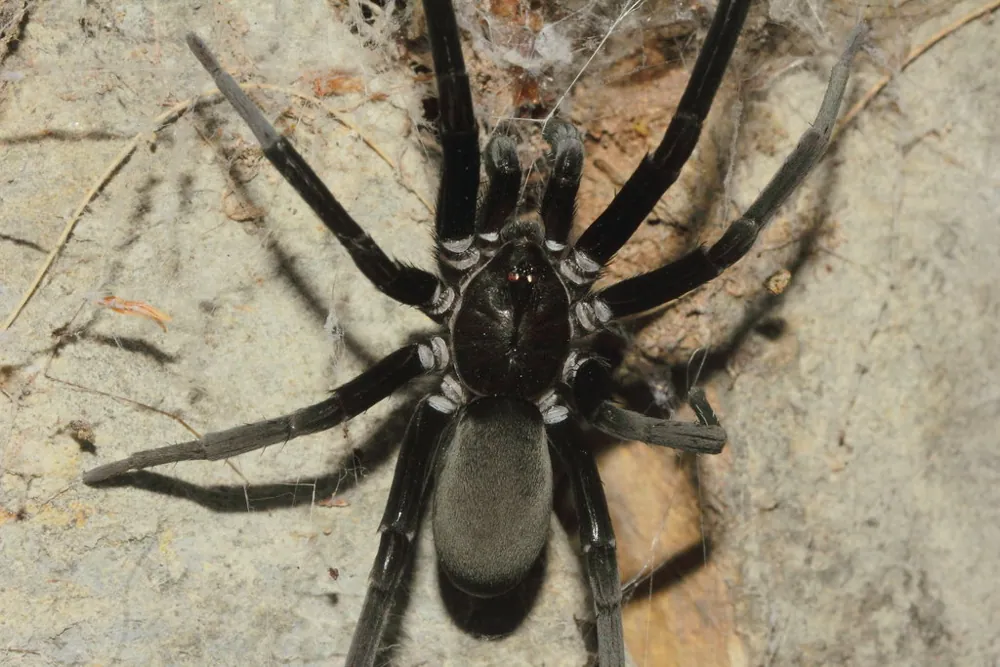
 Ni ngay ko xàmmee
- Females are dark brown or black and more compact in shape, with often larger, bulbous bodies.1
- Males have longer legs and unusually long, slender pedipalps (the leg-like feelers near the mouth).1
- Males lack the violin-shaped marking on the front part of the body that the brown recluse has.1
- The abdomen (rear part of the body) is covered in fine, velvety light grey hair.1
- Both sexes may grow to about 5.1 cm across with legs extended.1
Ñu ngi koy faral di jaxasoo ak: Males are often mistaken for the brown recluse because they have similar colours and body structure. Male southern house spiders are usually larger, have no violin shape on the front of the body, and have long, slender pedipalps.1
Kàttanu daŋar
Daŋar bi dafay génn ci bëñam yi su màttee.
Ni mu lore nit ñi?
Musiba ci nit: WoyofNi jamu yamb walla lu ko yées. Lu jege, amul lor ci nit.Males may seem aggressive, but they bite only when trapped. Their mouthparts are too small to easily get through human skin, so bites are unlikely to be harmful.1
Lan lay def bu tiitee?
When it feels threatened, it instinctively plays dead, a tactic that works well against its common predators.1
 Su màttee
- Raxas fa mu màtt te teg ci mbuusu galaas ngir metit wi. Wutal ndimbal doktoor su metit wi dëgëree, mu law, walla yaramu nit ki baaxul.
Saa su nekk, woo jëkk sa nimerob urgence (112, 000, 911). Lii ay ndigal yu yaatu ci ndimbal yu jëkk la, du ndigalu doktoor. Li war a xam ci ndimbal yu jëkk
 Sàmmal sa bopp
- Bul laal mukk, bul jàpp, bul sonal ab rab bu àll, doonte bu ndaw la, te doonte dafa mel ni dafa nelaw walla dafa dee.
- May ko bérab. Su nga ko gisee, dalal, dellu ginnaaw ndànk-ndànk te bàyyi ko mu dem yoonam.
- Su benn màttee la: dalal, bul yëngu, woo sa nimerob urgence (112, 000, 911) walla dem lopitaan ci gaaw. Bul fàtte ni mu meloon, ab nataal dina dimbali.
Du la wut. Dafay jëfandikoo daŋaram ngir jàpp lu muy lekk walla ngir aar boppam, te nëbbu moo ko gën a neex. Yeneen ci ni ngay sàmme sa bopp
Ni mu réye?
Ni mu guddoo?
 gën a gàtt sa baaraam bu ndaw
 mën na daw 100 meetar ci 330 segond (nit ki gën a gaaw soxla na 9,6)
Southern house spider ni mu réye ci wetu YOW?
Ay waññ rekk ci sa navigateur. Dara du denc te dara du yónnee fenn.
Ni mu gaawe?


Xibaar
It is a cribellate spider, meaning its silk is not sticky. Its web works by tangling silk into a velcro-like net.1
It can crawl through cracks as narrow as 0.66 cm, thanks to its long body and compact legs.1
It is almost blind, so it may crawl over anything in its path, living or not, without meaning to attack.1
Its mating ritual can last over an hour, with long pauses where neither spider moves much.1
Its family, Filistatidae, is known as the crevice weavers because the females build webs around cracks.1
Tasukatu léeb
Xalaat bu juum: Southern house spiders are aggressive and bite people often.
Dëgg: Males may look aggressive, but they bite only when trapped, and their mouthparts are too small to easily penetrate human skin. Their crawling over things is not aggression, as they cannot see larger animals.1
Fa xibaar yi jóge
- Southern house spider (Wikipedia (CC BY-SA 4.0))
- Kukulcania hibernalis (iNaturalist): tur ak ni ñu leen séddale.
- Venom Wiki: tolluwaayu musiba bi, réyaay bu yem bi ak xalaatu gaawaay bi, nun ñoo leen defar. Seetal ni nu leen waññe: Ni nuy natte musiba.
Xibaar bu nekk ci xët wii am na ab nimero buy won fa mu jóge. Su nu juumee, baal nu, nun ay nit ñu bëgg rab lanu, du ab jurnaalu xam-xam. Wax nu ko ci [email protected] te dinanu ko jubbanti.
 Jiit bi dafa xiif! Venom Wiki ab liggéeyu kenn la: amul pay, amul piblisite te amul traceur. Ab may bu tuuti dafay dimbali ngir mu des ci internet.Leel jiit bi
 Brazilian wandering spider
 Brown recluse
 Southern black widow
 Amazon wandering spider
 Chilean recluse
 Northern black widow
 Terciopelo
 Eastern coral snake
 Eastern diamondback rattlesnake
 Eyelash viper
 Timber rattlesnake
 Western diamondback rattlesnake