
 Afrig
Afrig Asi
Asi Tugal
Tugal Amerig gu Bëj-saalum
 Ostarali ak Oseyani
 Antarktig
 Mbàmbulaanu Pasifik
 Mbàmbulaanu Atlantig
 Mbàmbulaanu End
 Mbàmbulaanu Arktik
 Géeju Mediteraane
 Géej gu Xonq
 Géeju Karayib
 Géeju Koraay
 Géeju Siin gu Bëj-saalum
 Géeju Filipin
 Géeju Andaman
 Géeju Bëj-gànnaar
 Géeju Timor ak Arafura
 Golfu Bengal
 Golfu Kaliforni
Venezuelan suntiger
 Dafay màtt
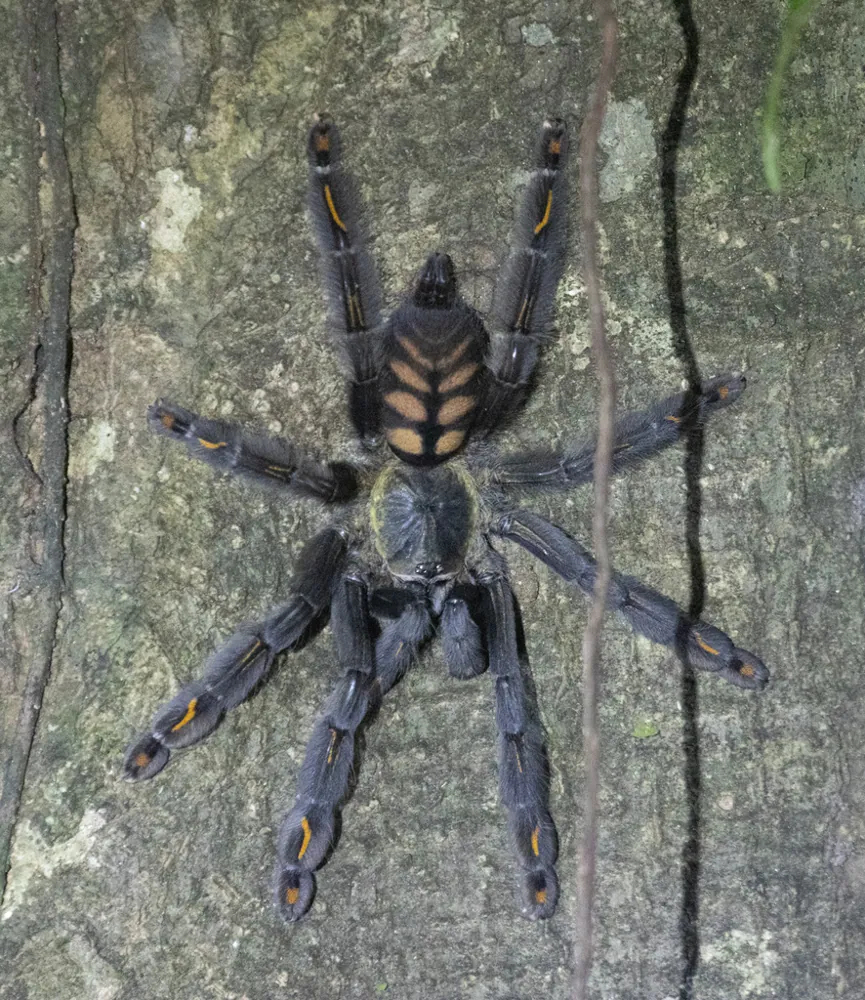
The Venezuelan suntiger is a tarantula that lives in the forests of northern South America. It spends much of its life in holes and crevices above ground, and it is a popular pet in the exotic pet trade. Its striking black and orange colours are the main reason it is so well known.1

 Ni ngay ko xàmmee
- Black, with vibrant orange markings on the abdomen and legs.1
- Adults of both sexes have orange 'flame' markings on the legs, and the abdomen has a chevron pattern.1
- Once mature, the male turns entirely grey or grey-brown, keeping orange only on the tarsi (the last leg segments).1
- Mature males have much 'leggier' proportions than females.1
- Spiderlings are orange-red on the carapace (the upper body shell), with black legs and a black abdomen. They gradually gain adult colours with each moult.1
Kàttanu daŋar
Daŋar bi dafay génn ci bëñam yi su màttee.
Ni mu lore nit ñi?
Musiba ci nit: Dafay mettiMën na metti lool, waaye lu bon du faral di am.Lan lay def bu tiitee?
When threatened, it may flee into its retreat or raise its front legs and show its fangs in a threat posture. If it cannot escape, it bites. It does not throw urticating hairs, unlike most New World tarantulas.1
 Su màttee
- Raxas fa mu màtt te sedal ko. Wutal ndimbal doktoor su metit wi dëgëree walla yaramu nit ki baaxul.
Saa su nekk, woo jëkk sa nimerob urgence (112, 000, 911). Lii ay ndigal yu yaatu ci ndimbal yu jëkk la, du ndigalu doktoor. Li war a xam ci ndimbal yu jëkk
 Sàmmal sa bopp
- Bul laal mukk, bul jàpp, bul sonal ab rab bu àll, doonte bu ndaw la, te doonte dafa mel ni dafa nelaw walla dafa dee.
- May ko bérab. Su nga ko gisee, dalal, dellu ginnaaw ndànk-ndànk te bàyyi ko mu dem yoonam.
- Su benn màttee la: dalal, bul yëngu, woo sa nimerob urgence (112, 000, 911) walla dem lopitaan ci gaaw. Bul fàtte ni mu meloon, ab nataal dina dimbali.
Du la wut. Dafay jëfandikoo daŋaram ngir jàpp lu muy lekk walla ngir aar boppam, te nëbbu moo ko gën a neex. Yeneen ci ni ngay sàmme sa bopp
Ni mu réye?
Ni mu guddoo?
 guddu na ni 4 bloku tabax yu ñu toftale
 mën na daw 100 meetar ci 210 segond (nit ki gën a gaaw soxla na 9,6)
Venezuelan suntiger ni mu réye ci wetu YOW?
Ay waññ rekk ci sa navigateur. Dara du denc te dara du yónnee fenn.
Ni mu gaawe?


Xibaar
Adult males change colour dramatically after their final moult, turning from black with orange to mostly grey.1
The undersides of its tarsi and metatarsi are iridescent, and they are visible during its threat display, which probably helps the display work.1
Psalmopoeus species lack the urticating hairs that most New World tarantulas use to defend themselves.1
Mature males spin special sperm webs, onto which they deposit sperm and then store it in their palpal bulbs (copulatory organs) ready for mating.1
The species is classed as a Psalmopoeus because it has stridulatory setae, also called a lyra, on its maxillae. No other described New World species has this trait.1
Fa xibaar yi jóge
- Psalmopoeus irminia (Wikipedia (CC BY-SA 4.0))
- Psalmopoeus irminia (iNaturalist): tur ak ni ñu leen séddale.
- Venom Wiki: tolluwaayu musiba bi, réyaay bu yem bi ak xalaatu gaawaay bi, nun ñoo leen defar. Seetal ni nu leen waññe: Ni nuy natte musiba.
Xibaar bu nekk ci xët wii am na ab nimero buy won fa mu jóge. Su nu juumee, baal nu, nun ay nit ñu bëgg rab lanu, du ab jurnaalu xam-xam. Wax nu ko ci [email protected] te dinanu ko jubbanti.
 Jiit bi dafa xiif! Venom Wiki ab liggéeyu kenn la: amul pay, amul piblisite te amul traceur. Ab may bu tuuti dafay dimbali ngir mu des ci internet.Leel jiit bi
Yeneen ci mbooloo mi: Tarentule ak atrax
 Goliath birdeaterTarentule ak atraxDafay metti rekk
 Brazilian salmon pink birdeaterTarentule ak atraxAmul lor
 Chilean rose tarantulaTarentule ak atraxAmul lor
 Greenbottle blue tarantulaTarentule ak atraxAmul lor
 Pinktoe tarantulaTarentule ak atraxAmul lor
 Brazilian funnel-web spiderTarentule ak atraxSoxla na doktoor
 Golden poison frog
 Terciopelo
 Brazilian wandering spider
 Eyelash viper
 Golden lancehead
 South American bushmaster