
 IAfrika
 IAsiya
 IYurophu
 uMzantsi Melika
 IOstreliya neOceania
 IAntarctica
 uLwandlekazi lwePasifiki
 uLwandlekazi lweAtlantiki
 uLwandlekazi lwaseIndiya
 uLwandlekazi lweArctic
 uLwandle lweMeditera
 uLwandle oluBomvu
 uLwandle lweKharibhiya
 uLwandle lweCoral
 uLwandle lwaseMzantsi China
 uLwandle lwePhilippines
 uLwandle lweAndaman
 uLwandle lwaseMntla (North Sea)
 uLwandle lweTimor ne-Arafura
 iBhayi yaseBengal
 iGulf yaseCalifornia
Oriental fire-bellied toad
 Ityhefu esikhumbeni sasoSitya: IzinambuzaneSiyatyhefa, asinatyhefu yokuluma okanye yokuhlaba
The Oriental fire-bellied toad is a small frog that lives in northeastern Asia, mostly near slow streams, ponds and forests. Its bright belly is a warning: when it is disturbed, it gives off a mild toxin through its skin. It is common across much of its range.1



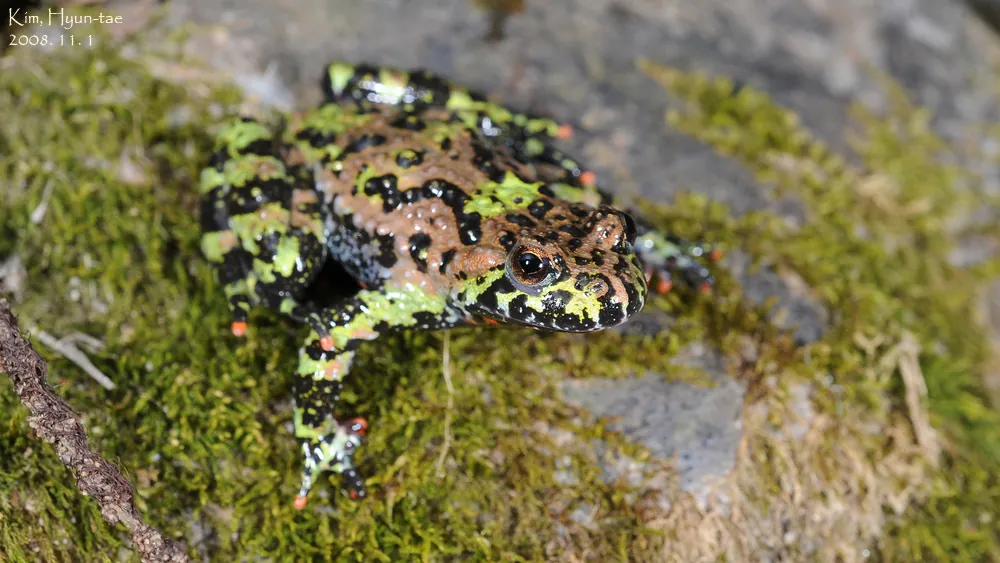
 Indlela yokusiqaphela
- Bright grey, brownish or green upper skin with black mottling.1
- Bright yellow, red or orange-red belly, mottled with dark spots.1
- Red finger and toe tips are usually present.1
- Skin on the upper side is covered in small bumps called tubercles, which give it a toad-like look.1
- Adults are about 3.8 to 5.1 cm long.1
Sidla ngokubhidaniswa no: It is often mistaken for a toad, but it is not a true toad. Compared with other Bombina frogs, it has no gular sacs (throat pouches), its belly is usually more red than yellow, and it has bright finger tips.1
Amandla etyhefu
Isikhumba saso siyatyhefa. Kuyingozi ukusichukumisa, ukusikhotha okanye ukusitya.
Ityhefu yaso etyhefayo (xa usichukumisa okanye usitya) yenza ntoni?
The toad's skin releases a milky, mildly toxic substance when it is disturbed or frightened, mostly from the hind legs and sometimes the belly. Its toxins are described as mild, and the toxin does not pose a significant threat to human health. Captive toads are generally less toxic than wild ones, because their diet in the wild adds to their toxicity.1
Siyingozi kangakanani ebantwini?
Ingozi ebantwini: KuthambileNjengokuhlatywa yinyosi okanye ngaphantsi. Phantse asinangozi ebantwini.The toxin does not pose a significant threat to human health, but its skin mucus can cause discomfort to the mouth and eyes if the toad is handled.1
Senza ntoni xa soyika?
When threatened, it releases toxin from its skin, lies on its back to show its brightly coloured belly, and arches its head and holds up its limbs as a warning.1
 Ukuba umntu usichukumisile okanye usityile
- Ukuba umntu usichukumisile: hlamba izandla kakuhle kwaye ungachukumisi amehlo okanye umlomo. Ukuba umntwana okanye isilwanyana sasekhaya sisikhothile okanye sisityile: tsalela iziko lezityhefu okanye inombolo kaxakeka.
Soloko utsalela inombolo kaxakeka kuqala (112, 000, 911). Esi sisikhokelo soncedo lokuqala ngokubanzi, asilocebiso lwezonyango. Iziseko zoncedo lokuqala
 Hlala ukhuselekile
- Ungaze uchukumise, ubambe okanye uqhule isilwanyana sasendle, nokuba sincinci, kwaye nokuba sibonakala silele okanye sifile.
- Sinike indawo. Ukuba udibana naso, hlala uzolile, buyela umva kancinci kwaye usiyeke sihambe ngendlela yaso.
- Ukuba usichukumisile okanye usityile: musa ukukhuhla amehlo okanye umlomo wakho, hlamba izandla zakho kwaye ufumane uncedo lwezonyango.
Asikuzingeli. Ityhefu yaso ikhona nje ukuze kungabikho nto isityayo. Okungakumbi malunga nokuhlala ukhuselekile
Sikhulu kangakanani?
Side kangakanani?
Sinzima kangakanani?
 mfutshane kunomnwe wakho omncinci
 singagqiba iimitha ezili-100 ngemizuzwana eyi-180 (owona mntu ukhawulezayo udinga i-9,6)
U-Oriental fire-bellied toad mkhulu kangakanani xa uthelekisa NAWE?
Zizibalo nje kwibhrawuza yakho. Akukho nto igcinwayo okanye ithunyelwa naphi na.
Sikhawuleza kangakanani?


Iinyaniso
Unusually for a frog, this species has no eardrum or resonator, and it makes its calls by inhaling.1
In experiments, these toads learned to solve mazes using water as a reward, which other frog types did not manage.1
Its skin contains bombesin, a peptide that affects stomach function in mammals. It was first found in its relative, the European fire-bellied toad.1
Males call to females with a light sound that is compared to a musical triangle.1
Grass snakes and other water-dwelling snakes are known to eat these toads without any ill effect.1
In captivity they often live for around 12 years, and some have lived up to 30 years.1
Umqhekezi weentsomi
Intsomi: It is a true toad.
Inyaniso: It is not a true toad, although its bumpy skin gives it a toad-like appearance.1
Kwiingcali zetyhefu
- Igama lenzululwazi
- Bombina orientalis
- Iqela
- Amasele atyhefayo, amaxoxo nee-newt
- Usapho
- Bombinatoridae2
- Ucwangco
- Anura
- Amazwekazi
- IAsiya
- Iintsana
- Females lay 40 to 110 eggs in a large cluster near the surface of the water.1
- Ixesha lobomi
- malunga neminyaka eyi-121
- Imeko yaso endle
- Least Concern1
- Ingozi ebantwini
- 1 / 5: Kuthambile3
Apho iinyaniso zivela khona
- Oriental fire-bellied toad (Wikipedia (CC BY-SA 4.0))
- Bombina orientalis (iNaturalist): amagama nokuhlelwa.
- Venom Wiki: inqanaba lengozi, ubungakanani obuqhelekileyo noqikelelo lwesantya zezethu. Bona indlela esizifumana ngayo: Indlela esilinganisa ngayo ingozi.
Inyaniso nganye kweli phepha inenombolo ebonisa umthombo wayo. Ukuba senze impazamo, uxolo, sithanda izilwanyana, asiyomagazini yenzululwazi. Sixelele ku-[email protected] kwaye siza kuyilungisa.
 Unomadudwane ulambile! I-Venom Wiki yiprojekthi yomntu omnye: isimahla, ayinazibhengezo kwaye ayinazilandeli. Isipho esincinci sinceda ukuyigcina ikwi-intanethi.Yondla unomadudwane
Okungakumbi kwiqela elinye: Amasele atyhefayo, amaxoxo nee-newt
 Japanese fire-bellied newtAmasele atyhefayo, amaxoxo nee-newtKufuna ugqirhaMusa ukuchukumisa
 Common toadAmasele atyhefayo, amaxoxo nee-newtKubuhlungu njeMusa ukuchukumisa
 Asian common toadAmasele atyhefayo, amaxoxo nee-newtKufuna ugqirhaMusa ukuchukumisa
 Asiatic toadAmasele atyhefayo, amaxoxo nee-newtKubuhlungu njeMusa ukuchukumisa
 Emperor newtAmasele atyhefayo, amaxoxo nee-newtKubuhlungu njeMusa ukuchukumisa
 Himalayan newtAmasele atyhefayo, amaxoxo nee-newtKubuhlungu njeMusa ukuchukumisa
 Deathstalker
 Indian cobra
 Indian saw-scaled viper
 King cobra
 Puff adder
 Irhamba likaRussell