
 IAfrika
 IAsiya
 IYurophu
 uMzantsi Melika
 IOstreliya neOceania
 IAntarctica
 uLwandlekazi lwePasifiki
 uLwandlekazi lweAtlantiki
 uLwandlekazi lwaseIndiya
 uLwandlekazi lweArctic
 uLwandle lweMeditera
 uLwandle oluBomvu
 uLwandle lweKharibhiya
 uLwandle lweCoral
 uLwandle lwaseMzantsi China
 uLwandle lwePhilippines
 uLwandle lweAndaman
 uLwandle lwaseMntla (North Sea)
 uLwandle lweTimor ne-Arafura
 iBhayi yaseBengal
 iGulf yaseCalifornia
South American coral snake
 Ukuluma
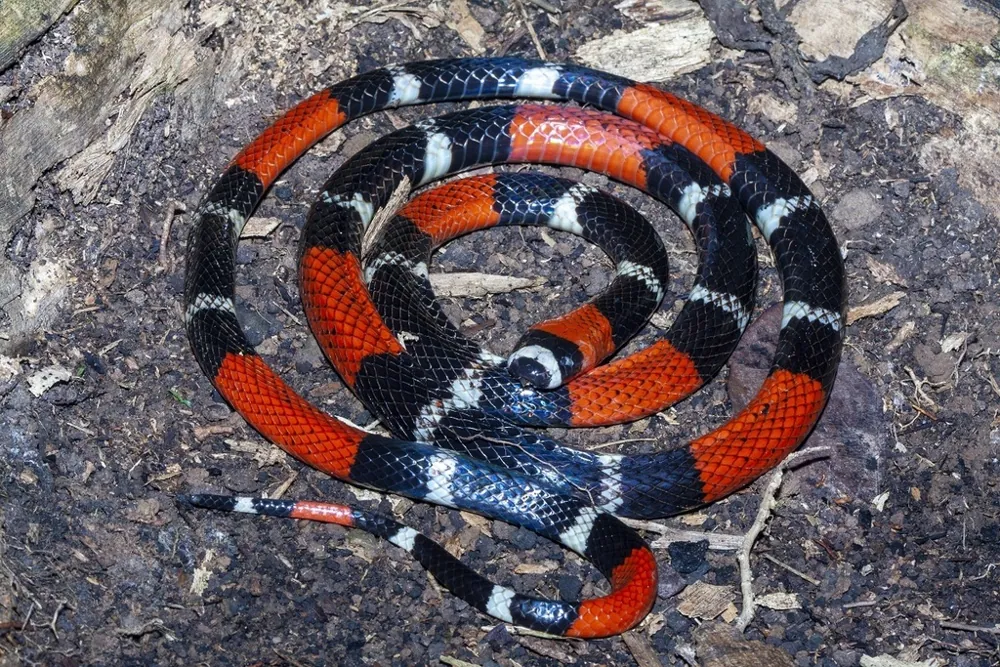
The South American coral snake is a thin, brightly coloured venomous snake. It lives only in South America, from Argentina to Venezuela. It is nocturnal, so it is most active at night, and its venom is strong enough to be dangerous to people.1



 Indlela yokusiqaphela
- The snout is black, followed by a narrow white band in front of the eyes and a wider black band across the eyes.1
- The rest of the head is red, and the body has broad red rings.1
- Between the red rings are 7 to 17 groups of three black and two white rings.1
- The tail has two of these black and white groups.1
- It is thin, and adults are usually 60 to 90 cm long, tail included.1
Amandla etyhefu yokuluma nokuhlaba
Ityhefu iphuma ngamazinyo aso etyhefu okanye ngamazinyo aso xa siluma.
Ityhefu yaso yokuluma okanye yokuhlaba yenza ntoni?
Its venom is a strong neurotoxin, which attacks the nerves. It acts both before and after the nerve connects to the muscle, and it causes a strong, permanent block of nerve signals to the muscles in vertebrates. A muscle-damaging toxin called lemnitoxin has also been isolated from the venom.1
Siyingozi kangakanani ebantwini?
Ingozi ebantwini: Siyingozi kakhuluSinokubulala umntu ongafumani nyango.It is not aggressive towards people, but it can bite to defend itself. The estimated lethal dose for an adult human is 5 to 7 mg of venom (dry weight). In laboratory milking, the average venom yield was 8 to 10 mg and the largest was 27 mg.1
Senza ntoni xa soyika?
It is not aggressive, but it can attack to defend itself when threatened.1
 Ukuba siyaluma
- Gcina umntu engashukumi kwaye ezolile uze umse esibhedlele ngokukhawuleza, nokuba indawo elunyiweyo ibonakala incinci: iimpawu zinokuqala kwiiyure ezininzi kamva.
Soloko utsalela inombolo kaxakeka kuqala (112, 000, 911). Esi sisikhokelo soncedo lokuqala ngokubanzi, asilocebiso lwezonyango. Iziseko zoncedo lokuqala
 Hlala ukhuselekile
- Ungaze uchukumise, ubambe okanye uqhule isilwanyana sasendle, nokuba sincinci, kwaye nokuba sibonakala silele okanye sifile.
- Sinike indawo. Ukuba udibana naso, hlala uzolile, buyela umva kancinci kwaye usiyeke sihambe ngendlela yaso.
- Ukuba siyakuluma: hlala uzolile, musa ukushukuma, tsalela inombolo kaxakeka (112, 000, 911) okanye uye esibhedlele ngokukhawuleza. Khumbula ukuba sasikhangeleka njani, ifoto iyanceda.
Asikuzingeli. Sisebenzisa ityhefu yaso ukubamba ukutya okanye ukuzikhusela, kwaye singakhetha ukuzimela. Okungakumbi malunga nokuhlala ukhuselekile
Sikhulu kangakanani?
Side kangakanani?
 ubude obulingana neekati zasekhaya eziyi-3 ukusuka empumlweni ukuya emsileni
 ubude obulingana neebhanana eziyi-8 zilandelelana
 singagqiba iimitha ezili-100 ngemizuzwana eyi-71 (owona mntu ukhawulezayo udinga i-9,6)
U-South American coral snake mkhulu kangakanani xa uthelekisa NAWE?
Zizibalo nje kwibhrawuza yakho. Akukho nto igcinwayo okanye ithunyelwa naphi na.
Sikhawuleza kangakanani?


Iinyaniso
The venom of this snake is strong enough to cause paralysis, because it blocks nerve signals to the muscles.1
It is one of the few snakes whose diet includes freshwater eels and gymnotiform fishes.1
It is nocturnal and digs in loose soil or leaf litter, so it spends much of its time hidden underground.1
It can live in disturbed land and near human homes, not only in deep forest.1
Umqhekezi weentsomi
Intsomi: Coral snakes are aggressive and will attack people.
Inyaniso: This snake is not aggressive towards people. It only bites to defend itself.1
Apho iinyaniso zivela khona
- Micrurus lemniscatus (Wikipedia (CC BY-SA 4.0))
- Micrurus lemniscatus (iNaturalist): amagama nokuhlelwa.
- Venom Wiki: inqanaba lengozi, ubungakanani obuqhelekileyo noqikelelo lwesantya zezethu. Bona indlela esizifumana ngayo: Indlela esilinganisa ngayo ingozi.
Inyaniso nganye kweli phepha inenombolo ebonisa umthombo wayo. Ukuba senze impazamo, uxolo, sithanda izilwanyana, asiyomagazini yenzululwazi. Sixelele ku-[email protected] kwaye siza kuyilungisa.
 Unomadudwane ulambile! I-Venom Wiki yiprojekthi yomntu omnye: isimahla, ayinazibhengezo kwaye ayinazilandeli. Isipho esincinci sinceda ukuyigcina ikwi-intanethi.Yondla unomadudwane
Okungakumbi kwiqela elinye: Iinyoka ze-coral
 Central American coral snakeIinyoka ze-coralSinokubulala
 Amazonian coral snakeIinyoka ze-coralSinokubulala
 Aquatic coral snakeIinyoka ze-coralSinokubulala
 Argentinian coral snakeIinyoka ze-coralSinokubulala
 Caatinga coral snakeIinyoka ze-coralSinokubulala
 Dumeril's coral snakeIinyoka ze-coralSinokubulala
 Golden poison frog
 Terciopelo
 Brazilian wandering spider
 Eyelash viper
 Golden lancehead
 South American bushmaster