
 I-Afrika
 I-Asia
 I-Yurophu
 INingizimu Melika
 I-Australia ne-Oceania
 I-Antarctica
 ULwandlekazi iPacific
 ULwandlekazi i-Atlantic
 ULwandlekazi i-India
 ULwandlekazi i-Arctic
 Ulwandle iMediterranean
 Ulwandle Olubomvu
 Ulwandle iCaribbean
 Ulwandle iCoral
 Ulwandle lwaseNingizimu China
 Ulwandle lwasePhilippines
 Ulwandle i-Andaman
 Ulwandle i-North Sea
 Ulwandle lwaseTimor ne-Arafura
 Ichweba laseBengal
 Ichweba laseCalifornia
Black-banded jumper ant
 Ukuhlaba
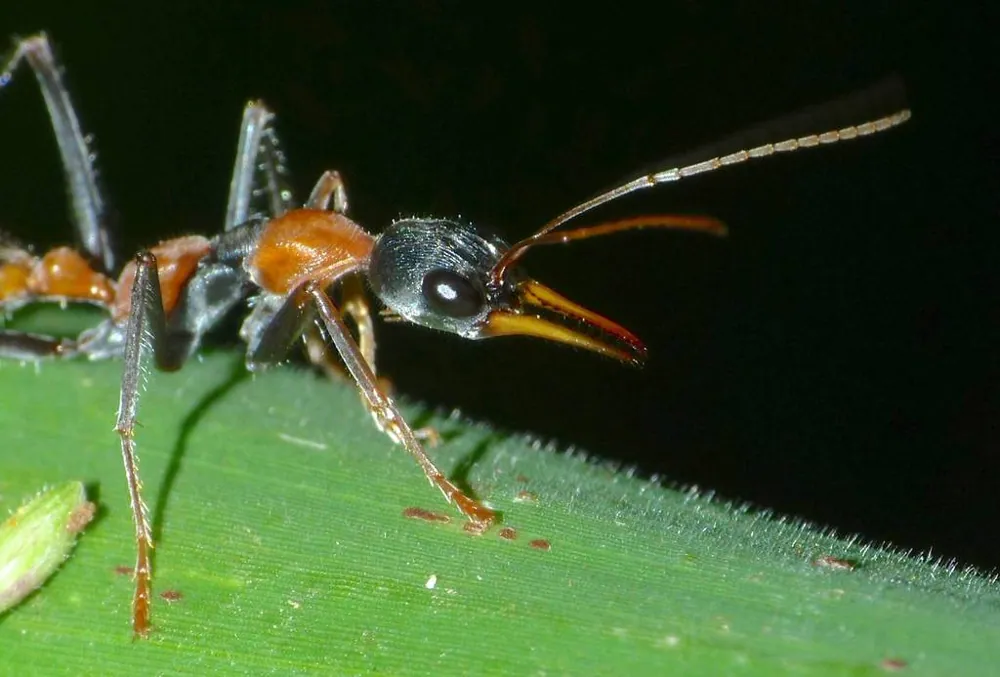
The black-banded jumper ant is a large ant that can leap up to 10 centimetres, which is far above its own body length. It lives in eastern Australia, including suburbs of Sydney and Brisbane. Its sting is painful and can cause serious allergic reactions in some people, so it is worth knowing how to recognise it.1



 Indlela yokusibona
- Mostly black and orange-red in colour.1
- The gaster (rear body), head, legs and mesonotum (middle back) are black, while the pronotum, propodeum, petiole and post-petiole are red.1
- Mandibles (jaws) are either black or yellow, depending on where the ant lives.1
- Workers are 13 to 15 mm long, males 16 to 17 mm, and queens 17 to 19 mm.1
- It can leap 76 to 102 mm by suddenly extending its middle and hind legs.1
Ivamise ukudidaniswa ne: It is often confused with other Myrmecia species. It can be told apart by its bi-coloured thorax and post-petiole, which are yellowish-red and black, and by its yellowish-red node.1
Amandla obuthi
Ubuthi buphuma ngodosi.
Ubuthi baso benzani?
Its sting is highly venomous and causes intense burning pain. The burning can last for many days, and the sting itches. If the sting is left untreated, it may develop into an ulcer (an open sore). The venom of a close relative, M. pilosula, is among the strongest of all ants and contains acids, enzymes and phospholipases.1
Siyingozi kangakanani ebantwini?
Ingozi ebantwini: KubuhlunguKungaba buhlungu ngempela, kodwa cishe akukaze kube kubi kakhulu.A 2011 study of Australian ant allergies found that 265 of 376 participants reacted to the stings of several Myrmecia species, which can cause anaphylaxis (a severe, whole-body allergic reaction). Of these, 15 reacted to this species, while 176 reacted to M. pilosula. The study concluded that Myrmecia species were among four main groups of Australian ants responsible for anaphylaxis.1
Senzani uma sesabile?
When threatened, workers and scouts quickly defend the nest and may react aggressively even to a shadow crossing it, bursting out in short hops to attack.1
 Uma sihlaba
- Geza bese upholisa izindawo ezihlatshiwe.
- Uma umuntu ephefumula kanzima, ebuso noma emphinjeni kuvuvukala, noma ezizwa ezoquleka, lesi yisimo esiphuthumayo se-allergy: shayela inombolo yezimo eziphuthumayo.
Njalo shayela kuqala inombolo yezimo eziphuthumayo (112, 000, 911). Lokhu kuyiseluleko sosizo lokuqala esijwayelekile, akusona iseluleko sezokwelapha. Izisekelo zosizo lokuqala
 Hlala uphephile
- Ungalokothi uthinte, ubambe noma ugcone isilwane sasendle, ngisho noma sincane, futhi ngisho noma sibukeka silele noma sifile.
- Sinike isikhala. Uma uhlangana naso, hlala uzolile, uhlehle kancane bese usiyeka sihambe ngendlela yaso.
- Uma sikuhlaba: hlala uzolile, ungashukumi, shayela inombolo yezimo eziphuthumayo (112, 000, 911) noma uye esibhedlela ngokushesha. Khumbula ukuthi besibukeka kanjani, isithombe siyasiza.
Asikuzingeli wena. Sisebenzisa ubuthi baso ukuze sibambe ukudla noma ukuzivikela, futhi singancamela ukucasha. Okwengeziwe mayelana nokuhlala uphephile
Sikhulu kangakanani?
Side kangakanani?
 sifushane kunomunwe wakho omncane
Black-banded jumper ant mkhulu kangakanani uma uqhathanisa NAWE?
Yizibalo nje kusiphequluli sakho. Akukho okulondolozwayo noma okuthunyelwa ndawo.
Sishesha kangakanani?


Amaqiniso
It can jump between 76 and 102 mm, which is far more than its own body length.1
Colonies can continue without a queen, because workers can lay fertile eggs.1
It often forages in trees, where it visits the flowers of some eucalyptus and senna plants and may help pollinate them.1
A worker can live for over a year, with a maximum of about 1.3 years.1
Its nests are camouflaged with twigs, leaves, gravel and other plant material.1
Okongoti bobuthi
- Igama lesayensi
- Myrmecia nigrocincta
- Iqembu
- Izintuthwane
- Umndeni
- Formicidae2
- Ukuhleleka
- Hymenoptera
- Amazwekazi
- I-Australia ne-Oceania
- Izinsana
- Worker-laid eggs can be reared into males in colonies with no queen. Colonies typically have between 400 and 1200 individuals.1
- Isikhathi sokuphila
- cishe iminyaka engu-1.31
- Ingozi ebantwini
- 2 / 5: Kubuhlungu3
Lapho amaqiniso evela khona
- Myrmecia nigrocincta (Wikipedia (CC BY-SA 4.0))
- Myrmecia nigrocincta (iNaturalist): amagama nokuhlelwa ngezigaba.
- Venom Wiki: izinga lengozi, usayizi ojwayelekile nesiqagela sejubane kungokwethu. Bona ukuthi sikubala kanjani: Indlela esilinganisa ngayo ingozi.
Iqiniso ngalinye kuleli khasi linenombolo ekhomba umthombo walo. Uma senze iphutha, uxolo, singabathandi bezilwane, hhayi iphephabhuku lesayensi. Sitshele ku-[email protected] futhi sizolilungisa.
 Ufezela ulambile! I-Venom Wiki iwumsebenzi womuntu oyedwa: imahhala, ayinazo izikhangiso noma izilandeli. Isipho esincane sisiza ukuyigcina ku-inthanethi.Phakela ufezela
Okunye okuvela eqenjini elifanayo: Izintuthwane
 Bulldog ant
 Jack jumper ant
 Green weaver ant
 Giant bull ant
 Green-head ant
 Inchman ant
Futhi ihlala: I-Australia ne-Oceania
 Coastal taipanIzinyoka zase-AustraliaKuyabulala
 Common death adderIzinyoka zase-AustraliaKuyabulala
 Eastern brown snakeIzinyoka zase-AustraliaKuyabulala
 Inland taipanIzinyoka zase-AustraliaKuyabulala
 Sydney funnel-web spiderAma-tarantula nama-funnel-webKuyabulala
 Inyoka yehlosiIzinyoka zase-AustraliaKuyabulala