
 I-Afrika
 I-Asia
 I-Yurophu
 INingizimu Melika
 I-Australia ne-Oceania
 I-Antarctica
 ULwandlekazi iPacific
 ULwandlekazi i-Atlantic
 ULwandlekazi i-India
 ULwandlekazi i-Arctic
 Ulwandle iMediterranean
 Ulwandle Olubomvu
 Ulwandle iCaribbean
 Ulwandle iCoral
 Ulwandle lwaseNingizimu China
 Ulwandle lwasePhilippines
 Ulwandle i-Andaman
 Ulwandle i-North Sea
 Ulwandle lwaseTimor ne-Arafura
 Ichweba laseBengal
 Ichweba laseCalifornia
Bluespotted ribbontail ray
 Ukuhlaba
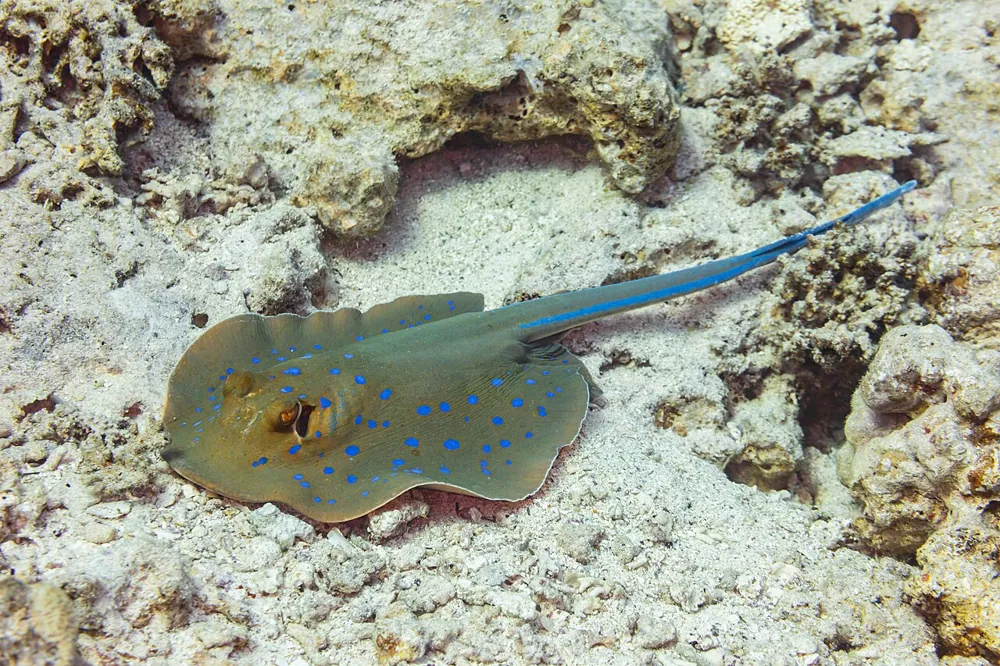
The bluespotted ribbontail ray is a small stingray with bright electric blue spots on its back. It lives on coral reefs and sandy flats across the tropical Indian and western Pacific Oceans. It can sting with its tail, but it is shy and usually flees when threatened.1



 Indlela yokusibona
- Numerous circular, neon blue spots on a yellowish brown or green back, with the spots smaller and denser towards the edge of the disc1
- Two stripes of the same blue running along the tail1
- Bright yellow eyes and a white belly1
- Oval, smooth-edged disc, with a thick tail about 1.5 times the length of the disc and one or two serrated spines near the base1
Amandla obuthi
Ubuthi buphuma ngodosi.
Ubuthi baso benzani?
Its tail carries one or two serrated spines that deliver venom when it stings. The sting can cause an excruciating wound.1
Siyingozi kangakanani ebantwini?
Ingozi ebantwini: Kubi kakhuluUkuhlatshwa kudinga udokotela. Ukufa kuyivelakancane kakhulu.It is timid and harmless towards people unless provoked, and it prefers to flee. It is capable of injuring people with its venomous tail spines.1
Senzani uma sesabile?
When threatened, it flees at high speed in a zigzag pattern to throw off pursuers.1
 Uma sihlaba
- Faka inxeba emanzini ashisayo, ashisa ngendlela umuntu angakwazi ukuyibekezelela ngaphandle kokusha (yihlole ngesandla sakho), imizuzu engama-30 kuya kwengama-90. Thola usizo lwezokwelapha, ikakhulukazi kuma-stonefish nama-stingray.
Njalo shayela kuqala inombolo yezimo eziphuthumayo (112, 000, 911). Lokhu kuyiseluleko sosizo lokuqala esijwayelekile, akusona iseluleko sezokwelapha. Izisekelo zosizo lokuqala
 Hlala uphephile
- Ungalokothi uthinte, ubambe noma ugcone isilwane sasendle, ngisho noma sincane, futhi ngisho noma sibukeka silele noma sifile.
- Sinike isikhala. Uma uhlangana naso, hlala uzolile, uhlehle kancane bese usiyeka sihambe ngendlela yaso.
- Uma sikuhlaba: hlala uzolile, ungashukumi, shayela inombolo yezimo eziphuthumayo (112, 000, 911) noma uye esibhedlela ngokushesha. Khumbula ukuthi besibukeka kanjani, isithombe siyasiza.
Asikuzingeli wena. Sisebenzisa ubuthi baso ukuze sibambe ukudla noma ukuzivikela, futhi singancamela ukucasha. Okwengeziwe mayelana nokuhlala uphephile
Kuphi emhlabeni?
Sikhulu kangakanani?
Side kangakanani?
Sisinda kangakanani?
 side njengamakati asekhaya angu-1.5 kusuka ekhaleni kuya emsileni
 side njengobhanana abangu-4 abalandelanayosisinda cishe njengekati lasekhaya
 singabhukuda ubude bechibi elikhulu lokubhukuda (50 m) ngemizuzwana engu-11
Bluespotted ribbontail ray mkhulu kangakanani uma uqhathanisa NAWE?
Yizibalo nje kusiphequluli sakho. Akukho okulondolozwayo noma okuthunyelwa ndawo.
Sishesha kangakanani?

,_mar_Rojo,_Egipto,_2023-04-14,_DD_64.jpg)
Amaqiniso
It has been seen raising the edges of its disc and pelvic fins to attract cleaning by the bluestreak cleaner wrasse.1
Goatfish often follow foraging rays to catch food the ray misses.1
Most specimens struggle in home aquariums, and many stop feeding or die for no clear reason, so public aquariums have had more success keeping them.1
Unlike many other stingrays, it seldom buries itself in sand.1
Okongoti bobuthi
- Igama lesayensi
- Taeniura lymma
- Iqembu
- Izinhlanzi ezinobuthi
- Umndeni
- Dasyatidae2
- Ukuhleleka
- Myliobatiformes
- Amazwekazi
- ULwandlekazi i-India, ULwandlekazi iPacific, Ulwandle Olubomvu, Ulwandle iCoral, Ulwandle lwase-Arabia ne-Persian Gulf, Ulwandle lwaseTimor ne-Arafura, Ichweba laseBengal, Izilwandlekazi
- Izinsana
- It gives birth to live young. Females bear litters of up to seven pups, each about 13–14 cm across, a miniature version of the adult.1
- Simo saso endle
- Least Concern (IUCN)1
- Ingozi ebantwini
- 3 / 5: Kubi kakhulu3
Lapho amaqiniso evela khona
- Bluespotted ribbontail ray (Wikipedia (CC BY-SA 4.0))
- Taeniura lymma (iNaturalist): amagama nokuhlelwa ngezigaba.
- Venom Wiki: izinga lengozi, usayizi ojwayelekile nesiqagela sejubane kungokwethu. Bona ukuthi sikubala kanjani: Indlela esilinganisa ngayo ingozi.
Iqiniso ngalinye kuleli khasi linenombolo ekhomba umthombo walo. Uma senze iphutha, uxolo, singabathandi bezilwane, hhayi iphephabhuku lesayensi. Sitshele ku-[email protected] futhi sizolilungisa.
 Ufezela ulambile! I-Venom Wiki iwumsebenzi womuntu oyedwa: imahhala, ayinazo izikhangiso noma izilandeli. Isipho esincane sisiza ukuyigcina ku-inthanethi.Phakela ufezela
Okunye okuvela eqenjini elifanayo: Izinhlanzi ezinobuthi
 Reef stonefishIzinhlanzi ezinobuthiKungabulalaUngathinti
 Red lionfishIzinhlanzi ezinobuthiKudinga udokotelaUngathinti
 Estuarine stonefishIzinhlanzi ezinobuthiKungabulalaUngathinti
 Short-tail stingrayIzinhlanzi ezinobuthiKungabulala
 Striped eel catfishIzinhlanzi ezinobuthiKungabulalaUngathinti
 Common stingrayIzinhlanzi ezinobuthiKudinga udokotela
Futhi ihlala: ULwandlekazi i-India
 Australian box jellyfishAma-jellyfish nezinye izilwane zasolwandle ezihlabayoKuyabulalaUngathinti
 Geography coneIminenke ye-cone nezingwaneKuyabulala
 Greater blue-ringed octopusIminenke ye-cone nezingwaneKuyabulala
 Southern blue-ringed octopusIminenke ye-cone nezingwaneKuyabulala
 Hawksbill sea turtleEzinye izilwane ezinoshevuKungabulala
 Irukandji jellyfishAma-jellyfish nezinye izilwane zasolwandle ezihlabayoKungabulalaUngathinti