
 I-Afrika
 I-Asia
 I-Yurophu
 INingizimu Melika
 I-Australia ne-Oceania
 I-Antarctica
 ULwandlekazi iPacific
 ULwandlekazi i-Atlantic
 ULwandlekazi i-India
 ULwandlekazi i-Arctic
 Ulwandle iMediterranean
 Ulwandle Olubomvu
 Ulwandle iCaribbean
 Ulwandle iCoral
 Ulwandle lwaseNingizimu China
 Ulwandle lwasePhilippines
 Ulwandle i-Andaman
 Ulwandle i-North Sea
 Ulwandle lwaseTimor ne-Arafura
 Ichweba laseBengal
 Ichweba laseCalifornia
Cow killer velvet ant
 Ukuhlaba
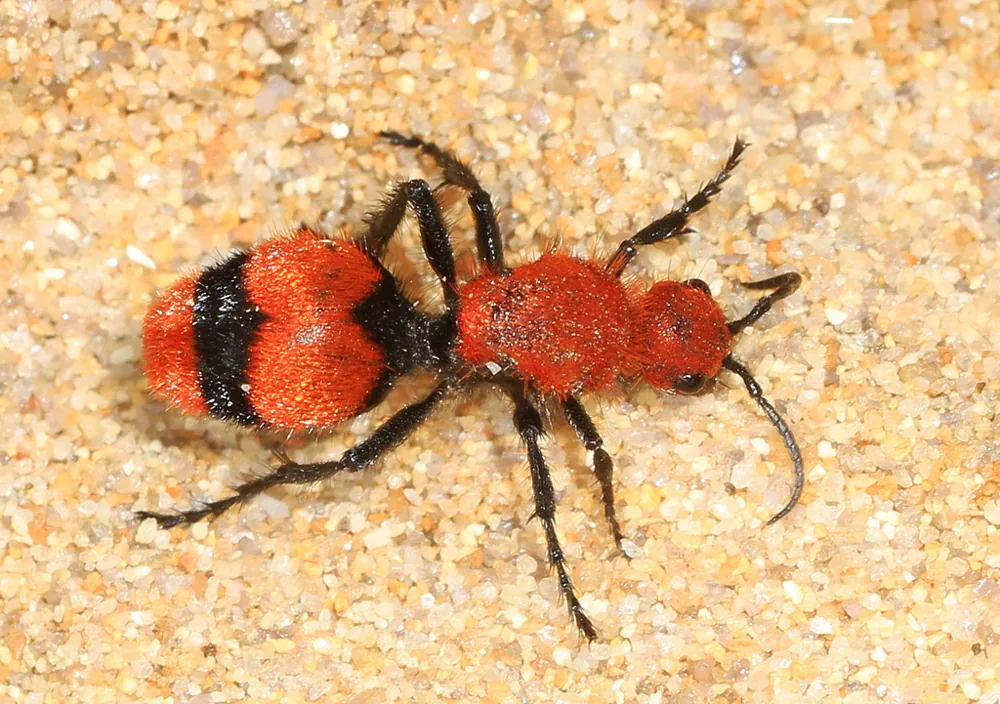
The cow killer velvet ant is a wasp that looks like a black and red ant. It lives in the eastern United States, from Connecticut and Kansas in the north to Florida and Texas in the south. It is known for a sting so painful that it earned the nickname cow killer.1

 Indlela yokusibona
- Black overall, with bright red on the upper side of the head, thorax and abdomen.1
- Females have no wings. Males have dark, translucent wings and no stinger.1
- Adults reach about 1.9 cm long, the largest velvet ant in the eastern United States.1
- Quick-moving, and often takes a defensive posture when threatened.1
- Adults are mostly seen in the summer months.1
Ivamise ukudidaniswa ne: It is often mistaken for an ant because of its appearance and its common name. It is actually a wasp, and only the males have wings.1
Amandla obuthi
Ubuthi buphuma ngodosi.
Ubuthi baso benzani?
Its sting is among the most painful of any insect, ranked 3 out of 4 on the Schmidt sting pain index. The venom contains a peptide called Do6a, which triggers a pain response in fruit fly larvae in laboratory studies.1
Siyingozi kangakanani ebantwini?
Ingozi ebantwini: KubuhlunguKungaba buhlungu ngempela, kodwa cishe akukaze kube kubi kakhulu.The sting is extremely painful, ranked 3 out of 4 on the Schmidt sting pain index. This is the reason for the nickname cow killer.1
Senzani uma sesabile?
It has a thickened exoskeleton, runs fast and evasively, shows warning colours, makes a squeaking sound by rubbing its abdominal segments together, releases a chemical secretion and uses its venom.1
 Uma sihlaba
- Khipha udosi lwenyosi ngokulukhuhla bese upholisa indawo.
- Uma umuntu ephefumula kanzima, ebuso noma emphinjeni kuvuvukala, noma ezizwa ezoquleka, lesi yisimo esiphuthumayo se-allergy: shayela inombolo yezimo eziphuthumayo futhi usebenzise ipeni lakhe le-adrenaline uma enalo.
Njalo shayela kuqala inombolo yezimo eziphuthumayo (112, 000, 911). Lokhu kuyiseluleko sosizo lokuqala esijwayelekile, akusona iseluleko sezokwelapha. Izisekelo zosizo lokuqala
 Hlala uphephile
- Ungalokothi uthinte, ubambe noma ugcone isilwane sasendle, ngisho noma sincane, futhi ngisho noma sibukeka silele noma sifile.
- Sinike isikhala. Uma uhlangana naso, hlala uzolile, uhlehle kancane bese usiyeka sihambe ngendlela yaso.
- Uma sikuhlaba: hlala uzolile, ungashukumi, shayela inombolo yezimo eziphuthumayo (112, 000, 911) noma uye esibhedlela ngokushesha. Khumbula ukuthi besibukeka kanjani, isithombe siyasiza.
Asikuzingeli wena. Sisebenzisa ubuthi baso ukuze sibambe ukudla noma ukuzivikela, futhi singancamela ukucasha. Okwengeziwe mayelana nokuhlala uphephile
Sikhulu kangakanani?
Side kangakanani?
 sifushane kunomunwe wakho omncane
Cow killer velvet ant mkhulu kangakanani uma uqhathanisa NAWE?
Yizibalo nje kusiphequluli sakho. Akukho okulondolozwayo noma okuthunyelwa ndawo.
Sishesha kangakanani?


Amaqiniso
Both sexes squeak to warn predators. Velvet ants rub their abdominal segments together, while crickets rub their legs against their abdomen.1
North American velvet ant species form one of the most intricate mimicry rings in the natural world, split into eight separate rings of mimicry.1
Males find females by smelling pheromones and by following their squeaking sounds. They carry the female in their jaws to a shaded, safe spot to mate.1
Females are wingless, a feature shared by all females in the family Mutillidae.1
Females are believed to mate only once in their lifetime.1
Umqothuli wezinganekwane
Inganekwane: It is an ant because it looks like one and has the name ant.
Iqiniso: It is a parasitoid wasp. It is only commonly mistaken for an ant.1
Okongoti bobuthi
- Igama lesayensi
- Dasymutilla occidentalis
- Iqembu
- Izinyosi, imivi nama-hornet
- Umndeni
- Mutillidae2
- Ukuhleleka
- Hymenoptera
- Amazwekazi
- INyakatho Melika
- Izinsana
- A female lays a single egg onto a host larva, such as one of the eastern cicada killer or horse guard wasp, and the grub that hatches eats the host larva.1
- Ingozi ebantwini
- 2 / 5: Kubuhlungu3
Lapho amaqiniso evela khona
- Dasymutilla occidentalis (Wikipedia (CC BY-SA 4.0))
- Dasymutilla occidentalis (iNaturalist): amagama nokuhlelwa ngezigaba.
- Venom Wiki: izinga lengozi, usayizi ojwayelekile nesiqagela sejubane kungokwethu. Bona ukuthi sikubala kanjani: Indlela esilinganisa ngayo ingozi.
Iqiniso ngalinye kuleli khasi linenombolo ekhomba umthombo walo. Uma senze iphutha, uxolo, singabathandi bezilwane, hhayi iphephabhuku lesayensi. Sitshele ku-[email protected] futhi sizolilungisa.
 Ufezela ulambile! I-Venom Wiki iwumsebenzi womuntu oyedwa: imahhala, ayinazo izikhangiso noma izilandeli. Isipho esincane sisiza ukuyigcina ku-inthanethi.Phakela ufezela
Okunye okuvela eqenjini elifanayo: Izinyosi, imivi nama-hornet
 Tarantula hawkIzinyosi, imivi nama-hornetKubuhlungu nje
 Executioner waspIzinyosi, imivi nama-hornetKudinga udokotela
 Warrior waspIzinyosi, imivi nama-hornetKudinga udokotela
 Bald-faced hornetIzinyosi, imivi nama-hornetKubuhlungu nje
 Eastern cicada killerIzinyosi, imivi nama-hornetAkunangozi
 Aerial yellowjacketIzinyosi, imivi nama-hornetKubuhlungu nje
 Terciopelo
 Eastern coral snake
 Eastern diamondback rattlesnake
 Eyelash viper
 Timber rattlesnake
 Western diamondback rattlesnake