
 I-Afrika
 I-Asia
 I-Yurophu
 INingizimu Melika
 I-Australia ne-Oceania
 I-Antarctica
 ULwandlekazi iPacific
 ULwandlekazi i-Atlantic
 ULwandlekazi i-India
 ULwandlekazi i-Arctic
 Ulwandle iMediterranean
 Ulwandle Olubomvu
 Ulwandle iCaribbean
 Ulwandle iCoral
 Ulwandle lwaseNingizimu China
 Ulwandle lwasePhilippines
 Ulwandle i-Andaman
 Ulwandle i-North Sea
 Ulwandle lwaseTimor ne-Arafura
 Ichweba laseBengal
 Ichweba laseCalifornia
Eastern diamondback rattlesnake
 Ukuluma
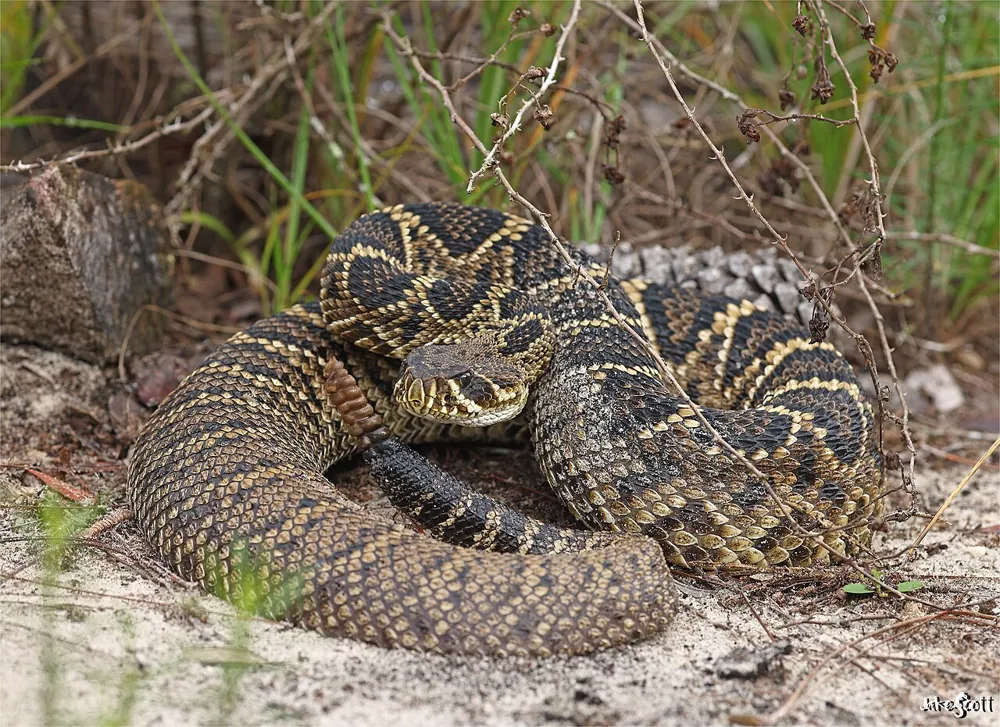
The eastern diamondback rattlesnake is a pit viper that lives in the southeastern United States. It is the largest rattlesnake species and one of the heaviest venomous snakes in the Americas. Its diamond-patterned back and loud rattle make it easy to recognise, and it is widely regarded as one of the most dangerous venomous snakes in North America.1



 Indlela yokusibona
- Dark brown to black diamond-shaped blotches on a brownish, grey or olive background, each outlined with cream or yellowish scales1
- A dark stripe runs from behind each eye to the mouth corner, edged above and below by white or yellow stripes1
- A rattle of hollow segments at the tail tip, which break off and are replaced when the snake sheds1
- Five to ten bands around the tail, below the diamond pattern1
- A large, heavy body, with adults often around 1.1 to 1.7 m long1
Amandla obuthi
Ubuthi buphuma ngamazinyo aso obuthi noma ngamazinyo uma siluma.
Ubuthi baso benzani?
Its venom contains more than 100 different toxins, and about 40 have been identified, making it one of the most studied snake venoms. The venom contains a thrombin-like enzyme called crotalase, which clots fibrinogen, a protein needed for blood clotting. The estimated human lethal dose is 100 to 150 mg.1
Siyingozi kangakanani ebantwini?
Ingozi ebantwini: Kuyingozi kakhuluSingabulala umuntu ongatholi kwelashwa.It has a reputation as the most dangerous venomous snake in North America. It is not usually aggressive, but it is large and powerful. Reported mortality from untreated bites is 10 to 20% in some studies and 30% in another, and it is a major cause of fatal snakebites within its range.1
Senzani uma sesabile?
When threatened, it raises the front half of its body in an S-shaped coil, rattles loudly, and can strike to at least a third of its body length.1
 Uma siluma
- Gcina umuntu engashukumi futhi ezolile, gcina isitho esilunyiwe sisezingeni lenhliziyo, khipha izindandatho nezinto eziqinile, bese umusa esibhedlela ngokushesha.
Njalo shayela kuqala inombolo yezimo eziphuthumayo (112, 000, 911). Lokhu kuyiseluleko sosizo lokuqala esijwayelekile, akusona iseluleko sezokwelapha. Izisekelo zosizo lokuqala
 Hlala uphephile
- Ungalokothi uthinte, ubambe noma ugcone isilwane sasendle, ngisho noma sincane, futhi ngisho noma sibukeka silele noma sifile.
- Sinike isikhala. Uma uhlangana naso, hlala uzolile, uhlehle kancane bese usiyeka sihambe ngendlela yaso.
- Uma sikuluma: hlala uzolile, ungashukumi, shayela inombolo yezimo eziphuthumayo (112, 000, 911) noma uye esibhedlela ngokushesha. Khumbula ukuthi besibukeka kanjani, isithombe siyasiza.
Asikuzingeli wena. Sisebenzisa ubuthi baso ukuze sibambe ukudla noma ukuzivikela, futhi singancamela ukucasha. Okwengeziwe mayelana nokuhlala uphephile
Sikhulu kangakanani?
Side kangakanani?
Sisinda kangakanani?
 side njengamakati asekhaya angu-5 kusuka ekhaleni kuya emsileni
 side njengobhanana abangu-13 abalandelanayo
 singahamba amamitha ali-100 ngemizuzwana engu-86 (umuntu oshesha kunabo bonke udinga engu-9,6)
Eastern diamondback rattlesnake mkhulu kangakanani uma uqhathanisa NAWE?
Yizibalo nje kusiphequluli sakho. Akukho okulondolozwayo noma okuthunyelwa ndawo.
Sishesha kangakanani?


Amaqiniso
It is the largest rattlesnake species. One specimen shot in 1946 measured 2.4 m and weighed 15.4 kg.1
In proportion to its length, it has the longest fangs of any rattlesnake, with fangs of over 25 mm expected in a 2.4 m adult.1
It can strike its prey within a tenth of a second.1
It can swim well and has been seen crossing water sometimes miles from land.1
Although mainly ground-dwelling, it has been spotted up to 10 m above the ground in bushes and trees.1
Males are usually larger than females, which is a rare pattern called reverse sexual size dimorphism.1
Umqothuli wezinganekwane
Inganekwane: The eastern diamondback must rattle before it strikes.
Iqiniso: It can strike while completely silent. Some individuals stay quiet even when approached closely.1
Okongoti bobuthi
- Igama lesayensi
- Crotalus adamanteus
- Iqembu
- Ama-rattlesnake
- Umndeni
- Viperidae2
- Ukuhleleka
- Squamata
- Amazwekazi
- INyakatho Melika
- Izinsana
- It gives birth to live young, between 4 and 28 at a time, usually from July to early October. The newborns are 30 to 36 cm long and look like adults, except they have a small button instead of a rattle.1
- Simo saso endle
- Least Concern on the IUCN Red List (2001), but its population trend is down. It is under review for the US Endangered Species List, and it is considered endangered in North Carolina.1
- Ingozi ebantwini
- 4 / 5: Kuyingozi kakhulu3
Lapho amaqiniso evela khona
- Eastern diamondback rattlesnake (Wikipedia (CC BY-SA 4.0))
- Crotalus adamanteus (iNaturalist): amagama nokuhlelwa ngezigaba.
- Venom Wiki: izinga lengozi, usayizi ojwayelekile nesiqagela sejubane kungokwethu. Bona ukuthi sikubala kanjani: Indlela esilinganisa ngayo ingozi.
Iqiniso ngalinye kuleli khasi linenombolo ekhomba umthombo walo. Uma senze iphutha, uxolo, singabathandi bezilwane, hhayi iphephabhuku lesayensi. Sitshele ku-[email protected] futhi sizolilungisa.
 Ufezela ulambile! I-Venom Wiki iwumsebenzi womuntu oyedwa: imahhala, ayinazo izikhangiso noma izilandeli. Isipho esincane sisiza ukuyigcina ku-inthanethi.Phakela ufezela
 Timber rattlesnake
 Western diamondback rattlesnake
 Sidewinder
 Mojave rattlesnake
 Aruba rattlesnake
 Black-tailed rattlesnake
 Terciopelo
 Eastern coral snake
 Eyelash viper
 Arizona bark scorpion
 Brown recluse
 Cane toad