
 I-Afrika
 I-Asia
 I-Yurophu
 INingizimu Melika
 I-Australia ne-Oceania
 I-Antarctica
 ULwandlekazi iPacific
 ULwandlekazi i-Atlantic
 ULwandlekazi i-India
 ULwandlekazi i-Arctic
 Ulwandle iMediterranean
 Ulwandle Olubomvu
 Ulwandle iCaribbean
 Ulwandle iCoral
 Ulwandle lwaseNingizimu China
 Ulwandle lwasePhilippines
 Ulwandle i-Andaman
 Ulwandle i-North Sea
 Ulwandle lwaseTimor ne-Arafura
 Ichweba laseBengal
 Ichweba laseCalifornia
Mediterranean box jellyfish
 Ama-tentacle ahlabayo
The Mediterranean box jellyfish is a small, see-through jellyfish with a box-shaped body about 3 cm across. It lives only in the Mediterranean Sea, where it is the only box jellyfish, and its sting can hurt people who swim in shallow water.1

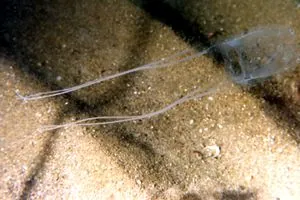

 Indlela yokusibona
- Transparent, box-shaped bell about 3 cm across1
- Four long tentacles at the lower corners of the bell, up to 30 cm long1
- Red banding on the tentacles1
- Small white or yellowish warts on the bell that carry stinging cells1
- Often found in small groups1
Ivamise ukudidaniswa ne: Other box jellyfish of the genus Carybdea look similar, but they live in warm oceans elsewhere. The red banding on the tentacles is the feature that separates this species from them.1
Amandla obuthi
Izinkulungwane zamaseli amancane ahlabayo ziyadubula uma kukhona okuzithintayo.
Ubuthi baso benzani?
Its sting is venomous to humans, but some swimmers feel no painful sensation at all. In severe cases the symptoms spread through the body, with pain at the sting site and elsewhere, paresthesia (abnormal prickling or tingling sensations), hyperesthesia (over-sensitive skin) and skin lesions. These symptoms can take a few months to fully disappear.1
Siyingozi kangakanani ebantwini?
Ingozi ebantwini: KubuhlunguKungaba buhlungu ngempela, kodwa cishe akukaze kube kubi kakhulu.It is far less dangerous than some box jellyfish species from other parts of the world. It is still considered the second-most significant stinging jellyfish in the Mediterranean, after Pelagia noctiluca.1
 Uma sihlaba
- Phuma emanzini bese ukhipha noma yimiphi imicu ehlabayo (ama-tentacle) (ngamagilavu noma ngendwangu).
- Kuma-box jellyfish asezindaweni ezishisayo: thela uviniga ezindaweni ezihlatshiwe okungenani imizuzwana engama-30, biza usizo futhi ulungele ukwenza i-CPR. Kuma-bluebottle nakwamanye amaningi: hlanza ngamanzi olwandle, bese usebenzisa amanzi ashisayo ngenxa yobuhlungu.
Njalo shayela kuqala inombolo yezimo eziphuthumayo (112, 000, 911). Lokhu kuyiseluleko sosizo lokuqala esijwayelekile, akusona iseluleko sezokwelapha. Izisekelo zosizo lokuqala
 Hlala uphephile
- Ungalokothi uthinte, ubambe noma ugcone isilwane sasendle, ngisho noma sincane, futhi ngisho noma sibukeka silele noma sifile.
- Sinike isikhala. Uma uhlangana naso, hlala uzolile, uhlehle kancane bese usiyeka sihambe ngendlela yaso.
- Uma sikuhlaba: hlala uzolile, ungashukumi, shayela inombolo yezimo eziphuthumayo (112, 000, 911) noma uye esibhedlela ngokushesha. Khumbula ukuthi besibukeka kanjani, isithombe siyasiza.
Asikuzingeli wena. Sisebenzisa ubuthi baso ukuze sibambe ukudla noma ukuzivikela, futhi singancamela ukucasha. Okwengeziwe mayelana nokuhlala uphephile
Kuphi emhlabeni?
Sikhulu kangakanani?
Side kangakanani?
 side cishe njengesibophi sephepha
 singabhukuda ubude bechibi elikhulu lokubhukuda (50 m) ngemizuzwana engu-36
Mediterranean box jellyfish mkhulu kangakanani uma uqhathanisa NAWE?
Yizibalo nje kusiphequluli sakho. Akukho okulondolozwayo noma okuthunyelwa ndawo.
Sishesha kangakanani?
Amaqiniso
It has comparatively sophisticated eyes with lenses, which help it detect and avoid obstacles such as posts or a ship's rudder.1
After a free-swimming larva forms, it develops into a polyp that can reproduce by budding, and it can regenerate missing parts within 72 hours.1
It swims by making rapid contractions of its bell, moving between 3 and 6 metres per minute.1
Its tentacles can grow up to 30 cm long, many times the width of its box-shaped bell.1
It is the only box jellyfish found in the Mediterranean Sea.1
Okongoti bobuthi
- Igama lesayensi
- Carybdea marsupialis
- Iqembu
- Ama-jellyfish nezinye izilwane zasolwandle ezihlabayo
- Umndeni
- Carybdeidae2
- Ukuhleleka
- Carybdeida
- Amazwekazi
- ULwandlekazi i-Atlantic, Ulwandle iMediterranean, Izilwandlekazi
- Izinsana
- The sexes are separate, and eggs and sperm (gametes) are released into the open water to fuse; the young develop into a free-swimming larva and then a small polyp stage before becoming jellyfish.1
- Ingozi ebantwini
- 2 / 5: Kubuhlungu3
Lapho amaqiniso evela khona
- Carybdea marsupialis (Wikipedia (CC BY-SA 4.0))
- Carybdea marsupialis (iNaturalist): amagama nokuhlelwa ngezigaba.
- Venom Wiki: izinga lengozi, usayizi ojwayelekile nesiqagela sejubane kungokwethu. Bona ukuthi sikubala kanjani: Indlela esilinganisa ngayo ingozi.
Iqiniso ngalinye kuleli khasi linenombolo ekhomba umthombo walo. Uma senze iphutha, uxolo, singabathandi bezilwane, hhayi iphephabhuku lesayensi. Sitshele ku-[email protected] futhi sizolilungisa.
 Ufezela ulambile! I-Venom Wiki iwumsebenzi womuntu oyedwa: imahhala, ayinazo izikhangiso noma izilandeli. Isipho esincane sisiza ukuyigcina ku-inthanethi.Phakela ufezela
Okunye okuvela eqenjini elifanayo: Ama-jellyfish nezinye izilwane zasolwandle ezihlabayo
 Australian box jellyfishAma-jellyfish nezinye izilwane zasolwandle ezihlabayoKuyabulalaUngathinti
 Irukandji jellyfishAma-jellyfish nezinye izilwane zasolwandle ezihlabayoKungabulalaUngathinti
 Portuguese man o' warAma-jellyfish nezinye izilwane zasolwandle ezihlabayoKudinga udokotelaUngathinti
 Lion's mane jellyfishAma-jellyfish nezinye izilwane zasolwandle ezihlabayoKubuhlungu njeUngathinti
 Moon jellyfishAma-jellyfish nezinye izilwane zasolwandle ezihlabayoAkunangozi
 Common kingslayerAma-jellyfish nezinye izilwane zasolwandle ezihlabayoKungabulalaUngathinti
Futhi ihlala: ULwandlekazi i-Atlantic
 Hawksbill sea turtleEzinye izilwane ezinoshevuKungabulala
 Blue sea dragonIminenke ye-cone nezingwaneKubuhlungu nje
 Greenland sharkEzinye izilwane ezinoshevuKubuhlungu nje
 Common octopusIminenke ye-cone nezingwaneAkunangozi
 Common stingrayIzinhlanzi ezinobuthiKudinga udokotela
 Greater weeverIzinhlanzi ezinobuthiKudinga udokotelaUngathinti