
 Abibirem
 Asia
Asia Yuropu
 Amerika Anaafoɔ
 Australia ne Oceania
 Antarctica
 Pacific Po
 Atlantic Po
 India Po
 Arctic Po
 Mediterranean Po
 Po Kɔkɔɔ
 Caribbean Po
 Coral Po
 China Anaafoɔ Po
 Philippine Po
 Andaman Po
 Atifi Po
 Timor ne Arafura Po
 Bengal Ɛpo Ano
 California Ɛpo Ano
By-the-wind sailor
 Nhama (tentacles) a ɛwɔ
The by-the-wind sailor is a small, deep blue animal that floats on the surface of the open ocean. It is not a single creature but a colony of tiny linked animals, and it moves by catching the wind with a small stiff sail. Its stinging tentacles are generally harmless to people, but they can irritate the skin.1

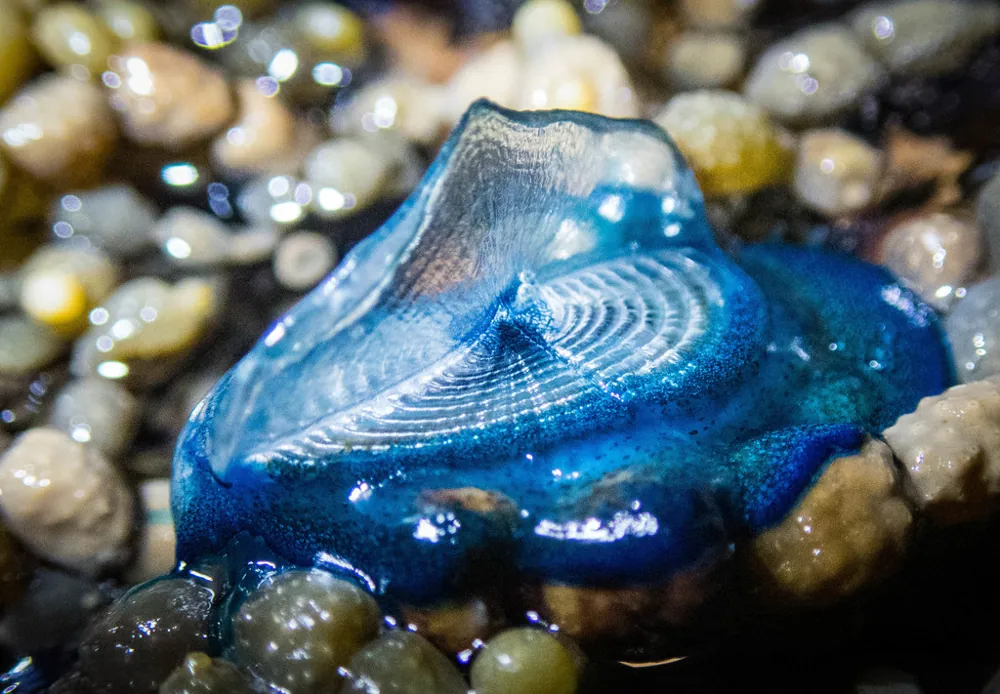
 Sɛdeɛ wobɛhunu no
Bɔre ahoɔden
Nwowaa (cells) nketewa mpempem a ɛwɔ tow wɔn bɔre bere a biribi de ne ho ka wɔn.
Ne bɔre yɛ dɛn?
Its nematocysts contain toxins that are effective against its prey, which are mostly plankton. The nematocysts are relatively benign to humans, but each person may respond differently to the toxin. Contact may cause irritation to exposed skin.1
Ne asiane ma nnipa te sɛn?
Asiane ma nnipa: Ɛnyɛ denƐte sɛ wowa wɔ anaa ɛnnu saa. Ɛkame ayɛ sɛ ɛnni asiane ma nnipa.It is relatively harmless to humans. Its main effect is possible skin irritation after contact. Mass strandings can leave large numbers of dying and rotting animals on beaches.1
 Sɛ ɛwɔ a
- Fi nsuo no mu na yi nhama (tentacles) biara a ɛda so (fa nsa kotokuo anaa ntoma).
- Box jellyfish a ɛwɔ nsuo hyew mu: hwie vinegar gu baabi a ɛwɔɔ no so anibu 30 anaa deɛ ɛsen saa, frɛ ma wɔmmɛboa na siesie wo ho sɛ wobɛyɛ CPR. Bluebottles ne afoforɔ dodoɔ no: fa ɛpo nsuo hohoro, na afei nsuo hyew ma yaw no.
Di kan frɛ wo ahohiahia nɔma (112, 000, 911). Yei yɛ mmoa a ɛdi kan ho akwankyerɛ, ɛnyɛ dɔkota afotuo. Mmoa a ɛdi kan ho nsɛm titiriw
 Hwɛ wo ho so
- Mfa wo nsa nka wiram aboa biara, nkyere no na mfa no nni agorɔ, sɛ ɔyɛ ketewa mpo, na sɛ ɛte sɛ ɔrededa anaa wawu mpo a.
- Ma no kwan. Sɛ wohyia baako a, ma wo bo nnwo, san w'akyi brɛoo na ma ɔnkɔ ne kwan.
- Sɛ baako wɔ wo a: ma wo bo nnwo, tena dinn, frɛ wo ahohiahia nɔma (112, 000, 911) anaa kɔ ayaresabea ntɛm. Kae sɛdeɛ na ɛte, mfonini bɛboa.
Ɛnhwehwɛ wo sɛ ɛbɛpira wo. Ɛde ne bɔre kyere aduane anaa ɛbɔ ne ho ban, na ɛpɛ sɛ ɛhinta sene biribiara. Nsɛm pii fa ahobammɔ ho
Wiase mu baabi bɛn?
Ne kɛseɛ te sɛn?
Ne tenten te sɛn?
 ne tenten te sɛ agodeɛ blɔk 2 a wɔde to ntoatoasoɔ mu
 ɛbɛtumi aguare aguare tare kɛseɛ tenten (50 m) wɔ anibu 180 mu
By-the-wind sailor kɛseɛ te sɛn sɛ wode toto WO ho a?
Akontabuo kɛkɛ wɔ wo browser mu. Wɔnkora hwee, na wɔmfa hwee nkɔ baabiara.
Ne ntɛm te sɛn?

Nsɛm
Its floating colonies are mirror images of each other, either 'left-handed' or 'right-handed', and this affects where they drift. In the northern Pacific, one form tends to drift to North America and the other to eastern Asia, such as Japan.1
Each blue 'animal' with a sail is really a colony of linked polyps that share food through a canal system.1
Each colony is either all male or all female.1
Its sail is not a fin. It works like a sail, so the animal tends to drift downwind at a small angle to the wind.1
Its tiny jellyfish carry zooxanthellae, single-celled organisms that use sunlight to provide energy, a feature also found in corals.1
It has no means of moving other than its sail, so it depends on prevailing winds, and mass strandings on beaches happen in many parts of the world.1
Atosɛm sɛefoɔ
Atosɛm: Each blue sail is a single, simple animal.
Nokorɛ: Each apparent individual is a colony of many connected polyps that share food and divide the work between feeding, reproductive and protective polyps.1
Ma bɔre ho animdefoɔ
- Nyansahu din
- Velella velella
- Kuo
- Jellyfish ne ɛpo mu mmoa a wɔwɔ
- Abusua
- Porpitidae2
- Nhyehyɛeɛ (Order)
- Anthoathecata
- Asaase akɛseɛ
- Pacific Po, Atlantic Po, India Po, Mediterranean Po, Anaafoɔ Po, Antarctica, Po akɛseɛ
- Mmofra nketewa
- Each colony's feeding polyps (gonozooids) bud off thousands of tiny jellyfish, each about 1 mm wide, over several weeks. These develop into a free-swimming larva called a conaria, which grows into a new floating colony.1
- Asiane ma nnipa
- 1 / 5: Ɛnyɛ den3
Baabi a nsɛm no fi
- Velella (Wikipedia (CC BY-SA 4.0))
- Velella velella (iNaturalist): din ne nkyekyɛmu.
- Venom Wiki: asiane gyinabea, kɛseɛ a ɛtaa yɛ ne ntɛm susuo no yɛ yɛn ankasa deɛ. Hwɛ sɛdeɛ yɛbu no: Sɛdeɛ yɛkyerɛ asiane gyinabea.
Nsɛm biara a ɛwɔ kratafa yi so wɔ nɔma a ɛkyerɛ ne fibea. Sɛ yɛfom biribi a, kafra, yɛyɛ mmoa ho akɔnnɔfoɔ, ɛnyɛ nyansahu nwoma. Ka kyerɛ yɛn wɔ [email protected] na yɛbɛsiesie.
 Ɔkɔm de akekantwerɛ no! Onipa baako na ɔyɛ Venom Wiki: ɛyɛ kwa, dawurubɔ nni so na biribiara nni so a ɛdi w'akyi. Akyɛdeɛ ketewa bi boa ma ɛkɔ so tena internet so.Ma akekantwere no aduane
Pii fi kuo korɔ no mu: Jellyfish ne ɛpo mu mmoa a wɔwɔ
 Australian box jellyfishJellyfish ne ɛpo mu mmoa a wɔwɔƐkumMfa wo nsa nka
 Irukandji jellyfishJellyfish ne ɛpo mu mmoa a wɔwɔƐtumi kumMfa wo nsa nka
 Portuguese man o' warJellyfish ne ɛpo mu mmoa a wɔwɔƐhia dɔkotaMfa wo nsa nka
 Lion's mane jellyfishJellyfish ne ɛpo mu mmoa a wɔwɔƐyɛ yaw kɛkɛMfa wo nsa nka
 Moon jellyfishJellyfish ne ɛpo mu mmoa a wɔwɔƐnni asiane
 Common kingslayerJellyfish ne ɛpo mu mmoa a wɔwɔƐtumi kumMfa wo nsa nka
Ɔte nso wɔ: Pacific Po
 Geography coneCone snails ne octopusƐkum
 Greater blue-ringed octopusCone snails ne octopusƐkum
 Japanese pufferfishMmoa afoforɔ a wɔn ho yɛ awuduroƐkum
 Southern blue-ringed octopusCone snails ne octopusƐkum
 Hawksbill sea turtleMmoa afoforɔ a wɔn ho yɛ awuduroƐtumi kum
 Reef stonefishApataa a wɔwɔ bɔreƐtumi kumMfa wo nsa nka