
 Abibirem
 Asia
Asia Yuropu
 Amerika Anaafoɔ
 Australia ne Oceania
 Antarctica
 Pacific Po
 Atlantic Po
 India Po
 Arctic Po
 Mediterranean Po
 Po Kɔkɔɔ
 Caribbean Po
 Coral Po
 China Anaafoɔ Po
 Philippine Po
 Andaman Po
 Atifi Po
 Timor ne Arafura Po
 Bengal Ɛpo Ano
 California Ɛpo Ano
Olive sea snake
 Ka
KaThe olive sea snake is a venomous sea snake that lives on coral reefs across the Indo-Pacific, including the Great Barrier Reef. It swims with a paddle-like tail and can grow up to about a metre long. Prawn trawl nets are one of its biggest threats.1



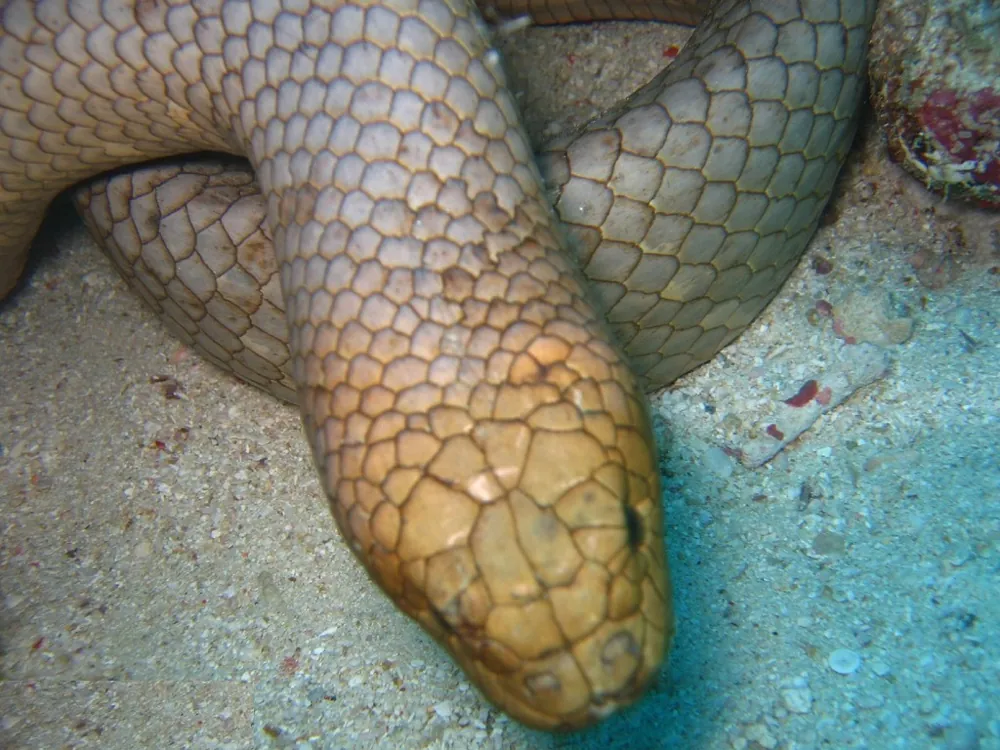
 Sɛdeɛ wobɛhunu no
Bɔre ahoɔden
Bɔre fi ne se mu ba bere a ɔka.
Ne bɔre yɛ dɛn?
Its venom is rich in enzymes that break down prey inside the body, which simplifies digestion. The venom also affects both the muscles and nerves of the prey, and it is used to incapacitate the prey.1
Ne asiane ma nnipa te sɛn?
Asiane ma nnipa: Asiane kɛseɛ womƐtumi kum onipa a wɔnhwɛ no yareɛ.It can be aggressive towards prey, but attacks on divers or larger animals are rare. If provoked, it will fight back against the attacker.1
Ɛyɛ dɛn bere a ehu aka no?
If provoked, it will engage the attacker, and during the day it hides inside coral holes.1
 Sɛ ɛka a
- Pressure immobilisation: fa elastic bandage a ɛyɛ den kyekyere baabi a ɛkaa no so, na afei kyekyere kɔ soro wɔ nsa anaa nan no nyinaa so, fa splint kyekyere ho, na ma onipa no ntena dinn koraa kosi sɛ mmoa bɛba.
- Yi onipa no fi nsuo no mu na fa no kɔ ayaresabea ntɛm.
Di kan frɛ wo ahohiahia nɔma (112, 000, 911). Yei yɛ mmoa a ɛdi kan ho akwankyerɛ, ɛnyɛ dɔkota afotuo. Mmoa a ɛdi kan ho nsɛm titiriw
 Hwɛ wo ho so
- Mfa wo nsa nka wiram aboa biara, nkyere no na mfa no nni agorɔ, sɛ ɔyɛ ketewa mpo, na sɛ ɛte sɛ ɔrededa anaa wawu mpo a.
- Ma no kwan. Sɛ wohyia baako a, ma wo bo nnwo, san w'akyi brɛoo na ma ɔnkɔ ne kwan.
- Sɛ baako ka wo a: ma wo bo nnwo, tena dinn, frɛ wo ahohiahia nɔma (112, 000, 911) anaa kɔ ayaresabea ntɛm. Kae sɛdeɛ na ɛte, mfonini bɛboa.
Ɛnhwehwɛ wo sɛ ɛbɛpira wo. Ɛde ne bɔre kyere aduane anaa ɛbɔ ne ho ban, na ɛpɛ sɛ ɛhinta sene biribiara. Nsɛm pii fa ahobammɔ ho
Wiase mu baabi bɛn?
Ne kɛseɛ te sɛn?
Ne tenten te sɛn?
 ne tenten te sɛ fie agyinamoa 4 a wɔde hwene ne dua to ntoatoasoɔ mu
 ne tenten te sɛ kwadu 11 a wɔde to ntoatoasoɔ mu
 ɛbɛtumi aguare aguare tare kɛseɛ tenten (50 m) wɔ anibu 40 mu
Olive sea snake kɛseɛ te sɛn sɛ wode toto WO ho a?
Akontabuo kɛkɛ wɔ wo browser mu. Wɔnkora hwee, na wɔmfa hwee nkɔ baabiara.
Ne ntɛm te sɛn?
Nsɛm
Its tail has light-sensitive cells in the skin, which help it detect light and stay fully hidden inside coral holes during the day.1
Males sometimes approach divers, possibly because they mistake the divers for female sea snakes.1
Prawn trawls are one of its greatest threats, and up to 50% of olive sea snakes caught in trawls are killed.1
Males can reach sexual maturity in their third year, while females do not mature until their fourth or fifth year.1
Atosɛm sɛefoɔ
Atosɛm: Sea snakes regularly attack divers.
Nokorɛ: Attacks on divers are rare. Males that approach divers are likely mistaking them for females.1
Ma bɔre ho animdefoɔ
- Nyansahu din
- Aipysurus laevis
- Kuo
- Ɛpo mu awɔ
- Abusua
- Elapidae2
- Nhyehyɛeɛ (Order)
- Squamata
- Asaase akɛseɛ
- India Po, Pacific Po, Coral Po, Timor ne Arafura Po, Po akɛseɛ
- Mmofra nketewa
- It gives birth to live young, with up to five at a time and, in rare cases, ten or eleven. Gestation lasts about nine months.1
- Mfeɛ a ɔtena ase
- bɛyɛ mfeɛ 151
- Asiane ma nnipa
- 4 / 5: Asiane kɛseɛ wom3
Baabi a nsɛm no fi
- Aipysurus laevis (Wikipedia (CC BY-SA 4.0))
- Aipysurus laevis (iNaturalist): din ne nkyekyɛmu.
- Venom Wiki: asiane gyinabea, kɛseɛ a ɛtaa yɛ ne ntɛm susuo no yɛ yɛn ankasa deɛ. Hwɛ sɛdeɛ yɛbu no: Sɛdeɛ yɛkyerɛ asiane gyinabea.
Nsɛm biara a ɛwɔ kratafa yi so wɔ nɔma a ɛkyerɛ ne fibea. Sɛ yɛfom biribi a, kafra, yɛyɛ mmoa ho akɔnnɔfoɔ, ɛnyɛ nyansahu nwoma. Ka kyerɛ yɛn wɔ [email protected] na yɛbɛsiesie.
 Ɔkɔm de akekantwerɛ no! Onipa baako na ɔyɛ Venom Wiki: ɛyɛ kwa, dawurubɔ nni so na biribiara nni so a ɛdi w'akyi. Akyɛdeɛ ketewa bi boa ma ɛkɔ so tena internet so.Ma akekantwere no aduane
Pii fi kuo korɔ no mu: Ɛpo mu awɔ
 Beaked sea snake
 Belcher's sea snake
 Black-banded sea krait
 Blue-lipped sea krait
 Dubois' sea snake
 Yellow-lipped sea krait
Ɔte nso wɔ: India Po
 Australian box jellyfishJellyfish ne ɛpo mu mmoa a wɔwɔƐkumMfa wo nsa nka
 Geography coneCone snails ne octopusƐkum
 Greater blue-ringed octopusCone snails ne octopusƐkum
 Southern blue-ringed octopusCone snails ne octopusƐkum
 Hawksbill sea turtleMmoa afoforɔ a wɔn ho yɛ awuduroƐtumi kum
 Irukandji jellyfishJellyfish ne ɛpo mu mmoa a wɔwɔƐtumi kumMfa wo nsa nka