
 Abibirem
 Asia
Asia Yuropu
 Amerika Anaafoɔ
 Australia ne Oceania
 Antarctica
 Pacific Po
 Atlantic Po
 India Po
 Arctic Po
 Mediterranean Po
 Po Kɔkɔɔ
 Caribbean Po
 Coral Po
 China Anaafoɔ Po
 Philippine Po
 Andaman Po
 Atifi Po
 Timor ne Arafura Po
 Bengal Ɛpo Ano
 California Ɛpo Ano
Savigny's long-spined urchin
 Nsɔe a bɔre wom
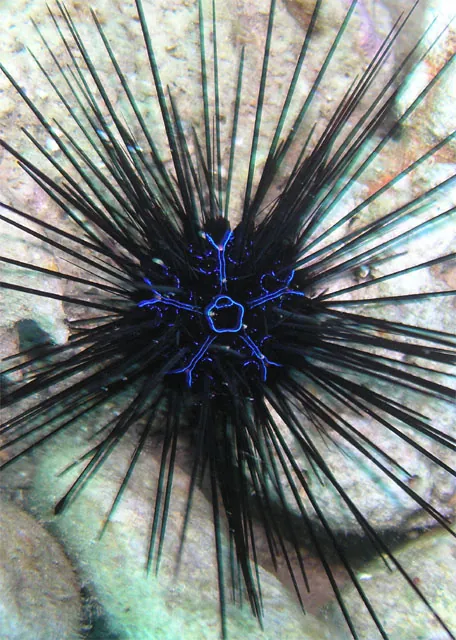
Savigny's long-spined urchin is a spiny sea animal that lives on reefs and in shallow lagoons. It has very long, thin spines that can grow up to 25 cm, and it comes out at night to graze on algae. Its spines are the part that can hurt people, so it is worth giving it plenty of room.1


 Sɛdeɛ wobɛhunu no
- Usually black, with a rounded body (called a test) up to about 9 cm across1
- Long, thin, hollow spines that grow in tufts and can reach 25 cm; they are usually black but can be grey, dark brown or purple1
- Juveniles may have bands of lighter and darker shades, and the occasional individual is completely white1
- Iridescent green or blue lines around the interambulacral areas and around the periproct (the cone-shaped region surrounding the anus)1
Wɔtaa fa no sɛ: It is very similar to Diadema setosum, which shares much of its range and often lives in the same groups. Savigny's long-spined urchin lacks the thin orange ring around the periproct that Diadema setosum has.1
Bɔre ahoɔden
Nsɔe a ano yɛ nnam na ɛkura bɔre no. Sɛ wotiatia so anaa wosɔ mu a, ɛyɛ yaw.
Ne asiane ma nnipa te sɛn?
Asiane ma nnipa: Ɛyɛ yawƐtumi yɛ yaw paa, nanso ɛkame ayɛ sɛ ɛnyɛ asiane kɛseɛ da.Ɛyɛ dɛn bere a ehu aka no?
When a shadow falls on it, it angles its spines towards the possible attacker.1
 Sɛ ne nsɔe hyɛ wo mu a
- Fa kuro no hyɛ nsuo hyew mu, ɛnyɛ hyew sene deɛ onipa no betumi agyina a ɛnhye no, na hwehwɛ dɔkota mmoa na wɔayi nsɔe no. Mmɔ mmɔden sɛ wo ankasa wobɛtutu wɔn.
Di kan frɛ wo ahohiahia nɔma (112, 000, 911). Yei yɛ mmoa a ɛdi kan ho akwankyerɛ, ɛnyɛ dɔkota afotuo. Mmoa a ɛdi kan ho nsɛm titiriw
 Hwɛ wo ho so
- Mfa wo nsa nka wiram aboa biara, nkyere no na mfa no nni agorɔ, sɛ ɔyɛ ketewa mpo, na sɛ ɛte sɛ ɔrededa anaa wawu mpo a.
- Ma no kwan. Sɛ wohyia baako a, ma wo bo nnwo, san w'akyi brɛoo na ma ɔnkɔ ne kwan.
- Sɛ ne nsɔe hyɛ wo mu a: ma wo bo nnwo, tena dinn, frɛ wo ahohiahia nɔma (112, 000, 911) anaa kɔ ayaresabea ntɛm. Kae sɛdeɛ na ɛte, mfonini bɛboa.
Ɛnhwehwɛ wo sɛ ɛbɛpira wo. Ɛde ne bɔre kyere aduane anaa ɛbɔ ne ho ban, na ɛpɛ sɛ ɛhinta sene biribiara. Nsɛm pii fa ahobammɔ ho
Wiase mu baabi bɛn?
Ne kɛseɛ te sɛn?
Ne tenten te sɛn?
 ne tenten te sɛ agodeɛ blɔk 3 a wɔde to ntoatoasoɔ mu
 ɛyɛ brɛoo sen nwa a ɔte turom
Savigny's long-spined urchin kɛseɛ te sɛn sɛ wode toto WO ho a?
Akontabuo kɛkɛ wɔ wo browser mu. Wɔnkora hwee, na wɔmfa hwee nkɔ baabiara.
Ne ntɛm te sɛn?


Nsɛm
Its spines are brittle, thin and hollow, and grow in tufts that can be as long as 25 cm.1
Small fish such as cardinal fish, flatworms and shrimps sometimes shelter among its long spines.1
It spawns just after the full moon, while its close relative Diadema setosum mostly spawns around days eight to ten of the lunar cycle, which keeps the two species from interbreeding.1
Its grazing helps control algae, which might otherwise smother corals.1
It is nocturnal, hiding in crevices or under boulders by day, though several individuals sometimes huddle together in the open.1
Its predators include pufferfish, porcupinefish, lobsters and snails.1
Ma bɔre ho animdefoɔ
- Nyansahu din
- Diadema savignyi
- Kuo
- Sea urchins, ɛpo nsoromma ne sonsono
- Abusua
- Diadematidae2
- Nhyehyɛeɛ (Order)
- Diadematoida
- Asaase akɛseɛ
- India Po, Pacific Po, Po Kɔkɔɔ, Arabia Po ne Persia Ɛpo Ano, Timor ne Arafura Po, Bengal Ɛpo Ano, Po akɛseɛ
- Mmofra nketewa
- It does not have live young. Instead it releases eggs and sperm into the water (spawning), mainly during the north-east monsoon period, peaking in May, and timed to the lunar cycle.1
- Asiane ma nnipa
- 2 / 5: Ɛyɛ yaw3
Baabi a nsɛm no fi
- Diadema savignyi (Wikipedia (CC BY-SA 4.0))
- Diadema savignyi (iNaturalist): din ne nkyekyɛmu.
- Venom Wiki: asiane gyinabea, kɛseɛ a ɛtaa yɛ ne ntɛm susuo no yɛ yɛn ankasa deɛ. Hwɛ sɛdeɛ yɛbu no: Sɛdeɛ yɛkyerɛ asiane gyinabea.
Nsɛm biara a ɛwɔ kratafa yi so wɔ nɔma a ɛkyerɛ ne fibea. Sɛ yɛfom biribi a, kafra, yɛyɛ mmoa ho akɔnnɔfoɔ, ɛnyɛ nyansahu nwoma. Ka kyerɛ yɛn wɔ [email protected] na yɛbɛsiesie.
 Ɔkɔm de akekantwerɛ no! Onipa baako na ɔyɛ Venom Wiki: ɛyɛ kwa, dawurubɔ nni so na biribiara nni so a ɛdi w'akyi. Akyɛdeɛ ketewa bi boa ma ɛkɔ so tena internet so.Ma akekantwere no aduane
Pii fi kuo korɔ no mu: Sea urchins, ɛpo nsoromma ne sonsono
 Crown-of-thorns starfishSea urchins, ɛpo nsoromma ne sonsonoƐhia dɔkotaMfa wo nsa nka
 Flower urchinSea urchins, ɛpo nsoromma ne sonsonoƐtumi kum
 Fire urchinSea urchins, ɛpo nsoromma ne sonsonoƐhia dɔkotaMfa wo nsa nka
 Bearded firewormSea urchins, ɛpo nsoromma ne sonsonoƐyɛ yaw kɛkɛMfa wo nsa nka
 Black long-spined urchinSea urchins, ɛpo nsoromma ne sonsonoƐyɛ yaw kɛkɛMfa wo nsa nka
 BloodwormSea urchins, ɛpo nsoromma ne sonsonoƐyɛ yaw kɛkɛ
Ɔte nso wɔ: India Po
 Australian box jellyfishJellyfish ne ɛpo mu mmoa a wɔwɔƐkumMfa wo nsa nka
 Geography coneCone snails ne octopusƐkum
 Greater blue-ringed octopusCone snails ne octopusƐkum
 Southern blue-ringed octopusCone snails ne octopusƐkum
 Hawksbill sea turtleMmoa afoforɔ a wɔn ho yɛ awuduroƐtumi kum
 Irukandji jellyfishJellyfish ne ɛpo mu mmoa a wɔwɔƐtumi kumMfa wo nsa nka