
 Abibirem
 Asia
Asia Yuropu
 Amerika Anaafoɔ
 Australia ne Oceania
 Antarctica
 Pacific Po
 Atlantic Po
 India Po
 Arctic Po
 Mediterranean Po
 Po Kɔkɔɔ
 Caribbean Po
 Coral Po
 China Anaafoɔ Po
 Philippine Po
 Andaman Po
 Atifi Po
 Timor ne Arafura Po
 Bengal Ɛpo Ano
 California Ɛpo Ano
Short-spined crown-of-thorns starfish
 Nsɔe a bɔre wom
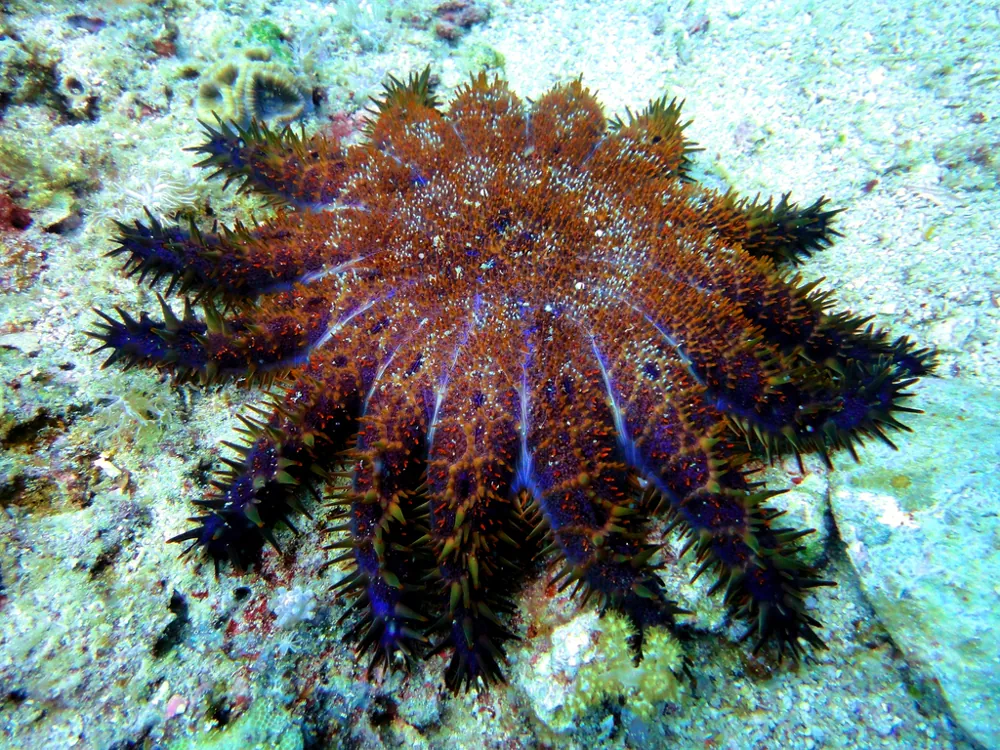
The short-spined crown-of-thorns starfish is a large, spiny sea star that lives on the sea floor in parts of the western Pacific and western Indian Ocean. It belongs to a genus with only two species, and it is less well known than its relative, the common crown-of-thorns starfish. Its many arms and dense spines make it easy to tell apart from typical starfish.1
 Sɛdeɛ wobɛhunu no
- Dense, blunt spines cover the upper surface of its central disc.1
- The upper surface is purple-brown and gets darker towards the arms.1
- Darker blotches run around the edge of the disc and along the arms, with a large blotch at the base of each arm.1
- Pale marks sit on the disc between each arm.1
- Its arm spines are shorter than those of the common crown-of-thorns starfish.1
Wɔtaa fa no sɛ: It is most often confused with the common crown-of-thorns starfish, Acanthaster planci. The short-spined species has blunt spines on its upper surface, short pedicellaria (tiny pincer-like structures), pale marks between the arms and shorter arm spines. The common species has longer arm spines and lacks the pale marks.1
Bɔre ahoɔden
Nsɔe a ano yɛ nnam na ɛkura bɔre no. Sɛ wotiatia so anaa wosɔ mu a, ɛyɛ yaw.
Ne asiane ma nnipa te sɛn?
Asiane ma nnipa: Ɛyɛ yawƐtumi yɛ yaw paa, nanso ɛkame ayɛ sɛ ɛnyɛ asiane kɛseɛ da. Sɛ ne nsɔe hyɛ wo mu a
- Fa kuro no hyɛ nsuo hyew mu, ɛnyɛ hyew sene deɛ onipa no betumi agyina a ɛnhye no, na hwehwɛ dɔkota mmoa na wɔayi nsɔe no. Mmɔ mmɔden sɛ wo ankasa wobɛtutu wɔn.
Di kan frɛ wo ahohiahia nɔma (112, 000, 911). Yei yɛ mmoa a ɛdi kan ho akwankyerɛ, ɛnyɛ dɔkota afotuo. Mmoa a ɛdi kan ho nsɛm titiriw
 Hwɛ wo ho so
- Mfa wo nsa nka wiram aboa biara, nkyere no na mfa no nni agorɔ, sɛ ɔyɛ ketewa mpo, na sɛ ɛte sɛ ɔrededa anaa wawu mpo a.
- Ma no kwan. Sɛ wohyia baako a, ma wo bo nnwo, san w'akyi brɛoo na ma ɔnkɔ ne kwan.
- Sɛ ne nsɔe hyɛ wo mu a: ma wo bo nnwo, tena dinn, frɛ wo ahohiahia nɔma (112, 000, 911) anaa kɔ ayaresabea ntɛm. Kae sɛdeɛ na ɛte, mfonini bɛboa.
Ɛnhwehwɛ wo sɛ ɛbɛpira wo. Ɛde ne bɔre kyere aduane anaa ɛbɔ ne ho ban, na ɛpɛ sɛ ɛhinta sene biribiara. Nsɛm pii fa ahobammɔ ho
Wiase mu baabi bɛn?
Ne kɛseɛ te sɛn?
Ne tenten te sɛn?
 ne tenten te sɛ agodeɛ blɔk 11 a wɔde to ntoatoasoɔ mu
 ɛyɛ brɛoo sen nwa a ɔte turom
Short-spined crown-of-thorns starfish kɛseɛ te sɛn sɛ wode toto WO ho a?
Akontabuo kɛkɛ wɔ wo browser mu. Wɔnkora hwee, na wɔmfa hwee nkɔ baabiara.
Ne ntɛm te sɛn?

Nsɛm
It catches scallops, which are fast swimmers, by sneaking up on them and trapping them under its body.1
It has many arms rather than the usual five, so it has lost the five-fold symmetry typical of starfish, although it starts life with five-fold symmetry.1
Its feeding posture, with the body arched over the prey, is so distinct that even the taste of scallop meat triggers it.1
In a 1973 laboratory experiment, it was crossed with the common crown-of-thorns starfish, and the hybrids reached sexual maturity at the end of their second year.1
Ma bɔre ho animdefoɔ
- Nyansahu din
- Acanthaster brevispinus
- Kuo
- Sea urchins, ɛpo nsoromma ne sonsono
- Abusua
- Acanthasteridae2
- Nhyehyɛeɛ (Order)
- Valvatida
- Asaase akɛseɛ
- India Po, Pacific Po, Coral Po, Philippine Po, Po akɛseɛ
- Mmofra nketewa
- It reproduces by releasing eggs and sperm, and the young develop through bipinnaria and brachiolaria larval stages before settling as tiny five-armed starfish about 0.4 to 1 mm across.1
- Asiane ma nnipa
- 2 / 5: Ɛyɛ yaw3
Baabi a nsɛm no fi
- Acanthaster brevispinus (Wikipedia (CC BY-SA 4.0))
- Acanthaster brevispinus (iNaturalist): din ne nkyekyɛmu.
- Venom Wiki: asiane gyinabea, kɛseɛ a ɛtaa yɛ ne ntɛm susuo no yɛ yɛn ankasa deɛ. Hwɛ sɛdeɛ yɛbu no: Sɛdeɛ yɛkyerɛ asiane gyinabea.
Nsɛm biara a ɛwɔ kratafa yi so wɔ nɔma a ɛkyerɛ ne fibea. Sɛ yɛfom biribi a, kafra, yɛyɛ mmoa ho akɔnnɔfoɔ, ɛnyɛ nyansahu nwoma. Ka kyerɛ yɛn wɔ [email protected] na yɛbɛsiesie.
 Ɔkɔm de akekantwerɛ no! Onipa baako na ɔyɛ Venom Wiki: ɛyɛ kwa, dawurubɔ nni so na biribiara nni so a ɛdi w'akyi. Akyɛdeɛ ketewa bi boa ma ɛkɔ so tena internet so.Ma akekantwere no aduane
Pii fi kuo korɔ no mu: Sea urchins, ɛpo nsoromma ne sonsono
 Crown-of-thorns starfishSea urchins, ɛpo nsoromma ne sonsonoƐhia dɔkotaMfa wo nsa nka
 Flower urchinSea urchins, ɛpo nsoromma ne sonsonoƐtumi kum
 Fire urchinSea urchins, ɛpo nsoromma ne sonsonoƐhia dɔkotaMfa wo nsa nka
 Bearded firewormSea urchins, ɛpo nsoromma ne sonsonoƐyɛ yaw kɛkɛMfa wo nsa nka
 Black long-spined urchinSea urchins, ɛpo nsoromma ne sonsonoƐyɛ yaw kɛkɛMfa wo nsa nka
 BloodwormSea urchins, ɛpo nsoromma ne sonsonoƐyɛ yaw kɛkɛ
Ɔte nso wɔ: India Po
 Australian box jellyfishJellyfish ne ɛpo mu mmoa a wɔwɔƐkumMfa wo nsa nka
 Geography coneCone snails ne octopusƐkum
 Greater blue-ringed octopusCone snails ne octopusƐkum
 Southern blue-ringed octopusCone snails ne octopusƐkum
 Hawksbill sea turtleMmoa afoforɔ a wɔn ho yɛ awuduroƐtumi kum
 Irukandji jellyfishJellyfish ne ɛpo mu mmoa a wɔwɔƐtumi kumMfa wo nsa nka