
 Bitten or stung?
 All animals
 Pick a continent
 Africa
 Asia
 Europe
 South America
 Australia & Oceania
 Antarctica
 Pacific Ocean
 Atlantic Ocean
 Indian Ocean
 Arctic Ocean
 Mediterranean Sea
 Red Sea
 Caribbean Sea
 Coral Sea
 South China Sea
 Philippine Sea
 Andaman Sea
 North Sea
 Timor & Arafura Sea
 Bay of Bengal
 Gulf of California
 Games
 Venom battle
 Animal race
 Field notebook
 Venom TOP lists
 Stay safe
 Surprise me

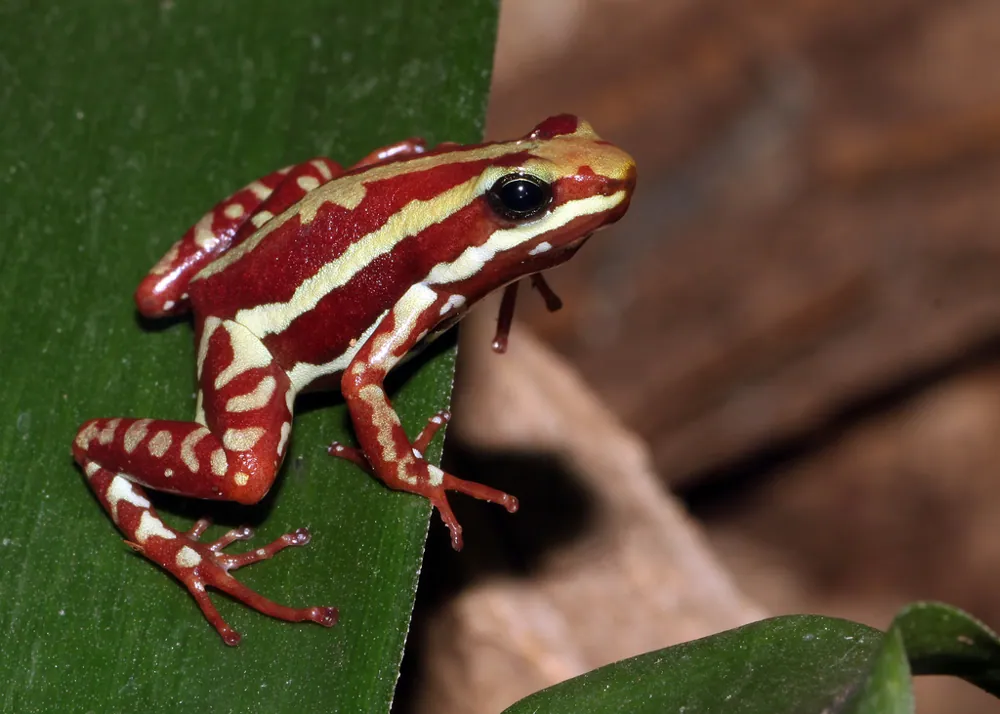
Anthony's poison arrow frog
 Poison in its skin
Anthony's poison arrow frog is a small, brightly marked frog that lives on the forest floor in southwestern Ecuador and northwestern Peru. It is poisonous rather than venomous: its skin carries a very strong toxin, so it should never be touched or handled. Scientists have used a chemical from this frog to study the nervous system.1
 How to recognise it
Poison power
Its skin is poisonous. It is dangerous to touch, lick or eat.
What does its poison do?
This frog is poisonous, not venomous. Its skin contains epibatidine, an extremely toxic substance similar to nicotine, which acts on the nerves. It is not used in medicine because it is too toxic for human use, and it is now used only for research.1
How dangerous is it to people?
Danger to people: PainfulIt can really hurt, but it is almost never serious.The frog's skin toxin is described as extremely toxic. Contact with the skin is the main concern, and the frog should not be handled.1
 If someone touched or ate it
Call your emergency number at once if the person has trouble breathing, swelling of the face or throat, or feels faint.
- If someone touched one: wash the hands well and do not touch the eyes or mouth. If a child or pet licked or ate one: call your poison centre or emergency number.
This is general first aid guidance, not medical advice. Based on the first aid guidelines of the World Health Organization and the Australian Resuscitation Council. Facts come from public sources and may contain mistakes. When in doubt, always get medical help. First aid basics
 Stay safe
- Never touch, catch or tease a wild animal, even a small one, and even if it looks asleep or dead.
- Give it space. If you meet one, stay calm, step back slowly and let it go its own way.
- If you touched or ate it: do not rub your eyes or mouth, wash your hands and get medical help.
It is not out to get you. Its poison is only there so that nothing eats it. More about staying safe
Where in the world?
How big is it?
How long is it?
 about as long as a paper clip
 could cover 100 metres in 110 seconds (the fastest human needs 9.6)
How big is Anthony's poison arrow frog compared to you?
Just maths in your browser. Nothing is saved or sent anywhere.
How fast is it?


Facts
Epibatidine, one of the most toxic substances found in this frog, was first derived from it and named after it.1
The toxin appears to come from the frog's diet, because frogs raised in captivity had none.1
The male, not the female, carries the tadpoles on his back to water.1
Frogs collected from different habitats had different levels of toxin.1
For venom experts
- Scientific name
- Epipedobates anthonyi
- Group
- Poison frogs, toads & newts
- Also called
- Anthony's poison dart frog, Epibatidine Poison Frog, Anthony's dart frog1
- Family
- Dendrobatidae2
- Order
- Anura
- Continents
- South America
- Babies
- The female lays a clutch of 15 to 40 eggs on the ground among leaf litter. The male guards the eggs until they hatch in about two weeks, then carries the tadpoles on his back to a suitable water body, where they develop into frogs in about sixty days.1
- How it is doing in the wild
- Near Threatened (IUCN and Peru); Least Concern in Ecuador1
- Danger to people
- 2 / 5: Painful3
Where the facts come from
- Anthony's poison arrow frog (Wikipedia (CC BY-SA 4.0))
- Epipedobates anthonyi (iNaturalist): names and classification.
- Venom Wiki: the danger level, the typical size and the speed guess are our own. See how we work them out: How we rate danger.
Every fact on this page has a number that points to its source. If we got something wrong, sorry, we are animal fans, not a science journal. Tell us at [email protected] and we will fix it.
Get the Venom Wiki app
Every creature, every picture and the games in your pocket, even without internet.


 Support Venom Wiki Venom Wiki is a one-man project: free, with no ads and no cookies. A small tip helps keep it online.Feed the scorpion
More from the same group: Poison frogs, toads & newts
 Golden poison frogPoison frogs, toads & newtsDeadlyDo not touch
 Cane toadPoison frogs, toads & newtsNeeds a doctorDo not touch
 Dyeing poison dart frogPoison frogs, toads & newtsPainfulDo not touch
 Black-legged poison frogPoison frogs, toads & newtsCan killDo not touch
 Harlequin poison frogPoison frogs, toads & newtsNeeds a doctorDo not touch
 Bruno's casque-headed frogPoison frogs, toads & newtsPainfulDo not touch
 Terciopelo
 Brazilian wandering spider
 Golden lancehead
 South American bushmaster
 Eyelash viper
 Peruvian giant centipede