
 Bitten or stung?
 All animals
 Pick a continent
 Africa
 Asia
 Europe
 South America
 Australia & Oceania
 Antarctica
 Pacific Ocean
 Atlantic Ocean
 Indian Ocean
 Arctic Ocean
 Mediterranean Sea
 Red Sea
 Caribbean Sea
 Coral Sea
 South China Sea
 Philippine Sea
 Andaman Sea
 North Sea
 Timor & Arafura Sea
 Bay of Bengal
 Gulf of California
 Games
 Venom battle
 Animal race
 Field notebook
 Venom TOP lists
 Stay safe
 Surprise me

Black-necked spitting cobra
 If it bites or spitsDanger to people: Very dangerousIt can kill a person who gets no treatment.
 Sprays or spits
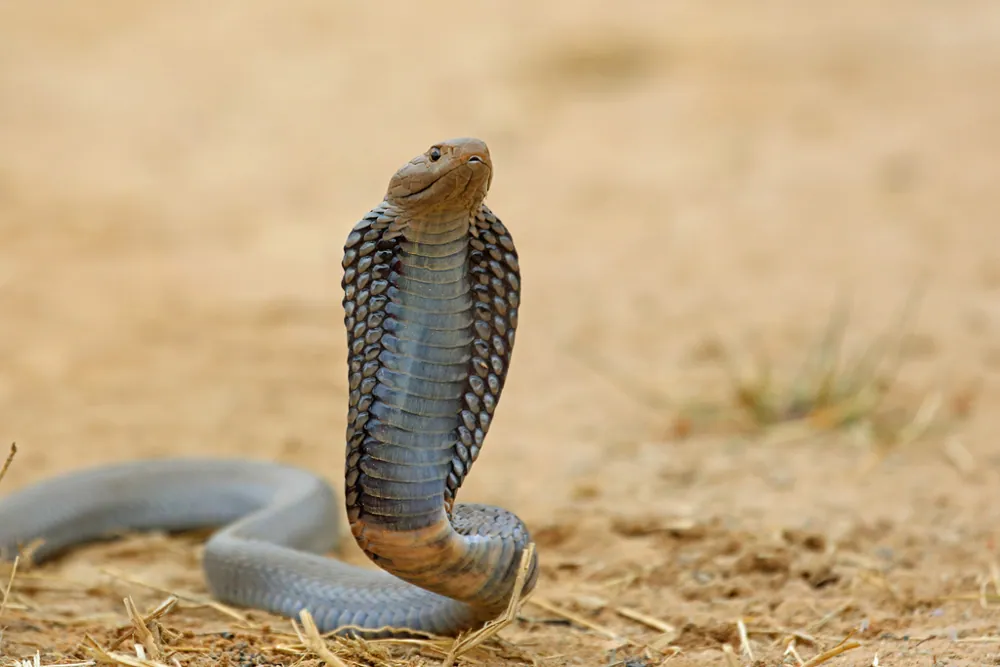
The black-necked spitting cobra is a venomous snake found mostly in sub-Saharan Africa. It can squirt venom from its fangs at a threat, and that venom can cause permanent blindness if it gets into the eyes. Its colours vary a lot from place to place.1
 How to recognise it
- Moderately sized, with a moderately distinct head, and grows to 1.2 to 2.2 metres.1
- Many specimens have a broad black neck band, often with an orange or pinkish bar on the neck.1
- Colours vary by region: black or pale grey, yellowish-brown, deep reddish-brown, olive brown, striped black and white, or totally white with dark eyes.1
- Some have a yellow or reddish belly, while others lack the neck bands and belly colour.1
Venom power
It sprays or spits a stinging liquid at attackers.
What does its venom do?
Its venom is mostly cytotoxic, meaning it destroys cells, and it also has typical elapid neurotoxic (nerve-attacking) effects and cardiotoxic (heart-damaging) components. A bite causes severe bleeding from the wound, tissue death around the bite, and difficulty breathing. Venom in the eyes causes extreme burning pain, loss of coordination, partial loss of vision, and permanent blindness.1
How dangerous is it to people?
Danger to people: Very dangerousIt can kill a person who gets no treatment.Its venom is medically significant. The death rate for untreated bites is about 5 to 10%, and under 1% in areas where it is common. When death occurs, it is usually from paralysis of the diaphragm, the muscle used for breathing.1
What does it do when it is scared?
It spits venom from its fangs at a threat, reaching up to 7 metres with good accuracy. It also bites readily, even with only slight provocation.1
If it bites or spits
Always call your emergency number first (for example 112 in Europe, 911 in North America, 000 in Australia).
- If venom gets into the eyes, rinse them at once with lots of clean water (or another bland liquid such as milk) for at least 15 minutes, without rubbing, and see a doctor. For a bite, call the emergency number and get to hospital fast. Keep the person still and calm and remove rings and tight items. Do not cut, suck or use a tourniquet.1
- Keep the person still and calm, remove rings and tight things, and get to a hospital fast: antivenom is the treatment. Be ready to give rescue breaths or CPR if breathing gets weak or stops.
- If venom was spat into the eyes, rinse them with lots of clean water straight away.
This is general first aid guidance, not medical advice. Based on the first aid guidelines of the World Health Organization and the Australian Resuscitation Council. Facts come from public sources and may contain mistakes. When in doubt, always get medical help. First aid basics
 Stay safe
- Never touch, catch or tease a wild animal, even a small one, and even if it looks asleep or dead.
- Give it space. If you meet one, stay calm, step back slowly and let it go its own way.
- If one bites you or spits venom in your eyes: stay calm, keep still, call your emergency number (for example 112 in Europe, 911 in North America, 000 in Australia) or get to a hospital fast. Remember what it looked like, a photo helps.
It is not out to get you. It uses its venom to catch food or to protect itself, and it would much rather hide. More about staying safe
Where in the world?
How big is it?
How long is it?
 as long as 4 house cats nose to tail
 as long as 12 bananas end to end
 could cover 100 metres in 46 seconds (the fastest human needs 9.6)
How big is Black-necked spitting cobra compared to you?
Just maths in your browser. Nothing is saved or sent anywhere.
How fast is it?


Facts
It can spit venom accurately more than 7 metres away.1
In 1944, a British eye surgeon, Major Harold Ridley, described eye damage from a spit from this cobra in Ghana. He treated the man and followed his case until the eye fully recovered.1
A single bite can deliver 200 to 350 mg of venom (dry weight), according to a 1974 study by Minton.1
It is an excellent tree climber and can live in trees at times.1
Wild-caught individuals tend to be nervous and spit readily, while captive-bred animals are much calmer.1
It can be active at night or during the day, depending on the season, location and temperature.1
Myth buster
Myth: Spitting cobras only spit venom and do not bite.
Truth: The black-necked spitting cobra also bites, and it will do so with only slight provocation.1
For venom experts
- Scientific name
- Naja nigricollis
- Group
- Cobras, mambas & kraits
- Also called
- Black-necked cobra1
- Family
- Elapidae2
- Order
- Squamata
- Continents
- Africa
- Babies
- Females usually lay 10 to 15 eggs, though they can lay between 8 and 22. The young are about 20 to 25 cm long when they hatch and are fully independent.1
- Danger to people
- 4 / 5: Very dangerous3
Where the facts come from
- Black-necked spitting cobra (Wikipedia (CC BY-SA 4.0))
- Naja nigricollis (iNaturalist): names and classification.
- Venom Wiki: the danger level, the typical size and the speed guess are our own. See how we work them out: How we rate danger.
Every fact on this page has a number that points to its source. If we got something wrong, sorry, we are animal fans, not a science journal. Tell us at [email protected] and we will fix it.
Get the Venom Wiki app
Every creature, every picture and the games in your pocket, even without internet.


 Support Venom Wiki Venom Wiki is a one-man project: free, with no ads and no cookies. A small tip helps keep it online.Feed the scorpion
 Black mamba
 Egyptian cobra
 Cape cobra
 Eastern green mamba
 Jameson's mamba
 Western green mamba
 Deathstalker
 Puff adder
 Boomslang
 Fat-tailed scorpion
 Gaboon viper
 Western honey bee