
 Bitten or stung?
 All animals
 Pick a continent
 Africa
 Asia
 Europe
 South America
 Australia & Oceania
 Antarctica
 Pacific Ocean
 Atlantic Ocean
 Indian Ocean
 Arctic Ocean
 Mediterranean Sea
 Red Sea
 Caribbean Sea
 Coral Sea
 South China Sea
 Philippine Sea
 Andaman Sea
 North Sea
 Timor & Arafura Sea
 Bay of Bengal
 Gulf of California
 Games
 Venom battle
 Animal race
 Field notebook
 Venom TOP lists
 Stay safe
 Surprise me

Fat-tailed scorpion
 If it stingsDanger to people: Very dangerousIt can kill a person who gets no treatment.
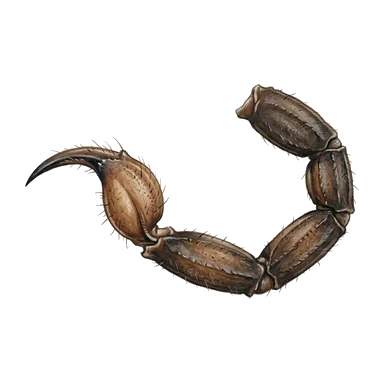 Stings
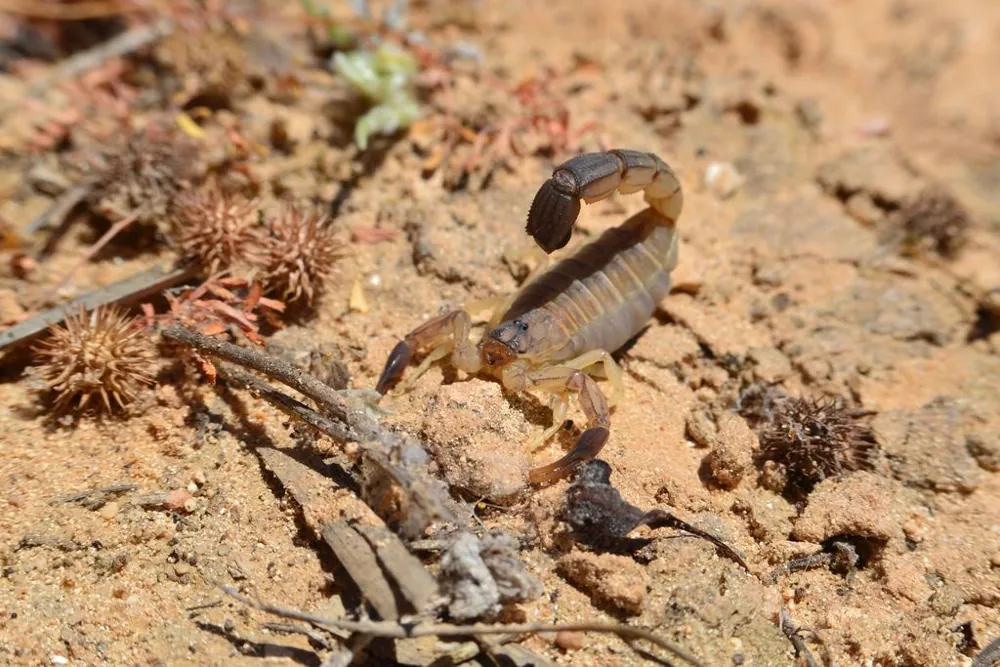
The fat-tailed scorpion is a hardy desert scorpion from North Africa. It can survive powerful sandstorms without digging a burrow. Its venom is among the most dangerous of any scorpion in the world, so it is important to know it by sight and keep well away from it.1
 How to recognise it
- It is a medium-sized scorpion that can grow up to 10 centimetres long.1
- It has a very thick, powerful tail.1
- Stripes run along the sides of its dome-shaped body.1
- Its armour is covered in tiny dome-shaped granules.1
- It is active at night and hides by day.1
Often confused with: Generally similar scorpions from the Middle East and India were once thought to be this species. Recent studies treat them as different species.1
Venom power
Venom comes out through a stinger.
What does its venom do?
Its venom is very potent and is mainly made of neurotoxins (which attack the nerves), cardiotoxins (which harm the heart) and myotoxins (which damage muscle). It also contains hemotoxins, which affect the blood. Deaths in people usually occur through heart and breathing failure, and sometimes through bleeding in the brain, organ damage or shock.1
How dangerous is it to people?
Danger to people: Very dangerousIt can kill a person who gets no treatment.It is one of the world's most dangerous scorpions, due to the strength of its venom and its aggressive temperament. It claims several lives each year.1
If it stings
Always call your emergency number first (for example 112 in Europe, 911 in North America, 000 in Australia).
- Call the emergency number or a poison centre and get to hospital, especially if a child is stung. Keep the person calm and still, and put a cold pack on the sting for pain. Do not cut, suck or use a tourniquet.1
- Cool the sting with an ice pack and keep the person still. Get medical help fast, especially for children: some scorpions are deadly to kids.
This is general first aid guidance, not medical advice. Based on the first aid guidelines of the World Health Organization and the Australian Resuscitation Council. Facts come from public sources and may contain mistakes. When in doubt, always get medical help. First aid basics
 Stay safe
- Never touch, catch or tease a wild animal, even a small one, and even if it looks asleep or dead.
- Give it space. If you meet one, stay calm, step back slowly and let it go its own way.
- If one stings you: stay calm, keep still, call your emergency number (for example 112 in Europe, 911 in North America, 000 in Australia) or get to a hospital fast. Remember what it looked like, a photo helps.
It is not out to get you. It uses its venom to catch food or to protect itself, and it would much rather hide. More about staying safe
Where in the world?
How big is it?
How long is it?
 about as long as a bank card
 could cover 100 metres in 180 seconds (the fastest human needs 9.6)
How big is Fat-tailed scorpion compared to you?
Just maths in your browser. Nothing is saved or sent anywhere.
How fast is it?


Facts
It can withstand sandstorms strong enough to strip paint off steel, and it does not dig burrows to shelter from them.1
Researchers have considered copying the sand-proof texture of its armour for use on aeroplanes and helicopters.1
Its armour has dome-shaped granules about 10 micrometres high, and scientists think this texture helps protect it from sand.1
The lethal dose (LD50) of its venom is 0.32 mg per kg when injected under the skin.1
Its venom contains a toxin called AaTX1, which was first found in this species.1
Myth buster
Myth: The fat-tailed scorpion lives across the Middle East and as far east as India.
Truth: Older data suggested a wider range, but more recent studies have discredited this. It is found in North Africa.1
Where the facts come from
- Androctonus australis (Wikipedia (CC BY-SA 4.0))
- Androctonus australis (iNaturalist): names and classification.
- Venom Wiki: the danger level, the typical size and the speed guess are our own. See how we work them out: How we rate danger.
Every fact on this page has a number that points to its source. If we got something wrong, sorry, we are animal fans, not a science journal. Tell us at [email protected] and we will fix it.
Get the Venom Wiki app
Every creature, every picture and the games in your pocket, even without internet.


 Support Venom Wiki Venom Wiki is a one-man project: free, with no ads and no cookies. A small tip helps keep it online.Feed the scorpion
 Deathstalker
 Emperor scorpion
 Arabian fat-tailed scorpion
 Transvaal thick-tailed scorpion
 European yellow-tailed scorpion
 Flat rock scorpion
 Black mamba
 Egyptian cobra
 Puff adder
 Boomslang
 Gaboon viper
 Western honey bee