
 Bitten or stung?
 All animals
 Pick a continent
 Africa
 Asia
 Europe
 South America
 Australia & Oceania
 Antarctica
 Pacific Ocean
 Atlantic Ocean
 Indian Ocean
 Arctic Ocean
 Mediterranean Sea
 Red Sea
 Caribbean Sea
 Coral Sea
 South China Sea
 Philippine Sea
 Andaman Sea
 North Sea
 Timor & Arafura Sea
 Bay of Bengal
 Gulf of California
 Games
 Venom battle
 Animal race
 Field notebook
 Venom TOP lists
 Stay safe
 Surprise me

Common stingray
 StingsEats: MeatTOP 50 · No. 38: LongestTOP 50 · No. 16: FastestTOP 50 · No. 19: Longest living
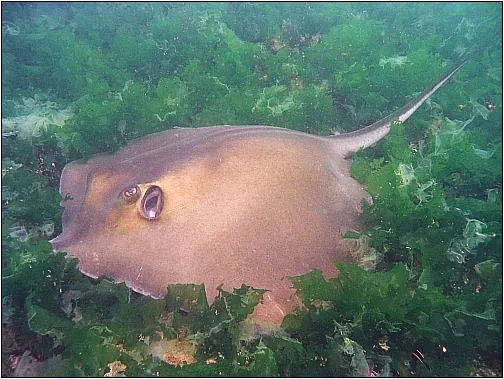
The common stingray is a flat, diamond-shaped ray that lives on sandy or muddy seabeds in shallow coastal waters. It is found in the northeastern Atlantic, the Mediterranean and the Black Sea. It has a venomous spine on its tail, which can give a very painful sting.1
 How to recognise it
- Diamond-shaped pectoral fin disc that is slightly wider than it is long1
- Plain colour: solid grey, brown, reddish or olive-green above, and whitish below with dark fin edges1
- Mostly smooth skin; the largest individuals have a row of bony knobs along the middle of the back1
- Slender, whip-like tail with a serrated venomous spine about a third of the way along it1
Often confused with: The blue stingray of southern Africa was once thought to be a variant of this species, but it is a separate species. The common stingray lacks the blue markings of the blue stingray. Tortonese's stingray of the Mediterranean is similar, and the difference between the two is poorly understood.1
Venom power
Venom comes out through a stinger.
What does its venom do?
The venom comes from a gland at the base of a serrated tail spine. A sting causes an excruciatingly painful wound. It is rarely life-threatening.1
How dangerous is it to people?
Danger to people: SeriousA sting needs a doctor. Deaths are very rare.The common stingray is not aggressive, but it can inflict a very painful wound with its tail spine. The wound is rarely life-threatening.1
 If it stings
Always call your emergency number first (for example 112 in Europe, 911 in North America, 000 in Australia).
- Get out of the water and soak the wound in hot water, as hot as the person can stand without scalding (about 45 °C), for 30 to 90 minutes. Do not pull out a spine stuck deep in the body. See a doctor, as wounds often need cleaning, X-rays and a tetanus shot. Call the emergency number for a chest or belly wound or heavy bleeding.1
- Put the wound in hot water, about 45 °C: as hot as the helper can comfortably hold their own hand in, never hotter, for 30 to 90 minutes. Get medical help, especially for stonefish and stingrays.
This is general first aid guidance, not medical advice. Based on the first aid guidelines of the World Health Organization and the Australian Resuscitation Council. Facts come from public sources and may contain mistakes. When in doubt, always get medical help. First aid basics
 Stay safe
- Never touch, catch or tease a wild animal, even a small one, and even if it looks asleep or dead.
- Give it space. If you meet one, stay calm, step back slowly and let it go its own way.
- If one stings you: stay calm, keep still, call your emergency number (for example 112 in Europe, 911 in North America, 000 in Australia) or get to a hospital fast. Remember what it looked like, a photo helps.
It is not out to get you. It uses its venom to catch food or to protect itself, and it would much rather hide. More about staying safe
Where in the world?
How big is it?
How long is it?
 as long as 2.5 dogs nose to tail
 as long as 14 bananas end to end
 could swim the length of a big swimming pool (50 m) in 9.5 seconds
How big is Common stingray compared to you?
Just maths in your browser. Nothing is saved or sent anywhere.
How fast is it?

Facts
The tail spine is replaced regularly, and a second or even third spine may be growing in behind the first.1
The largest recorded specimen was found in 2016 in İzmir Province, Turkey, with fins measuring 2.21 m across.1
Welsh fishermen once used its liver oil to treat burns and other injuries, and its liver is a delicacy in French cuisine.1
The oldest known wild individual was ten years old, but the species has lived up to 21 years in captivity.1
Myth buster
Myth: The stingray's spine could kill trees, pierce armour like an arrow, corrode iron and even dissolve stone, as some ancient writers claimed.
Truth: The common stingray's wound is painful but rarely life-threatening. These ancient claims about its spine were legends.1
For venom experts
- Scientific name
- Dasyatis pastinaca
- Group
- Venomous fish
- Also called
- Fire-flare, Fiery-flare1
- Family
- Dasyatidae2
- Order
- Myliobatiformes
- Continents
- Atlantic Ocean, Mediterranean Sea, North Sea, The oceans
- Babies
- It is aplacental viviparous, meaning it gives birth to live young. Females bear 4 to 9 young twice a year in shallow inshore water, after a gestation period of four months.1
- Lifespan
- about 21 years1
- How it is doing in the wild
- Vulnerable1
- Danger to people
- 3 / 5: Serious3
Where the facts come from
- Common stingray (Wikipedia (CC BY-SA 4.0))
- Dasyatis pastinaca (iNaturalist): names and classification.
- Venom Wiki: the danger level, the typical size and the speed guess are our own. See how we work them out: How we rate danger.
Every fact on this page has a number that points to its source. If we got something wrong, sorry, we are animal fans, not a science journal. Tell us at [email protected] and we will fix it.
Get the Venom Wiki app
Every creature, every picture and the games in your pocket, even without internet.


 Support Venom Wiki Venom Wiki is a one-man project: free, with no ads and no cookies. A small tip helps keep it online.Feed the scorpion
More from the same group: Venomous fish
 Reef stonefish
 Red lionfish
 Estuarine stonefish
 Short-tail stingray
 Bluespotted ribbontail ray
 Demon stinger

Also lives in: Atlantic Ocean
 Hawksbill sea turtleOther poisonous animalsCan kill
 Portuguese man o' warJellyfish & sea stingersNeeds a doctorDo not touch
 Blue sea dragonCone snails & octopusesPainful
 Greenland sharkOther poisonous animalsPainful
 Lion's mane jellyfishJellyfish & sea stingersPainfulDo not touch
 Common octopusCone snails & octopusesMild