
 Bitten or stung?
 All animals
 Pick a continent
 Africa
 Asia
 Europe
 South America
 Australia & Oceania
 Antarctica
 Pacific Ocean
 Atlantic Ocean
 Indian Ocean
 Arctic Ocean
 Mediterranean Sea
 Red Sea
 Caribbean Sea
 Coral Sea
 South China Sea
 Philippine Sea
 Andaman Sea
 North Sea
 Timor & Arafura Sea
 Bay of Bengal
 Gulf of California
 Games
 Venom battle
 Animal race
 Field notebook
 Venom TOP lists
 Stay safe
 Surprise me

Red lionfish
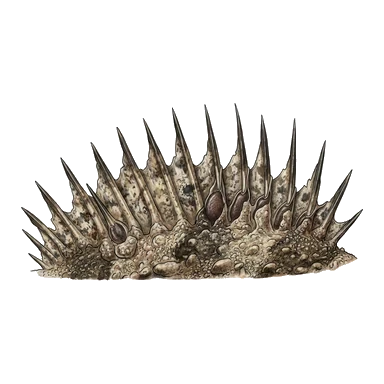 Venomous spines
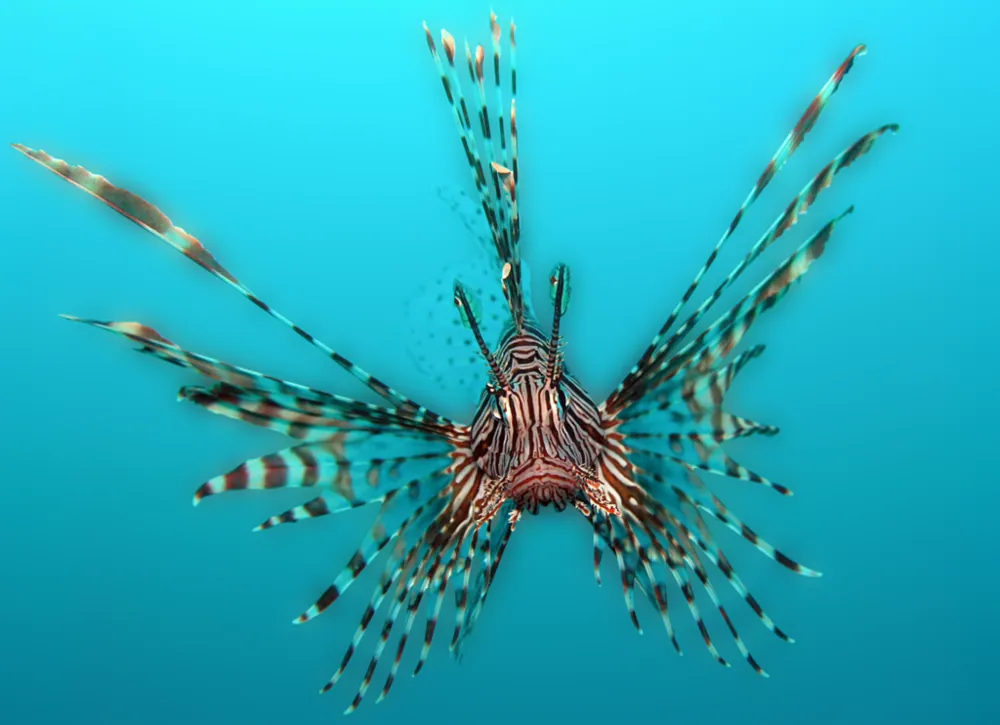
The red lionfish is a venomous coral reef fish with long, frilled fins that look like a mane. It is native to the Indo-Pacific, but it has spread into the Caribbean, the east coast of the United States and other areas, where it is an invasive species. Its spreading is a serious problem for local reef life.1
 How to recognise it
- White stripes alternate with red, maroon or brown stripes.1
- Large venomous spines run along the back (dorsal) fin, with more on the pelvic and anal fins.1
- Long, non-venomous fins create a mane-like outline.1
- Adults can grow up to 47 cm long.1
Often confused with: Pterois miles is a similar relative, and both species are invasive in the same areas.1
Venom power
Sharp spines carry the venom. Stepping on it or grabbing it hurts.
What does its venom do?
Its venomous spines are used purely for defence. A sting can cause extreme pain, and possibly headaches, vomiting and breathing difficulties.1
How dangerous is it to people?
Danger to people: SeriousIf its spines stab you, see a doctor. Deaths are very rare.Its sting is usually not fatal to humans. Some people are more sensitive to the venom than others, so the effects can be more serious for them.1
What does it do when it is scared?
When threatened, it turns its venomous dorsal spines towards the attacker, even if it has to swim upside down.1
 If its spines stab you
Always call your emergency number first (for example 112 in Europe, 911 in North America, 000 in Australia).
- Get out of the water. Put the stung part in hot water, about 45 °C: as hot as the helper can comfortably hold their own hand in, never hotter, for 30 to 90 minutes to ease the pain. Remove any spine pieces you can see and clean the wound. See a doctor, and call the emergency number if the pain is severe, the person feels faint or has trouble breathing.1
- Put the wound in hot water, about 45 °C: as hot as the helper can comfortably hold their own hand in, never hotter, for 30 to 90 minutes. Get medical help, especially for stonefish and stingrays.
This is general first aid guidance, not medical advice. Based on the first aid guidelines of the World Health Organization and the Australian Resuscitation Council. Facts come from public sources and may contain mistakes. When in doubt, always get medical help. First aid basics
 Stay safe
- Never touch, catch or tease a wild animal, even a small one, and even if it looks asleep or dead.
- Give it space. If you meet one, stay calm, step back slowly and let it go its own way.
- If its spines stab you: stay calm, keep still, call your emergency number (for example 112 in Europe, 911 in North America, 000 in Australia) or get to a hospital fast. Remember what it looked like, a photo helps.
It is not out to get you. It uses its venom to catch food or to protect itself, and it would much rather hide. More about staying safe
Where in the world?
How big is it?
How long is it?
 as long as 2.5 bananas end to end
 as long as 5 bank cards end to end
 could swim the length of a big swimming pool (50 m) in 29 seconds
How big is Red lionfish compared to you?
Just maths in your browser. Nothing is saved or sent anywhere.
How fast is it?
Facts
About 93% of the invasive lionfish population is the red lionfish.1
It strikes at prey that comes within 9 cm of its mouth, drawing the prey in with a sudden rush of water.1
Lionfish reproduce monthly, which helps their numbers grow quickly in new areas.1
Lionfish larvae hatch 36 hours after fertilisation.1
The larval stage is the shortest part of its life, lasting about one month.1
For venom experts
- Scientific name
- Pterois volitans
- Group
- Venomous fish
- Also called
- Common Lionfish, Turkey Fish, Turkeyfish1
- Family
- Scorpaenidae2
- Order
- Perciformes
- Continents
- Indian Ocean, Pacific Ocean, Red Sea, Coral Sea, Philippine Sea, South China Sea, Andaman Sea, Arabian Sea & Persian Gulf, Timor & Arafura Sea, The oceans, Atlantic Ocean, Caribbean Sea, Gulf of Mexico
- Babies
- After courtship, the female releases two egg masses, and one mating session can produce up to 30,000 eggs.1
- Lifespan
- about 10 years1
- Danger to people
- 3 / 5: Serious3
Where the facts come from
- Red lionfish (Wikipedia (CC BY-SA 4.0))
- Pterois volitans (iNaturalist): names and classification.
- Venom Wiki: the danger level, the typical size and the speed guess are our own. See how we work them out: How we rate danger.
Every fact on this page has a number that points to its source. If we got something wrong, sorry, we are animal fans, not a science journal. Tell us at [email protected] and we will fix it.
Get the Venom Wiki app
Every creature, every picture and the games in your pocket, even without internet.


 Support Venom Wiki Venom Wiki is a one-man project: free, with no ads and no cookies. A small tip helps keep it online.Feed the scorpion
More from the same group: Venomous fish
 Reef stonefish
 Estuarine stonefish
 Short-tail stingray
 Bluespotted ribbontail ray
 Common stingray
 Demon stinger
Also lives in: Indian Ocean
 Australian box jellyfishJellyfish & sea stingersDeadlyDo not touch
 Geography coneCone snails & octopusesDeadly
 Greater blue-ringed octopusCone snails & octopusesDeadly
 Southern blue-ringed octopusCone snails & octopusesDeadly
 Hawksbill sea turtleOther poisonous animalsCan kill
 Irukandji jellyfishJellyfish & sea stingersCan killDo not touch