
 Bitten or stung?
 All animals
 Pick a continent
 Africa
 Asia
 Europe
 South America
 Australia & Oceania
 Antarctica
 Pacific Ocean
 Atlantic Ocean
 Indian Ocean
 Arctic Ocean
 Mediterranean Sea
 Red Sea
 Caribbean Sea
 Coral Sea
 South China Sea
 Philippine Sea
 Andaman Sea
 North Sea
 Timor & Arafura Sea
 Bay of Bengal
 Gulf of California
 Games
 Venom battle
 Animal race
 Field notebook
 Venom TOP lists
 Stay safe
 Surprise me

Blue sea dragon
 Stings
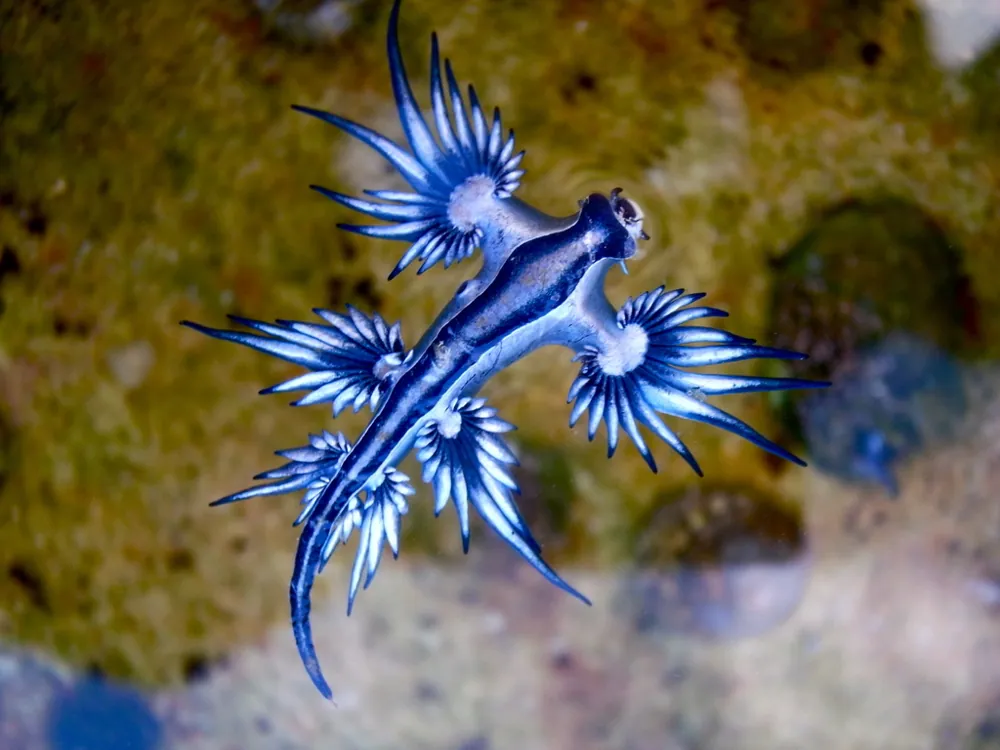
The blue sea dragon is a small, bright blue sea slug that floats upside down on the open ocean. It drifts with winds and currents in warm and temperate seas around the world. It is special because it steals stinging cells from the animals it eats and uses them as its own weapon.1
 How to recognise it
- Usually around 3 cm long1
- Floats upside down at the surface, with its blue side facing up1
- Silvery grey on its back, which faces down in the water1
- Dark blue stripes on its head1
- Six finger-like, feathery appendages called cerata1
Often confused with: It is closely related to G. marginatus, which is now known to be four separate species living in the Indian and Pacific Oceans. It also shares the name "blue dragon" with Pteraeolidia ianthina and G. marginatus.1
Venom power
It fires a tiny harpoon-like tooth full of venom.
What does its venom do?
It does not make its own venom. It takes the stinging cells (nematocysts) from the Portuguese man o' war and stores them in its cerata, a process called kleptocnidy. Because it concentrates this venom, its sting can be stronger than that of the animal it eats. Symptoms can include pain, nausea, vomiting, a rash, redness and blisters.1
How dangerous is it to people?
Danger to people: PainfulIt can really hurt, but it is almost never serious.Picking up the animal can cause a very painful sting that may be dangerous. Its sting produces symptoms similar to those of the Portuguese man o' war.1
What does it do when it is scared?
It stores stinging cells from its prey in its cerata and uses them against predators.1
 If it stings
Call your emergency number at once if the person has trouble breathing, swelling of the face or throat, or feels faint.
- Pressure immobilisation: wrap a firm elastic bandage over the bite and then up the whole limb, splint it, and keep the person completely still until help arrives.
- A blue-ringed octopus or cone snail can stop a person breathing while they are still awake: call for help and be ready to give rescue breaths until the ambulance takes over.
This is general first aid guidance, not medical advice. Based on the first aid guidelines of the World Health Organization and the Australian Resuscitation Council. Facts come from public sources and may contain mistakes. When in doubt, always get medical help. First aid basics
 Stay safe
- Never touch, catch or tease a wild animal, even a small one, and even if it looks asleep or dead.
- Give it space. If you meet one, stay calm, step back slowly and let it go its own way.
- If it hurts you: wash the spot, stay calm and get medical help if the pain is strong or spreads, or the person feels unwell.
It is not out to get you. It uses its venom to catch food or to protect itself, and it would much rather hide. More about staying safe
Where in the world?
How big is it?
How long is it?
 about as long as a paper clip
 slower than a garden snail
How big is Blue sea dragon compared to you?
Just maths in your browser. Nothing is saved or sent anywhere.
How fast is it?

Facts
It can eat the Portuguese man o' war without harm, because it is immune to that animal's stinging cells.1
It floats upside down because its gas-filled stomach sac sits on the wrong side of its body, so its foot becomes its upper surface.1
Its blue colour is thought to reflect harmful ultraviolet sunlight.1
Its countershading, with blue on top and silver-grey below, helps it hide from predators above and below.1
It can lay up to 55 egg strings per hour.1
For venom experts
- Scientific name
- Glaucus atlanticus
- Group
- Cone snails & octopuses
- Also called
- Sea swallow, Blue angel, Blue glaucus1
- Family
- Glaucidae2
- Order
- Nudibranchia
- Continents
- Atlantic Ocean, Pacific Ocean, Indian Ocean, The oceans
- Babies
- After mating, both partners lay egg strings with up to 20 eggs on each string, often on floating wood or on the remains of prey.1
- Lifespan
- about 1 years1
- Danger to people
- 2 / 5: Painful3
Where the facts come from
- Glaucus atlanticus (Wikipedia (CC BY-SA 4.0))
- Glaucus atlanticus (iNaturalist): names and classification.
- Venom Wiki: the danger level, the typical size and the speed guess are our own. See how we work them out: How we rate danger.
Every fact on this page has a number that points to its source. If we got something wrong, sorry, we are animal fans, not a science journal. Tell us at [email protected] and we will fix it.
Get the Venom Wiki app
Every creature, every picture and the games in your pocket, even without internet.


 Support Venom Wiki Venom Wiki is a one-man project: free, with no ads and no cookies. A small tip helps keep it online.Feed the scorpion
More from the same group: Cone snails & octopuses
 Geography cone
 Greater blue-ringed octopus
 Southern blue-ringed octopus
 Common octopus
 Giant Pacific octopus
 Blue-lined octopus
Also lives in: Atlantic Ocean
 Hawksbill sea turtleOther poisonous animalsCan kill
 Portuguese man o' warJellyfish & sea stingersNeeds a doctorDo not touch
 Red lionfishVenomous fishNeeds a doctorDo not touch
 Greenland sharkOther poisonous animalsPainful
 Lion's mane jellyfishJellyfish & sea stingersPainfulDo not touch
 Moon jellyfishJellyfish & sea stingersMild