
 Bitten or stung?
 All animals
 Pick a continent
 Africa
 Asia
 Europe
 South America
 Australia & Oceania
 Antarctica
 Pacific Ocean
 Atlantic Ocean
 Indian Ocean
 Arctic Ocean
 Mediterranean Sea
 Red Sea
 Caribbean Sea
 Coral Sea
 South China Sea
 Philippine Sea
 Andaman Sea
 North Sea
 Timor & Arafura Sea
 Bay of Bengal
 Gulf of California
 Games
 Venom battle
 Animal race
 Field notebook
 Venom TOP lists
 Stay safe
 Surprise me

Giant leaf frog
 Poison in its skin
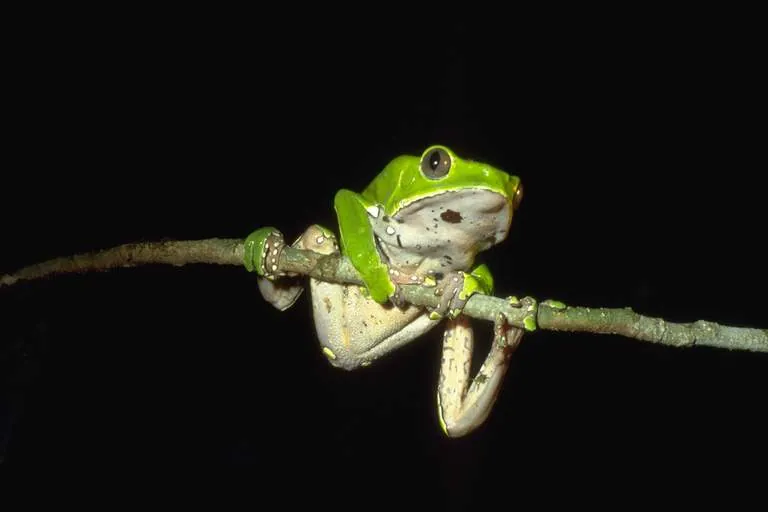
The giant leaf frog is a large tree frog with lime green skin and a white or cream belly. It lives in the rainforests of the Amazon basin in South America. Its skin releases chemicals that act as a defence against predators.1
 How to recognise it
- Lime green back with a white to yellow-white or cream belly1
- Sparse white spots with dark frames on the lower lips, chest and front legs, denser on the flanks and hind legs1
- Transparent brown fingers with large green adhesive discs1
- A prominent gland behind each eye, extending over the eardrum1
- Dark grey iris1
Poison power
Its skin is poisonous. It is dangerous to touch, lick or eat.
What does its poison do?
The giant leaf frog's skin secretion contains opioid peptides, including deltorphin and dermorphin. Its skin peptides act as a chemical defence against predators. In kambo rituals, where the secretion is used, it induces intense vomiting.1
How dangerous is it to people?
Danger to people: PainfulIt can really hurt, but it is almost never serious.What does it do when it is scared?
When threatened, its skin produces peptides that act as a chemical defence against predators.1
 If someone touched or ate it
Call your emergency number at once if the person has trouble breathing, swelling of the face or throat, or feels faint.
- If someone touched one: wash the hands well and do not touch the eyes or mouth. If a child or pet licked or ate one: call your poison centre or emergency number.
This is general first aid guidance, not medical advice. Based on the first aid guidelines of the World Health Organization and the Australian Resuscitation Council. Facts come from public sources and may contain mistakes. When in doubt, always get medical help. First aid basics
 Stay safe
- Never touch, catch or tease a wild animal, even a small one, and even if it looks asleep or dead.
- Give it space. If you meet one, stay calm, step back slowly and let it go its own way.
- If you touched or ate it: do not rub your eyes or mouth, wash your hands and get medical help.
It is not out to get you. Its poison is only there so that nothing eats it. More about staying safe
Where in the world?
How big is it?
How long is it?
 about as long as a bank card
 could cover 100 metres in 72 seconds (the fastest human needs 9.6)
How big is Giant leaf frog compared to you?
Just maths in your browser. Nothing is saved or sent anywhere.
How fast is it?


Facts
Its skin secretion is known as Vacina do sapo, or frog vaccine, and is used in a ritual called kambo or sapo.1
Up to 61% of the eggs of the giant leaf frog are eaten by predators.1
Males fight rivals for mating rights by using their heads to separate a rival male from a female, and by pushing with their hind legs.1
Males are more likely to be targeted by predators during mating season, because their loud fights can be heard easily.1
Eggs are eaten by rove beetles, phorid flies, possibly tufted capuchins and banded cat-eyed snakes, because they are a source of protein.1
For venom experts
- Scientific name
- Phyllomedusa bicolor
- Group
- Poison frogs, toads & newts
- Also called
- bicolor tree-frog, giant monkey frog, waxy-monkey treefrog1
- Family
- Phyllomedusidae2
- Order
- Anura
- Continents
- South America
- Babies
- The female and male build a leaf-nest above forest pools and lay eggs in a gelatinous mass about 70 cm above the water. The eggs hatch in about 14 days, and the tadpoles fall into the water to develop into adult frogs.1
- How it is doing in the wild
- Least Concern1
- Danger to people
- 2 / 5: Painful3
Where the facts come from
- Phyllomedusa bicolor (Wikipedia (CC BY-SA 4.0))
- Phyllomedusa bicolor (iNaturalist): names and classification.
- Venom Wiki: the danger level, the typical size and the speed guess are our own. See how we work them out: How we rate danger.
Every fact on this page has a number that points to its source. If we got something wrong, sorry, we are animal fans, not a science journal. Tell us at [email protected] and we will fix it.
Get the Venom Wiki app
Every creature, every picture and the games in your pocket, even without internet.


 Support Venom Wiki Venom Wiki is a one-man project: free, with no ads and no cookies. A small tip helps keep it online.Feed the scorpion
More from the same group: Poison frogs, toads & newts
 Golden poison frogPoison frogs, toads & newtsDeadlyDo not touch
 Cane toadPoison frogs, toads & newtsNeeds a doctorDo not touch
 Dyeing poison dart frogPoison frogs, toads & newtsPainfulDo not touch
 Black-legged poison frogPoison frogs, toads & newtsCan killDo not touch
 Harlequin poison frogPoison frogs, toads & newtsNeeds a doctorDo not touch
 Bruno's casque-headed frogPoison frogs, toads & newtsPainfulDo not touch
 Terciopelo
 Brazilian wandering spider
 Golden lancehead
 South American bushmaster
 Eyelash viper
 Peruvian giant centipede
