
 Bitten or stung?
 All animals
 Pick a continent
 Africa
 Asia
 Europe
 South America
 Australia & Oceania
 Antarctica
 Pacific Ocean
 Atlantic Ocean
 Indian Ocean
 Arctic Ocean
 Mediterranean Sea
 Red Sea
 Caribbean Sea
 Coral Sea
 South China Sea
 Philippine Sea
 Andaman Sea
 North Sea
 Timor & Arafura Sea
 Bay of Bengal
 Gulf of California
 Games
 Venom battle
 Animal race
 Field notebook
 Venom TOP lists
 Stay safe
 Surprise me

Japanese fire-bellied newt
 Poison in its skinEats: MeatTOP 50 · No. 16: Longest livingPoisonous, not venomous
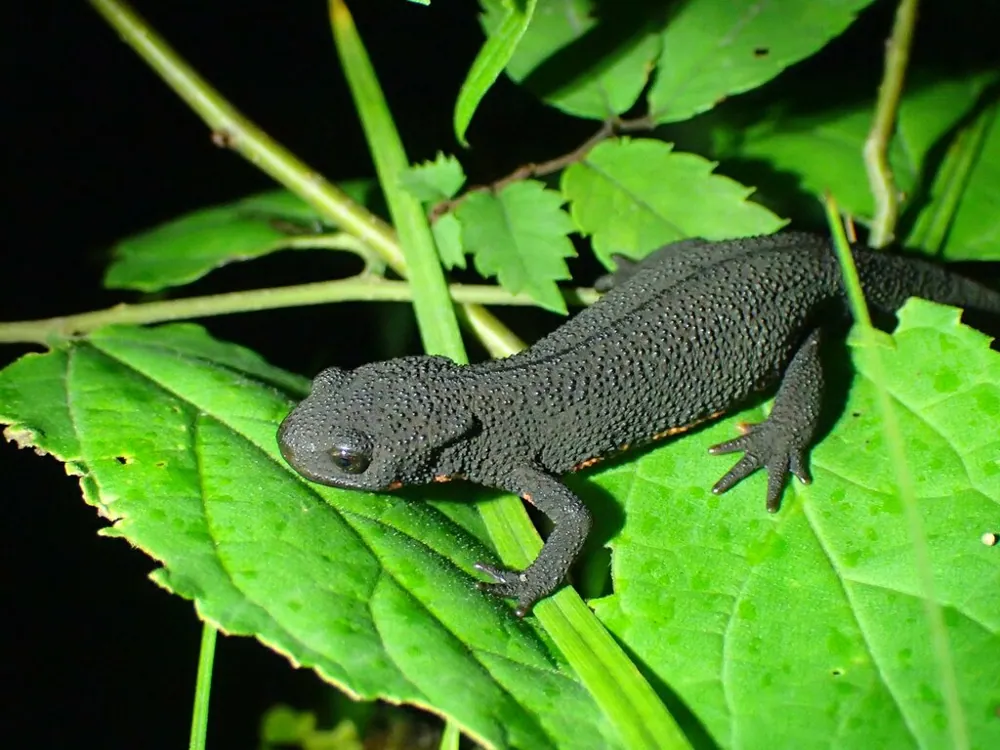
The Japanese fire-bellied newt is a small amphibian with a dark back and a bright red belly. It lives only in Japan, in ponds, streams, forests and grasslands. Its body contains a strong poison that helps protect it from predators.1
 How to recognise it
- The skin on its upper body is dark brown, approaching black, and covered in wartlike bumps.1
- The underbelly and underside of the tail are bright red with black spots.1
- Young juveniles have creamy coloured bellies instead of red, though most larger juveniles show some red.1
- Males have flatter, wider tails and more red on the belly than females.1
- Adults are 8 to 15 cm long.1
Often confused with: The German zoologist Heinrich Boie, who first described it in 1826, said he would have mistaken it for the smooth newt if he had not known it came from Japan.1
Poison power
Its skin is poisonous. It is dangerous to touch, lick or eat.
What does its poison do?
The newt is not venomous: it does not bite or sting with venom. Its body contains high levels of tetrodotoxin, a neurotoxin, which is a poison that attacks the nerves. The newt gets most of this poison from its diet.1
How dangerous is it to people?
Danger to people: PainfulIt can really hurt, but it is almost never serious.What does it do when it is scared?
Newts on smaller islands use the unken reflex, where they expose their bright red belly to startle or deter a predator. Newts on the mainland use different antipredator behaviour.1
 If someone touched or ate it
Call your emergency number at once if the person has trouble breathing, swelling of the face or throat, or feels faint.
- Wash your hands after touching the newt and do not touch your eyes or mouth. Never eat it. If any part of a newt has been swallowed, call the emergency number or poison centre straight away.1
- If someone touched one: wash the hands well and do not touch the eyes or mouth. If a child or pet licked or ate one: call your poison centre or emergency number.
This is general first aid guidance, not medical advice. Based on the first aid guidelines of the World Health Organization and the Australian Resuscitation Council. Facts come from public sources and may contain mistakes. When in doubt, always get medical help. First aid basics
 Stay safe
- Never touch, catch or tease a wild animal, even a small one, and even if it looks asleep or dead.
- Give it space. If you meet one, stay calm, step back slowly and let it go its own way.
- If you touched or ate it: do not rub your eyes or mouth, wash your hands and get medical help.
It is not out to get you. Its poison is only there so that nothing eats it. More about staying safe
Where in the world?
How big is it?
How long is it?
 as long as 2 bank cards end to end
How big is Japanese fire-bellied newt compared to you?
Just maths in your browser. Nothing is saved or sent anywhere.
How fast is it?


Facts
The newt's body contains tetrodotoxin, a poison that it mostly takes in from the food it eats.1
Newts can regrow missing body parts, and this ability has been studied by scientists.1
Wild individuals as old as 23 years have been found.1
Males and females both produce peptide pheromones, chemical signals that attract the opposite sex when they are ready to mate.1
The larvae hatch as swimming, gilled young and lose their gills and fins at five to six months, when they become juveniles that live on land.1
For venom experts
- Scientific name
- Cynops pyrrhogaster
- Group
- Poison frogs, toads & newts
- Also called
- Japanese Fire Belly Newt, Red-bellied newt, Japanese fire-bellied salamander1
- Family
- Salamandridae2
- Order
- Caudata
- Continents
- Asia
- Babies
- Females lay eggs one at a time on underwater objects such as leaves and submerged roots. They can lay up to 40 eggs in one session and 100 to 400 in a breeding season. The eggs hatch after about three weeks.1
- Lifespan
- about 23 years1
- Danger to people
- 2 / 5: Painful3
Where the facts come from
- Japanese fire-bellied newt (Wikipedia (CC BY-SA 4.0))
- Cynops pyrrhogaster (iNaturalist): names and classification.
- Venom Wiki: the danger level, the typical size and the speed guess are our own. See how we work them out: How we rate danger.
Every fact on this page has a number that points to its source. If we got something wrong, sorry, we are animal fans, not a science journal. Tell us at [email protected] and we will fix it.
Get the Venom Wiki app
Every creature, every picture and the games in your pocket, even without internet.


 Support Venom Wiki Venom Wiki is a one-man project: free, with no ads and no cookies. A small tip helps keep it online.Feed the scorpion
More from the same group: Poison frogs, toads & newts
 Common toadPoison frogs, toads & newtsMild
 Oriental fire-bellied toadPoison frogs, toads & newtsMild
 Asian common toadPoison frogs, toads & newtsNeeds a doctorDo not touch
 Asiatic toadPoison frogs, toads & newtsPainfulDo not touch
 Emperor newtPoison frogs, toads & newtsPainfulDo not touch
 Himalayan newtPoison frogs, toads & newtsPainfulDo not touch
 Indian cobra
 Indian saw-scaled viper
 King cobra
 Puff adder
 Russell's viper
 Asian giant hornet