
 Bitten or stung?
 All animals
 Pick a continent
 Africa
 Asia
 Europe
 South America
 Australia & Oceania
 Antarctica
 Pacific Ocean
 Atlantic Ocean
 Indian Ocean
 Arctic Ocean
 Mediterranean Sea
 Red Sea
 Caribbean Sea
 Coral Sea
 South China Sea
 Philippine Sea
 Andaman Sea
 North Sea
 Timor & Arafura Sea
 Bay of Bengal
 Gulf of California
 Games
 Venom battle
 Animal race
 Field notebook
 Venom TOP lists
 Stay safe
 Surprise me

Oriental fire-bellied toad
 Poison in its skin
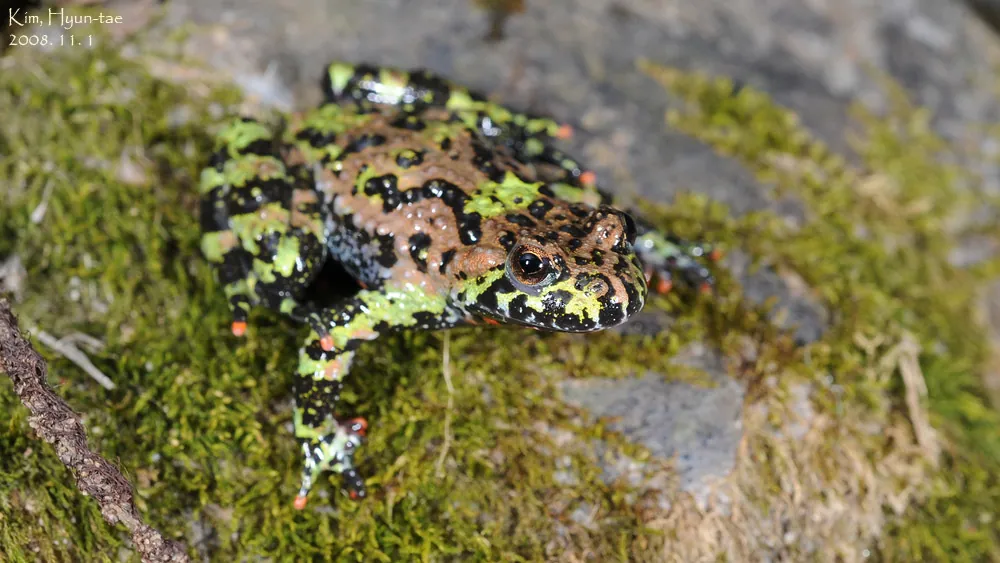
The Oriental fire-bellied toad is a small frog that lives in northeastern Asia, mostly near slow streams, ponds and forests. Its bright belly is a warning: when it is disturbed, it gives off a mild toxin through its skin. It is common across much of its range.1
 How to recognise it
- Bright grey, brownish or green upper skin with black mottling.1
- Bright yellow, red or orange-red belly, mottled with dark spots.1
- Red finger and toe tips are usually present.1
- Skin on the upper side is covered in small bumps called tubercles, which give it a toad-like look.1
- Adults are about 3.8 to 5.1 cm long.1
Often confused with: It is often mistaken for a toad, but it is not a true toad. Compared with other Bombina frogs, it has no gular sacs (throat pouches), its belly is usually more red than yellow, and it has bright finger tips.1
Poison power
Its skin is poisonous. It is dangerous to touch, lick or eat.
What does its poison do?
The toad's skin releases a milky, mildly toxic substance when it is disturbed or frightened, mostly from the hind legs and sometimes the belly. Its toxins are described as mild, and the toxin does not pose a significant threat to human health. Captive toads are generally less toxic than wild ones, because their diet in the wild adds to their toxicity.1
How dangerous is it to people?
Danger to people: MildLike a bee sting or less. Basically harmless to people, unless the person is allergic.The toxin does not pose a significant threat to human health, but its skin mucus can cause discomfort to the mouth and eyes if the toad is handled.1
What does it do when it is scared?
When threatened, it releases toxin from its skin, lies on its back to show its brightly coloured belly, and arches its head and holds up its limbs as a warning.1
 If someone touched or ate it
Call your emergency number at once if the person has trouble breathing, swelling of the face or throat, or feels faint.
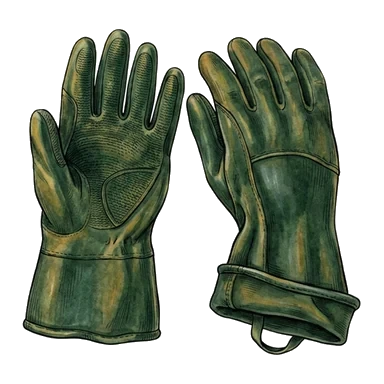
- If someone touched one: wash the hands well and do not touch the eyes or mouth. If a child or pet licked or ate one: call your poison centre or emergency number.
This is general first aid guidance, not medical advice. Based on the first aid guidelines of the World Health Organization and the Australian Resuscitation Council. Facts come from public sources and may contain mistakes. When in doubt, always get medical help. First aid basics
 Stay safe
- Never touch, catch or tease a wild animal, even a small one, and even if it looks asleep or dead.
- Give it space. If you meet one, stay calm, step back slowly and let it go its own way.
- If you touched or ate it: do not rub your eyes or mouth, wash your hands and get medical help.
It is not out to get you. Its poison is only there so that nothing eats it. More about staying safe
Where in the world?
How big is it?
How long is it?
How heavy is it?
 shorter than your little finger
 could cover 100 metres in 180 seconds (the fastest human needs 9.6)
How big is Oriental fire-bellied toad compared to you?
Just maths in your browser. Nothing is saved or sent anywhere.
How fast is it?


Facts
Unusually for a frog, this species has no eardrum or resonator, and it makes its calls by inhaling.1
In experiments, these toads learned to solve mazes using water as a reward, which other frog types did not manage.1
Its skin contains bombesin, a peptide that affects stomach function in mammals. It was first found in its relative, the European fire-bellied toad.1
Males call to females with a light sound that is compared to a musical triangle.1
Grass snakes and other water-dwelling snakes are known to eat these toads without any ill effect.1
In captivity they often live for around 12 years, and some have lived up to 30 years.1
Myth buster
Myth: It is a true toad.
Truth: It is not a true toad, although its bumpy skin gives it a toad-like appearance.1
For venom experts
- Scientific name
- Bombina orientalis
- Group
- Poison frogs, toads & newts
- Also called
- Oriental Bell Toad, Chinese bell toad, Eastern fire-bellied toad1
- Family
- Bombinatoridae2
- Order
- Anura
- Continents
- Asia
- Babies
- Females lay 40 to 110 eggs in a large cluster near the surface of the water.1
- Lifespan
- about 12 years1
- How it is doing in the wild
- Least Concern1
- Danger to people
- 1 / 5: Mild3
Where the facts come from
- Oriental fire-bellied toad (Wikipedia (CC BY-SA 4.0))
- Bombina orientalis (iNaturalist): names and classification.
- Venom Wiki: the danger level, the typical size and the speed guess are our own. See how we work them out: How we rate danger.
Every fact on this page has a number that points to its source. If we got something wrong, sorry, we are animal fans, not a science journal. Tell us at [email protected] and we will fix it.
Get the Venom Wiki app
Every creature, every picture and the games in your pocket, even without internet.


 Support Venom Wiki Venom Wiki is a one-man project: free, with no ads and no cookies. A small tip helps keep it online.Feed the scorpion
More from the same group: Poison frogs, toads & newts
 Japanese fire-bellied newtPoison frogs, toads & newtsPainfulDo not touch
 Common toadPoison frogs, toads & newtsMild
 Asian common toadPoison frogs, toads & newtsNeeds a doctorDo not touch
 Asiatic toadPoison frogs, toads & newtsPainfulDo not touch
 Emperor newtPoison frogs, toads & newtsPainfulDo not touch
 Himalayan newtPoison frogs, toads & newtsPainfulDo not touch
 Indian cobra
 Indian saw-scaled viper
 King cobra
 Puff adder
 Russell's viper
 Asian giant hornet