
 Bitten or stung?
 All animals
 Pick a continent
 Africa
 Asia
 Europe
 South America
 Australia & Oceania
 Antarctica
 Pacific Ocean
 Atlantic Ocean
 Indian Ocean
 Arctic Ocean
 Mediterranean Sea
 Red Sea
 Caribbean Sea
 Coral Sea
 South China Sea
 Philippine Sea
 Andaman Sea
 North Sea
 Timor & Arafura Sea
 Bay of Bengal
 Gulf of California
 Games
 Venom battle
 Animal race
 Field notebook
 Venom TOP lists
 Stay safe
 Surprise me

Katipo
 Bites
The katipō is a cobweb spider found only in New Zealand, where it lives in coastal sand dunes. It is closely related to the Australian redback spider. Its bite is venomous to people, but bites are rare.1
 How to recognise it
- Adult females have a body length of 8 to 10 mm (about 0.3 to 0.4 in).1
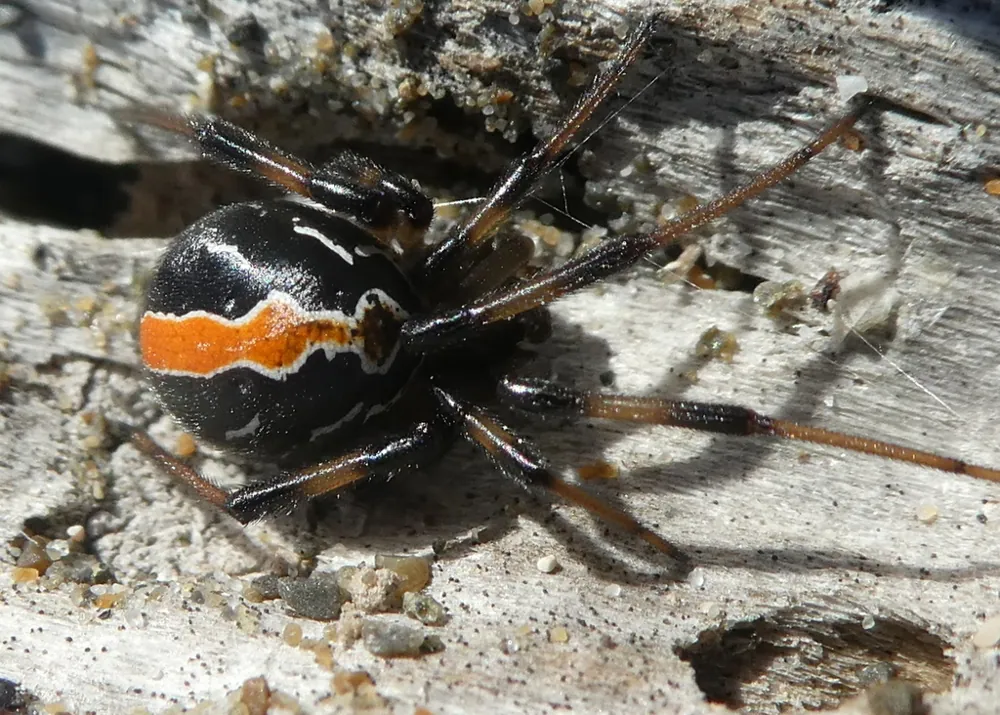
- The red katipō, found in the South Island and lower North Island, has a large black, shiny abdomen with a white-bordered orange or red stripe on top, and a red hourglass-shaped marking underneath.1
- The black katipō, found in the upper North Island, has no upper red or orange stripe and is somewhat lighter in colour.1
- Males are 4 to 5 mm long, white with black stripes and red hourglass-shaped markings.1
Often confused with: Steatoda species, which share the same habitat, are very similar and are called "false katipō" in New Zealand. The katipō has a less shiny, more tapered abdomen, and its side eyes are further apart. It is also similar to the redback, but the katipō has only short hair-like spines on its abdomen, while the redback has a mix of long and short ones.1
Venom power
Venom comes out through its fangs or teeth when it bites.
What does its venom do?
The bite can cause latrodectism, a toxic syndrome that affects the nerves and body. Symptoms include extreme pain and, potentially, high blood pressure (hypertension) or seizures.1
How dangerous is it to people?
Danger to people: SeriousA bite needs a doctor. Deaths are very rare.Katipō are venomous to humans, but bites are described as rare. Serious symptoms are possible, including extreme pain, high blood pressure and seizures.1
 Good news: doctors have a medicine (antivenom) or a treatment for this.1
 If it bites
Always call your emergency number first (for example 112 in Europe, 911 in North America, 000 in Australia).
- Wash the bite and put a cold pack on it to ease the pain. Do not use a tight bandage. See a doctor if the pain spreads, the person sweats a lot or feels unwell, and call the emergency number (111 in New Zealand) if symptoms are severe. Antivenom is available in hospital.1
- Wash the bite and put an ice pack on it for the pain. Get medical help if the pain is strong, spreads or the person feels unwell.
This is general first aid guidance, not medical advice. Based on the first aid guidelines of the World Health Organization and the Australian Resuscitation Council. Facts come from public sources and may contain mistakes. When in doubt, always get medical help. First aid basics
 Stay safe
- Never touch, catch or tease a wild animal, even a small one, and even if it looks asleep or dead.
- Give it space. If you meet one, stay calm, step back slowly and let it go its own way.
- If one bites you: stay calm, keep still, call your emergency number (for example 112 in Europe, 911 in North America, 000 in Australia) or get to a hospital fast. Remember what it looked like, a photo helps.
It is not out to get you. It uses its venom to catch food or to protect itself, and it would much rather hide. More about staying safe
Where in the world?
How big is it?
How long is it?
 smaller than a fingernail
How big is Katipo compared to you?
Just maths in your browser. Nothing is saved or sent anywhere.
How fast is it?


Facts
In one 24-hour study of young spiders, 28% left the web by ballooning, carried by air currents.1
Katipō is one of the few Māori words that refers to a specific species of spider.1
The female does not usually eat the male after mating, unlike some other widow spiders.1
Females cover their egg sacs with silk and sand, which partly hides them in the web.1
The katipō is found only in New Zealand.1
Myth buster
Myth: The katipō is just a form of the redback spider.
Truth: The katipō is genetically and physically distinct from the redback, even though the two are closely related. It was once thought to be a subspecies of the redback.1
For venom experts
- Scientific name
- Latrodectus katipo
- Group
- Spiders
- Also called
- Black katipō, Red katipō1
- Family
- Theridiidae2
- Order
- Araneae
- Continents
- Australia & Oceania
- Babies
- The female lays five or six egg sacs in November or December, with about 70 to 90 eggs in each. The young hatch after 20 to 25 days and leave the egg sac in January and February.1
- How it is doing in the wild
- At Risk, Declining (New Zealand Threat Classification System)1
- Danger to people
- 3 / 5: Serious3
Where the facts come from
- Katipō (Wikipedia (CC BY-SA 4.0))
- Latrodectus katipo (iNaturalist): names and classification.
- Venom Wiki: the danger level, the typical size and the speed guess are our own. See how we work them out: How we rate danger.
Every fact on this page has a number that points to its source. If we got something wrong, sorry, we are animal fans, not a science journal. Tell us at [email protected] and we will fix it.
Get the Venom Wiki app
Every creature, every picture and the games in your pocket, even without internet.


 Support Venom Wiki Venom Wiki is a one-man project: free, with no ads and no cookies. A small tip helps keep it online.Feed the scorpion
 Redback spider
 Noble false widow
 White-tailed spider
 Peacock spider
 Badge huntsman spider
 Black house spider
 Coastal taipan
 Common death adder
 Eastern brown snake
 Inland taipan
 Sydney funnel-web spider
 Tiger snake