
 Bitten or stung?
 All animals
 Pick a continent
 Africa
 Asia
 Europe
 South America
 Australia & Oceania
 Antarctica
 Pacific Ocean
 Atlantic Ocean
 Indian Ocean
 Arctic Ocean
 Mediterranean Sea
 Red Sea
 Caribbean Sea
 Coral Sea
 South China Sea
 Philippine Sea
 Andaman Sea
 North Sea
 Timor & Arafura Sea
 Bay of Bengal
 Gulf of California
 Games
 Venom battle
 Animal race
 Field notebook
 Venom TOP lists
 Stay safe
 Surprise me

Mottled cup moth
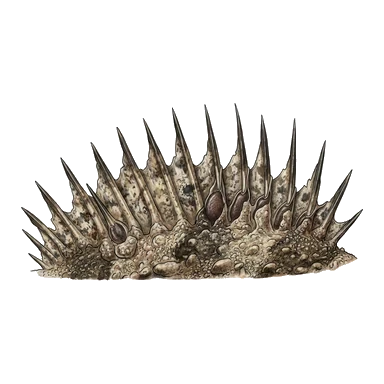 Venomous spines
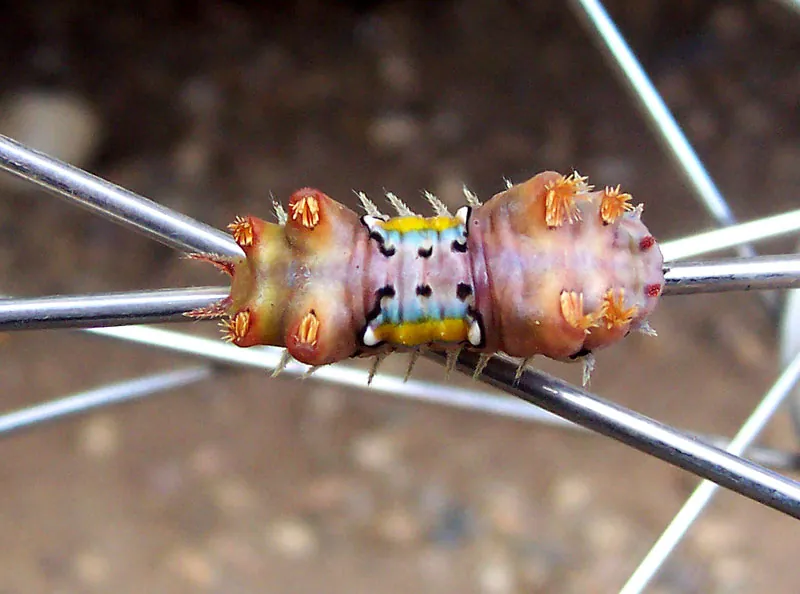
The mottled cup moth is a small Australian moth. Its caterpillar is the part to know about, because it has yellow stinging spines that release painful toxins when touched. The caterpillar's bright bands warn that it is dangerous.1
 How to recognise it
- The adult moth has a rust-coloured body and a white area around its antennae.1
- Its front legs have white bands.1
- The forewings are shiny rust-coloured with silvery edges, and the hindwings are dull white.1
- The caterpillar is only about 2 cm long, grey with many dark spots and streaks.1
- Each side of the caterpillar has a clear yellow band lined with green, and it has spiny projections at both ends.1
Venom power
Sharp spines carry the venom. Stepping on it or grabbing it hurts.
What does its venom do?
The caterpillar's yellow needle-like spines contain a mixture of at least 151 toxins, which are proteins or protein-like substances. The spines cause pain and can induce severely inflamed swellings. The toxins are released when the spine tips break on contact.1
How dangerous is it to people?
Danger to people: PainfulIt can really hurt, but it is almost never serious.Contact with the spines causes painful, severely inflamed swellings.1
What does it do when it is scared?
The caterpillar raises up to eight projections, each with about a hundred stinging spines, but only when it is disturbed or agitated. Its banded colours warn predators that it is dangerous.1
 If its spines stab you
Call your emergency number at once if the person has trouble breathing, swelling of the face or throat, or feels faint.
- For stinging caterpillar hairs: lift them off with sticky tape, then wash the skin. Do not rub.
This is general first aid guidance, not medical advice. Based on the first aid guidelines of the World Health Organization and the Australian Resuscitation Council. Facts come from public sources and may contain mistakes. When in doubt, always get medical help. First aid basics
 Stay safe
- Never touch, catch or tease a wild animal, even a small one, and even if it looks asleep or dead.
- Give it space. If you meet one, stay calm, step back slowly and let it go its own way.
- If it hurts you: wash the spot, stay calm and get medical help if the pain is strong or spreads, or the person feels unwell.
It is not out to get you. It uses its venom to catch food or to protect itself, and it would much rather hide. More about staying safe
Where in the world?
How big is it?
How long is it?
 shorter than your little finger
How big is Mottled cup moth compared to you?
Just maths in your browser. Nothing is saved or sent anywhere.
How fast is it?


Facts
Researchers at the University of Queensland reported in 2021 that the caterpillar's venom contains at least 151 different toxins.1
The toxin cecropin causes the pain and also breaks down the cell membranes of bacteria and worms.1
A protein called DV33 can kill Haemonchus contortus, a roundworm that affects sheep.1
Some of the toxins have medicinal properties, such as the ability to kill harmful bacteria and parasitic worms.1
Some of the nervous-system proteins in the venom may have beneficial effects, such as in epilepsy.1
Where the facts come from
- Doratifera vulnerans (Wikipedia (CC BY-SA 4.0))
- Doratifera vulnerans (iNaturalist): names and classification.
- Venom Wiki: the danger level, the typical size and the speed guess are our own. See how we work them out: How we rate danger.
Every fact on this page has a number that points to its source. If we got something wrong, sorry, we are animal fans, not a science journal. Tell us at [email protected] and we will fix it.
Get the Venom Wiki app
Every creature, every picture and the games in your pocket, even without internet.


 Support Venom Wiki Venom Wiki is a one-man project: free, with no ads and no cookies. A small tip helps keep it online.Feed the scorpion
More from the same group: Caterpillars & bugs
 Bag-shelter mothCaterpillars & bugsPainfulDo not touch
 Common Australian assassin bugCaterpillars & bugsMild
 House pseudoscorpionCaterpillars & bugsMild
 Giant silkworm moth caterpillarCaterpillars & bugsCan killDo not touch
 Vinchuca kissing bugCaterpillars & bugsNeeds a doctor
 Giant water bugCaterpillars & bugsPainful
 Coastal taipan
 Common death adder
 Eastern brown snake
 Inland taipan
 Sydney funnel-web spider
 Tiger snake
