
 Bitten or stung?
 All animals
 Pick a continent
 Africa
 Asia
 Europe
 South America
 Australia & Oceania
 Antarctica
 Pacific Ocean
 Atlantic Ocean
 Indian Ocean
 Arctic Ocean
 Mediterranean Sea
 Red Sea
 Caribbean Sea
 Coral Sea
 South China Sea
 Philippine Sea
 Andaman Sea
 North Sea
 Timor & Arafura Sea
 Bay of Bengal
 Gulf of California
 Games
 Venom battle
 Animal race
 Field notebook
 Venom TOP lists
 Stay safe
 Surprise me

Patagonian bumblebee
 Stings
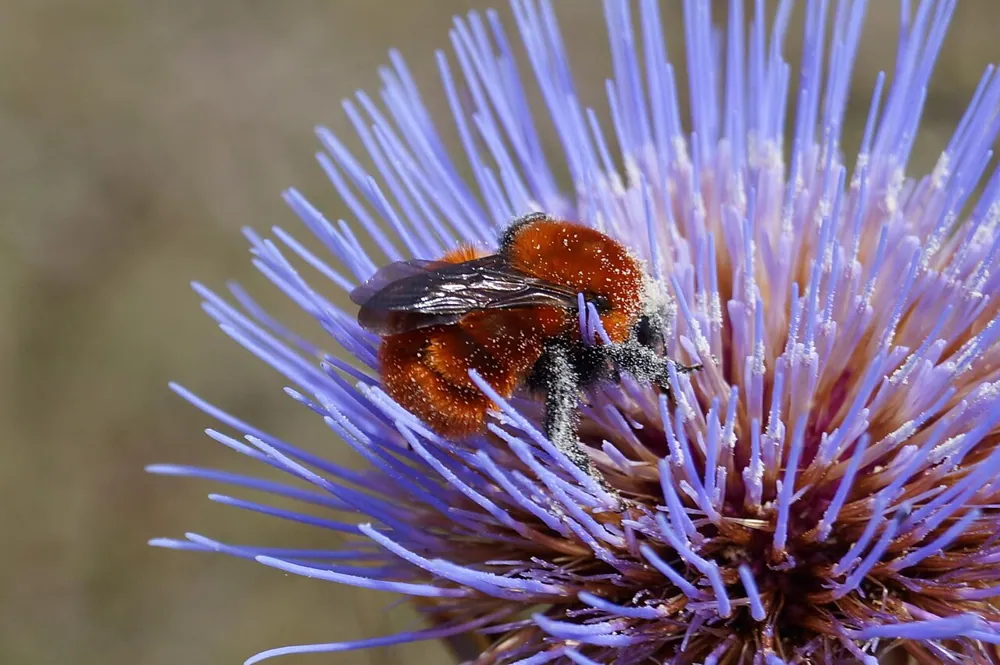
The Patagonian bumblebee is a large, furry bee that lives naturally only in the temperate forests of southern South America. Its queens are among the biggest bumblebees in the world. Its numbers have fallen since other bumblebee species were brought into the region to pollinate crops.1
 How to recognise it
- Mostly red-orange in colour, with a completely red-orange thorax.1
- The abdomen is a lighter orange, fading slightly towards the end, and has a rounded tip.1
- The head, wings and legs are distinctly black.1
- Long bristles cover most of the body, giving it a very furry look.1
- Queens can reach up to 4 cm from head to tail and weigh around 0.5 to 1.5 grams.1
Often confused with: The syrphid fly Aneriophora aureorufa looks very similar to this bumblebee. The two have similar colour and size and can be hard to tell apart in the wild because of their similar flight.1
Venom power
Venom comes out through a stinger.
How dangerous is it to people?
Danger to people: MildLike a bee sting or less. Basically harmless to people, unless the person is allergic. If it stings
Call your emergency number at once if the person has trouble breathing, swelling of the face or throat, or feels faint.
- Scrape out a bee sting and cool the spot.
- If the person has trouble breathing, swelling of the face or throat, or feels faint, it is an allergic emergency: call your emergency number and use their adrenaline pen if they have one.
This is general first aid guidance, not medical advice. Based on the first aid guidelines of the World Health Organization and the Australian Resuscitation Council. Facts come from public sources and may contain mistakes. When in doubt, always get medical help. First aid basics
 Stay safe
- Never touch, catch or tease a wild animal, even a small one, and even if it looks asleep or dead.
- Give it space. If you meet one, stay calm, step back slowly and let it go its own way.
- If it hurts you: wash the spot, stay calm and get medical help if the pain is strong or spreads, or the person feels unwell.
It is not out to get you. It uses its venom to catch food or to protect itself, and it would much rather hide. More about staying safe
Where in the world?
How big is it?
How long is it?
How heavy is it?
 about as long as a paper clip
 so light you would not feel it on your hand
 could fly across a whole football pitch in 10 seconds
How big is Patagonian bumblebee compared to you?
Just maths in your browser. Nothing is saved or sent anywhere.
How fast is it?


Facts
It is one of the largest bee species in the world, and its furry look has earned it the nickname 'flying mouse'.1
It often visits red flowers, which most bees avoid. It can detect red through a specific receptor system.1
A syrphid fly in Patagonia, Aneriophora aureorufa, has evolved to look and fly much like this bumblebee, which may help it avoid predators.1
In the Maulino forest of central Chile, individuals living in fragmented forest have longer wings relative to their body size, because they need to fly longer distances between patches.1
Its populations began to decline after non-native bumblebees were introduced into Chile to pollinate crops.1
It is the only native bumblebee species in southern South America.1
For venom experts
- Scientific name
- Bombus dahlbomii
- Group
- Bees, wasps & hornets
- Also called
- Moscardón, Mangangá, Flying mouse1
- Family
- Apidae2
- Order
- Hymenoptera
- Continents
- South America
- Babies
- Queens lay their first eggs in a structure made of pollen and wax inside an underground cavity. The first brood becomes workers after a couple of months, and nests can hold more than 100 workers.1
- Danger to people
- 1 / 5: Mild3
Where the facts come from
- Bombus dahlbomii (Wikipedia (CC BY-SA 4.0))
- Bombus dahlbomii (iNaturalist): names and classification.
- Venom Wiki: the danger level, the typical size and the speed guess are our own. See how we work them out: How we rate danger.
Every fact on this page has a number that points to its source. If we got something wrong, sorry, we are animal fans, not a science journal. Tell us at [email protected] and we will fix it.
Get the Venom Wiki app
Every creature, every picture and the games in your pocket, even without internet.


 Support Venom Wiki Venom Wiki is a one-man project: free, with no ads and no cookies. A small tip helps keep it online.Feed the scorpion
 Common wasp
 Tarantula hawk
 Western honey bee
 Executioner wasp
 Warrior wasp
 Armadillo wasp
 Golden poison frog
 Terciopelo
 Brazilian wandering spider
 Golden lancehead
 South American bushmaster
 Cane toad
