
 Bitten or stung?
 All animals
 Pick a continent
 Africa
 Asia
 Europe
 South America
 Australia & Oceania
 Antarctica
 Pacific Ocean
 Atlantic Ocean
 Indian Ocean
 Arctic Ocean
 Mediterranean Sea
 Red Sea
 Caribbean Sea
 Coral Sea
 South China Sea
 Philippine Sea
 Andaman Sea
 North Sea
 Timor & Arafura Sea
 Bay of Bengal
 Gulf of California
 Games
 Venom battle
 Animal race
 Field notebook
 Venom TOP lists
 Stay safe
 Surprise me
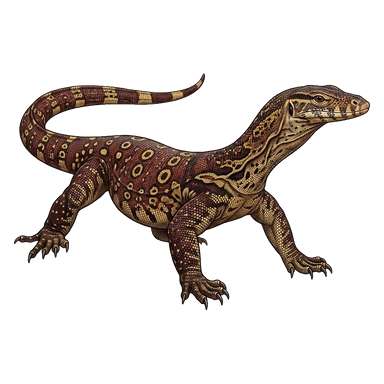
Perentie
 BitesEats: MeatTOP 50 · No. 39: LongestTOP 50 · No. 18: HeaviestTOP 50 · No. 2: FastestTOP 50 · No. 11: Gentle giants
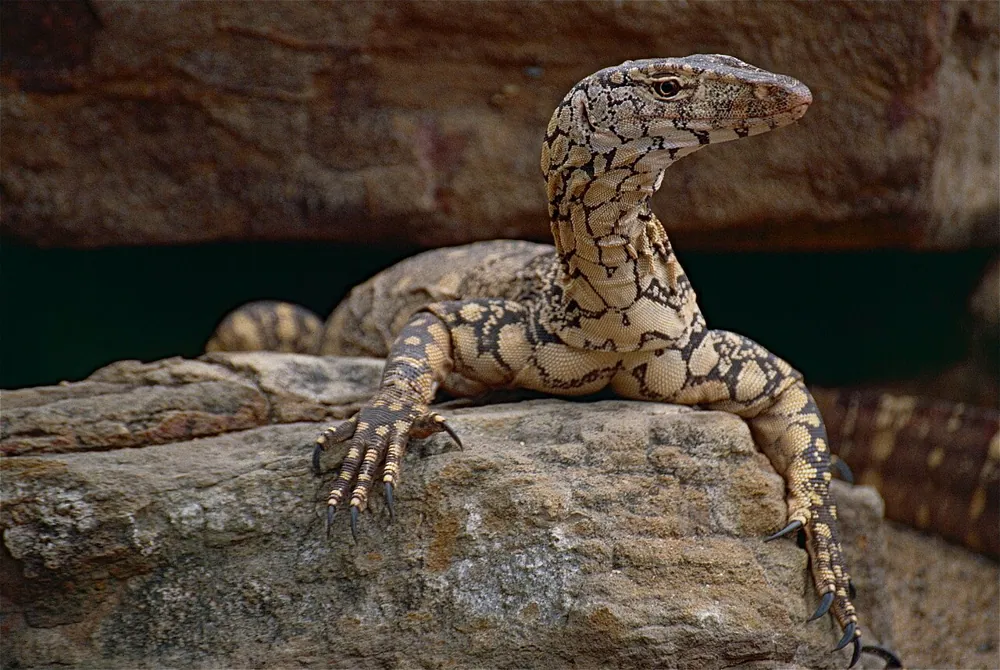
The perentie is one of the largest lizards alive, and the largest in Australia. It lives in the dry deserts of the west, centre and north of the country, where it is rarely seen. It is a powerful hunter that eats a wide range of animals, and it is important in many Aboriginal cultures.1
 How to recognise it
- Head and neck are creamy-white with a net-like (reticulated) pattern of black lines and flecks.1
- Body is yellow or cream, with brown rosette markings on the back.1
- Limbs are dark with white spots.1
- Very lean for a large monitor, so much less bulky than a rock monitor of similar length.1
Often confused with: Rock monitors can reach a similar length, but they are much bulkier. Perenties are very lean for their size.1
Venom power
Venom comes out through its fangs or teeth when it bites.
What does its venom do?
Researchers at the University of Melbourne found in 2005 that monitors may be somewhat venomous, which means they inject mild venom with a bite. A perentie bite can cause swelling within minutes, localised disruption of blood clotting (the blood's ability to clot is affected in the area), and shooting pain up to the elbow that can last several hours.1
How dangerous is it to people?
Danger to people: PainfulIt can really hurt, but it is almost never serious.The bite can do much damage, not only from the teeth but also from the oral secretions.1
What does it do when it is scared?
If threatened, a perentie will usually freeze flat on the ground or run away. If cornered, it stands its ground, inflates its throat, hisses, strikes with its tail, and may lunge with its mouth open.1
 If it bites
Call your emergency number at once if the person has trouble breathing, swelling of the face or throat, or feels faint.
- Wash the wound, keep the person calm and get medical help.
This is general first aid guidance, not medical advice. Based on the first aid guidelines of the World Health Organization and the Australian Resuscitation Council. Facts come from public sources and may contain mistakes. When in doubt, always get medical help. First aid basics
 Stay safe
- Never touch, catch or tease a wild animal, even a small one, and even if it looks asleep or dead.
- Give it space. If you meet one, stay calm, step back slowly and let it go its own way.
- If it hurts you: wash the spot, stay calm and get medical help if the pain is strong or spreads, or the person feels unwell.
It is not out to get you. It uses its venom to catch food or to protect itself, and it would much rather hide. More about staying safe
Where in the world?
How big is it?
How long is it?
How heavy is it?

 as long as 2.5 dogs nose to tail
 as long as 14 bananas end to end
 could cover 100 metres in 20 seconds (the fastest human needs 9.6)
How big is Perentie compared to you?
Just maths in your browser. Nothing is saved or sent anywhere.
How fast is it?

Facts
Perenties eat other monitor lizards, including a 2 m perentie that was seen killing and eating a 1.5 m one.1
They often stand on their back legs and tail to get a better view, a behaviour called "tripoding".1
Perenties are among the largest living lizards, after the Komodo dragon, Asian water monitor and crocodile monitor.1
Perenties can dig a burrow for shelter in only minutes.1
The species was first named the "gigantic water lizard", even though it lives in dry desert country.1
The perentie has long been important to desert Aboriginal peoples, who ate it as food and used its fat for medicinal and ceremonial purposes.1
Myth buster
Myth: Monitor lizard bites only cause problems because of infection from bacteria in the animal's mouth.
Truth: Researchers showed that the immediate effects of monitor bites, including swelling and pain, are caused by mild envenomation.1
Where the facts come from
- Perentie (Wikipedia (CC BY-SA 4.0))
- Varanus giganteus (iNaturalist): names and classification.
- Venom Wiki: the danger level, the typical size and the speed guess are our own. See how we work them out: How we rate danger.
Every fact on this page has a number that points to its source. If we got something wrong, sorry, we are animal fans, not a science journal. Tell us at [email protected] and we will fix it.
Get the Venom Wiki app
Every creature, every picture and the games in your pocket, even without internet.


 Support Venom Wiki Venom Wiki is a one-man project: free, with no ads and no cookies. A small tip helps keep it online.Feed the scorpion
 Lace monitor
 Spiny-tailed monitor
 Yellow-spotted monitor
 Mitchell's water monitor
 Komodo dragon
 Gila monster
 Coastal taipan
 Common death adder
 Eastern brown snake
 Inland taipan
 Sydney funnel-web spider
 Tiger snake
