
 Bitten or stung?
 All animals
 Pick a continent
 Africa
 Asia
 Europe
 South America
 Australia & Oceania
 Antarctica
 Pacific Ocean
 Atlantic Ocean
 Indian Ocean
 Arctic Ocean
 Mediterranean Sea
 Red Sea
 Caribbean Sea
 Coral Sea
 South China Sea
 Philippine Sea
 Andaman Sea
 North Sea
 Timor & Arafura Sea
 Bay of Bengal
 Gulf of California
 Games
 Venom battle
 Animal race
 Field notebook
 Venom TOP lists
 Stay safe
 Surprise me

Red spitting cobra
 If it bites or spitsDanger to people: Very dangerousIt can kill a person who gets no treatment.
 Sprays or spits
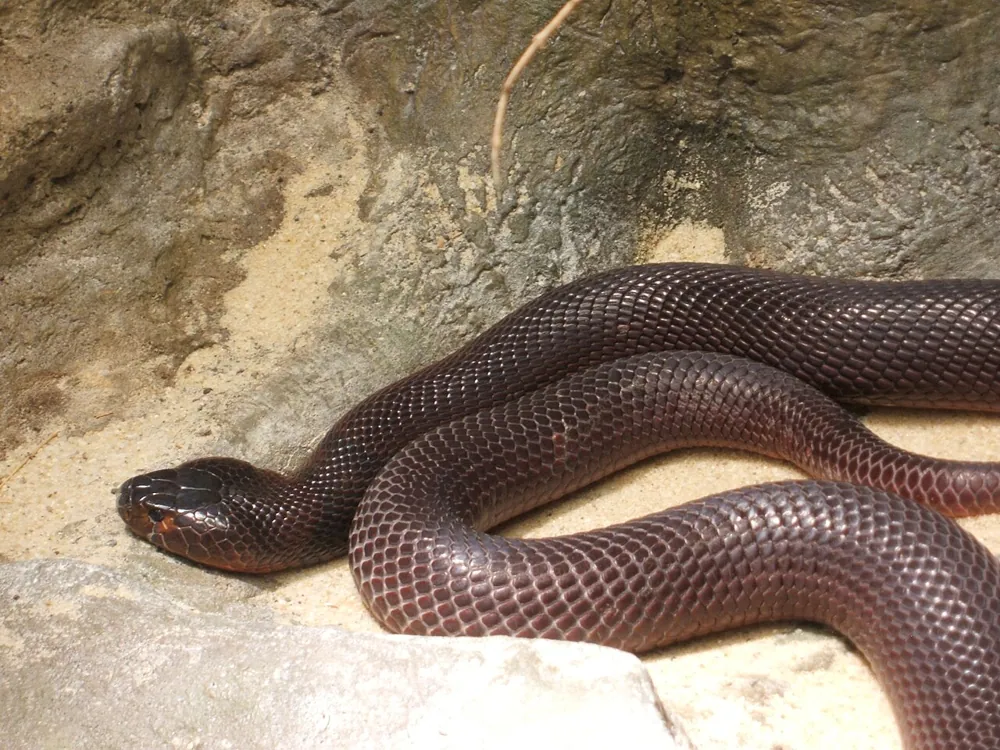
The red spitting cobra is a medium-sized cobra found in East Africa. When threatened, it can spray venom into an attacker's face, which can cause burning pain and blindness. It is often considered an attractive snake, usually bright salmon-red with a black throat band.1
 How to recognise it
- Usually bright salmon-red, with a broad black throat band and teardrop markings below the eyes1
- Colour varies by region: specimens from southern Kenya and northern Tanzania are orange-red with a dark blue or black throat band1
- The throat band often fades or disappears in larger adults, and true red specimens turn reddish-brown with age1
- Adults typically measure 0.7 to 1.2 metres1
- When threatened, it rears up, shows a cobra hood and hisses loudly1
Venom power
It sprays or spits a stinging liquid at attackers.
What does its venom do?
Its venom contains a mixture of neurotoxins, which attack the nerves, and cytotoxins, which damage cells. A bite causes slight pain around the wound and numbness of the lips, fingers and tongue. Venom sprayed into the eyes causes burning pain and can cause blindness.1
How dangerous is it to people?
Danger to people: Very dangerousIt can kill a person who gets no treatment.It seldom causes human deaths, but survivors of its bites are usually left disfigured. In September 2011, a snake keeper from South Africa died shortly after venom was sprayed into his face while he was photographing the snake. The venom is thought to have entered his nasal passages and caused anaphylactic shock, a severe allergic reaction, and his asthma may have contributed.1
 Good news: doctors have a medicine (antivenom) or a treatment for this.1
What does it do when it is scared?
When threatened, it rears up, displays its hood and hisses loudly, and if the intruder does not retreat, it may spray venom at the face. In very rare cases it sprays without first rearing up.1
If it bites or spits
Always call your emergency number first (for example 112 in Europe, 911 in North America, 000 in Australia).
- If venom is spat into the eyes, rinse them at once with lots of clean water for 15 minutes and do not rub them, then see a doctor. For a bite, call the emergency number and get to hospital. Keep the person calm and still and the bitten limb still. Do not cut, suck or use a tourniquet.1
- Keep the person still and calm, remove rings and tight things, and get to a hospital fast: antivenom is the treatment. Be ready to give rescue breaths or CPR if breathing gets weak or stops.
- If venom was spat into the eyes, rinse them with lots of clean water straight away.
This is general first aid guidance, not medical advice. Based on the first aid guidelines of the World Health Organization and the Australian Resuscitation Council. Facts come from public sources and may contain mistakes. When in doubt, always get medical help. First aid basics
 Stay safe
- Never touch, catch or tease a wild animal, even a small one, and even if it looks asleep or dead.
- Give it space. If you meet one, stay calm, step back slowly and let it go its own way.
- If one bites you or spits venom in your eyes: stay calm, keep still, call your emergency number (for example 112 in Europe, 911 in North America, 000 in Australia) or get to a hospital fast. Remember what it looked like, a photo helps.
It is not out to get you. It uses its venom to catch food or to protect itself, and it would much rather hide. More about staying safe
Where in the world?
How big is it?
How long is it?
 as long as 2.5 house cats nose to tail
 as long as 7 bananas end to end
 could cover 100 metres in 53 seconds (the fastest human needs 9.6)
How big is Red spitting cobra compared to you?
Just maths in your browser. Nothing is saved or sent anywhere.
How fast is it?


Facts
Where the facts come from
- Red spitting cobra (Wikipedia (CC BY-SA 4.0))
- Naja pallida (iNaturalist): names and classification.
- Venom Wiki: the danger level, the typical size and the speed guess are our own. See how we work them out: How we rate danger.
Every fact on this page has a number that points to its source. If we got something wrong, sorry, we are animal fans, not a science journal. Tell us at [email protected] and we will fix it.
Get the Venom Wiki app
Every creature, every picture and the games in your pocket, even without internet.


 Support Venom Wiki Venom Wiki is a one-man project: free, with no ads and no cookies. A small tip helps keep it online.Feed the scorpion
 Black mamba
 Egyptian cobra
 Cape cobra
 Eastern green mamba
 Jameson's mamba
 Western green mamba
 Deathstalker
 Puff adder
 Boomslang
 Fat-tailed scorpion
 Gaboon viper
 Western honey bee
